- BRICS Summit 2026 adopted the New Delhi Declaration to boost Global South's global governance role
- The declaration calls for IMF, World Bank reforms to increase emerging economies' voting power
- BRICS supports WTO-centered fair, transparent trade with special treatment for developing countries
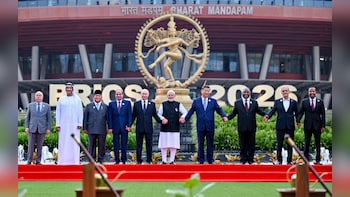
The 18th BRICS Summit held in New Delhi concluded with the adoption of the New Delhi Declaration on Saturday, Sept. 12, outlining a push for greater representation of emerging and developing economies in global decision making.
With economic governance, trade, sustainable development and greater Global South representation at its core, the declaration seeks to strengthen the role of emerging economies in shaping global institutions while calling for reforms to bodies such as the International Monetary Fund (IMF), World Bank and the World Trade Organisation (WTO).
ALSO READ: PM Modi's Camaraderie With Putin, Declaration To Gala Dinner — BRICS's Defining Frames From Day 1
Also Read | Layoffs Are Rising In Tech, But These Skills Are Helping People Unlock Better Pay
What is the New Delhi Declaration?
BRICS leaders unanimously adopted the New Delhi Declaration 2026 during the 18th BRICS Summit in New Delhi on Sept. 12, with the summit continuing through Sept. 13. The declaration laid out an agenda focused on strengthening the voice of the Global South, reforming global governance and deepening cooperation among emerging and developing economies. The declaration was adopted under India's 2026 BRICS chairship, whose theme is "Building for Resilience, Innovation, Cooperation and Sustainability."
The document contains 140 paragraphs organised around an 18-point agenda, with economic cooperation, sustainable development, multilateral reform and greater Global South representation among its central themes. The BRICS grouping currently consists of Brazil, Russia, India, China, South Africa, Egypt, Ethiopia, Indonesia, Iran and the United Arab Emirates.
Why is the Declaration Significant for the Global Economy?
At its core, the declaration seeks to reshape how emerging and developing economies participate in the institutions that govern the global economy. In his remarks, Prime Minister Narendra Modi hailed BRICS for emerging as a key global body and called for a "new and ambitious agenda" for the grouping for the next 20 years so that it can effectively handle pressing global challenges.
The summit also holds great significance as it is taking place amid a global economy facing the adverse impacts of the Russia-Ukraine war, the West Asia crisis, especially the blockade of the Strait of Hormuz, and the Trump administration's trade and tariff policies.
"The current structure of global governance resembles a pyramid: power and decision-making are concentrated at the top, while the lower tiers consist of nations that are affected by these decisions but unable to shape them," PM Modi said.
"Today, the Global South stands in the front row of global crises but in the back row of decision-making. We must transform this 'pyramid of privilege' into a 'platform of partnership' -- one where every nation has a voice, every member has a stake, and the development of humanity lies at the heart of every effort," he said.
IMF, World Bank, WTO and A Multilateral Trade System
One of the most important economic components was the call for reform of the Bretton Woods institutions, particularly the IMF and the World Bank. The declaration stated that their governance structures should be reformed to reflect changes in the global economy and give developing and emerging economies a voice corresponding to their economic weight.
The declaration specifically supported IMF quota and governance reform, including increasing the quota and voting shares of emerging and developing economies. It also called for the implementation of previously agreed upon quota increases without any further delay.
The declaration also reaffirmed BRICS' support for the World Trade Organisation (WTO) and a rules based multilateral trading system. BRICS called for a trading system that is open, equitable, transparent, fair, inclusive, and predictable, while retaining the WTO at its centre. The grouping also stressed the importance of special and different treatment for developing countries, particularly least developed countries.
Trade And Cross-Border Payments
The declaration calls for deeper economic cooperation among BRICS members and supports efforts to make cross-border payments more efficient. The BRICS Payment Task Force is examining the connectivity between payment and messaging systems, while members are also discussing trade settlements and investments using local currencies. The declaration focuses on practical mechanisms for facilitating trade and investment while allowing individual countries to determine their own approach.
Opposition to Unilateral Tariffs
BRICS leaders also raised concerns over unilateral tariff and non-tariff measures, arguing that such actions can disrupt international trade. Reuters reported that the declaration's position comes against the backdrop of wider trade tensions and sanctions affecting countries including Iran and Russia. The bloc reaffirmed its support for a multilateral trading system and greater economic resilience, including stronger global value chains.
Energy Security and West Asia
The declaration also has major implications for energy security. BRICS leaders expressed concerns over the escalating conflict in West Asia and called for maximum restraint, dialogue and diplomacy.
Chinese President Xi Jinping on Saturday said that the BRICS cooperation mechanism has become the world's most influential platform for cooperation among emerging markets and developing countries and called on the grouping to play its “due role” in bringing peace in West Asia.
The issue has direct economic consequences as prolonged instability in the region can affect energy supplies, shipping routes, insurance costs, and global inflation.
Noting that the situation in West Asia remains complex and fluid, Xi said this war has inflicted serious losses on the people of all countries in the region and is against the common interests of the international community.
Global Economy In Focus
The New Delhi Declaration 2026 does not seek an immediate replacement of the existing global financial systems. Instead, it represents a push by emerging economies to reshape that system from within through greater representation, stronger economic cooperation, more efficient cross-border payments and reduced vulnerability to trade and geopolitical disruptions.
For India, the declaration also reinforces its push for a stronger Global South voice and reforms to global governance. The BRICS chairship will now pass to China, which will host the summit in 2027.
ALSO READ: BRICS Day 2: Early Warning System To Incubator Network — Three Takeaways From PM Modi's Speech
Essential Business Intelligence, Sharp Market Insights, Practical Personal Finance Advice, Daily Fuel, Gold and Silver Prices and Latest Stories — On NDTV Profit.