The wealth management industry in India has witnessed a silent revolution of sorts over the past decade-one led not by large institutions but by nimble, tech-driven innovators, who are using wealthtech to transform the way individuals engage with their finances.
Wealthtech, a confluence of technology and financial advisory, is poised to be one of the most disruptive and inclusive forces in the domestic financial services landscape. Firms are developing technology-driven platforms that offer personalised, scalable and low-cost wealth solutions to clients. This, in turn, is democratising the financial advisory industry.
Once characterised by exclusivity and high cost-to-serve models that cater to high-networth individuals, the wealth management industry is now pivoting toward serving a wider, mass affluent and retail investor base.
Also Read | Layoffs Are Rising In Tech, But These Skills Are Helping People Unlock Better Pay
With more than 1,000 million internet users (April 2025) and a steadily growing pool of retail investors (~216 million demat accounts as of December 2025), India is one of the most fertile environments for wealthtech globally.
Broadening Investment Horizon
By blending access with simplicity, wealthtech is delivering investment capabilities to a demographic that had been under-served by traditional players, thereby hastening inclusion.
Today, digital-first investment platforms allow users to build diversified portfolios with low minimums, offering thematic baskets, global exchange traded funds, structured debt products and even fractional investments.
Over 80% of new digital investment customers now come from non-metro cities, a trend driven by vernacular platforms, mobile-first experiences and growing financial literacy.
AI, Data, Modular Tech Stack
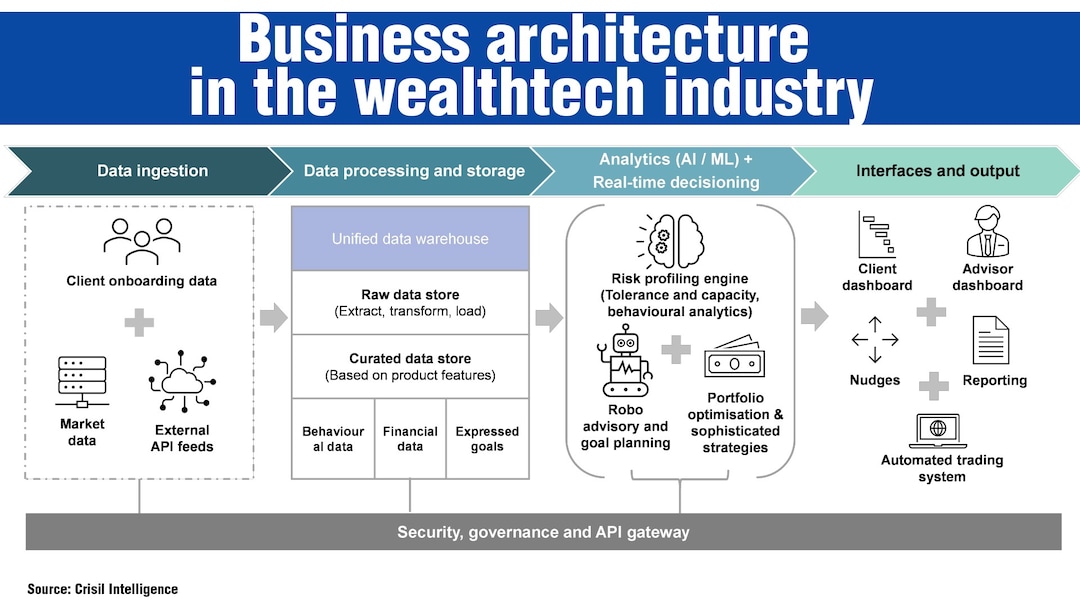
At the core of wealthtech lies a robust, modular architecture, which has the technological prowess to reshape every element of wealth management.
At the front end, e-KYC, UPI and Open Banking APIs enable instant onboarding and seamless money movement. Risk profiling is powered by dynamic questionnaires and machine learning (ML) algorithms that incorporate behavioural cues, spending patterns and life goals.
The heart of these platforms lies in the advisory engine, which is a mix of artificial intelligence (AI)/ML models that drive personalised portfolio construction, rebalancing and goal tracking.
At the back end, data lakes and cloud-native architecture allow firms to ingest large volumes of user data, regulatory signals and market feeds. They build foundational data lake for turning real-time insights into a competitive edge. Predictive analytics further helps flag financial gaps and suggest next best actions.
Now firms are also using generative AI to create tools that summarise tax documents, extract structured data from PDFs and generate personalised reports, reducing operational overhead and enhancing advisor productivity.
Reworking Economics of Advice
One of wealthtech's biggest contributions is its ability to reimagine the economics of financial advice. Traditional advisory models have been costly and human-intensive, often making them viable only for HNIs.
Digital platforms, by contrast, deliver hyper-personalised recommendations at scale and at a fraction of the cost. Automated advisory platforms reduce customer acquisition costs by up to 40-50% and operational costs by 30-40% when compared with legacy models.
This cost-efficiency enables platforms to cater to low-ticket-size customers, which is particularly critical in a country like India where household savings are fragmented and often lack long-term orientation.
Moreover, digital advisory models improve customer retention by offering greater transparency, real-time control and consistent portfolio engagement. Features such as goal tracking, nudges, behavioural insights and personalised alerts keep investors informed and engaged, increasing loyalty in an otherwise low-switching-barrier market.
Funding, Strategic Interest
Despite macro volatility, the domestic Wealthtech segment has retained investor interest, especially among venture capitalists and private equity funds seeking scalable, compliance-ready and monetizable platforms.
The increasing popularity of Wealthtech has not gone unnoticed by traditional financial institutions. Banks and asset managers are also launching their own digital advisory platforms or partnering with financial technology (fintech) firms to cash in on the trend.
Moreover, the recent strategic mergers and acquisitions, such as Groww's acquisition of Fisdom or 360 ONE WAM's acquisition of ET Money, signal a growing urgency among incumbents to build or buy tech capability.
Not surprisingly, Indian Wealthtech funding grew an exponential 251% on-year in fiscal 2025 to $193 million from $55 million in fiscal 2024. Funding cycles have also moved from growth-at-all-costs to sustainability, governance and advisory-led revenue models, with greater focus on longer investor lifecycle value and tech-driven differentiation.
ALSO READ: Google Maps To Have AI Features With Real-Time 3D Navigation, Give Recommendations, Make Itineraries
What Lies Ahead
As India's middle class matures, the need for high-quality, digital-first financial advice will only increase going forward.
By 2030, we expect wealthtech to become a mainstream enabler of financial well-being. However, scaling responsibly will require addressing key risks from data privacy to regulatory clarity on AI-driven advice.
At the same time, platforms must invest in user education and financial literacy.
We believe the firms that can balance innovation with trust, scale with personalisation and automation with empathy will emerge as the true leaders of this revolution.
In this milieu, incumbents, too, must rethink their operating models to compete with agile wealthtech. They will have to reconfigure legacy systems, embed AI into client journeys and shift from product-push to needs-based advisory.
Those who can blend human trust with digital scale are likely best positioned for the future.
Aniket Dani and Aakash Agarwal are director and associate director respectively at Crisil Intelligence.
Disclaimer: The views expressed in this article are solely those of the author and do not necessarily reflect the opinion of NDTV Profit or its affiliates. Readers are advised to conduct their own research or consult a qualified professional before making any investment or business decisions. NDTV Profit does not guarantee the accuracy, completeness, or reliability of the information presented in this article.
ALSO READ: Creative Crisis In Human Beings: Use Of AI Chatbots Is Suppressing Perspectives, Warns Study
Essential Business Intelligence, Sharp Market Insights, Practical Personal Finance Advice, Daily Fuel, Gold and Silver Prices and Latest Stories — On NDTV Profit.