- Nvidia CEO Jensen Huang predicts $1 trillion in AI chip sales through 2027 at GTC event
- Nvidia plans to expand into CPUs and launched Groq-based AI language processing chips
- New AI processors Vera Rubin and Feynman designs will debut in 2026 and after
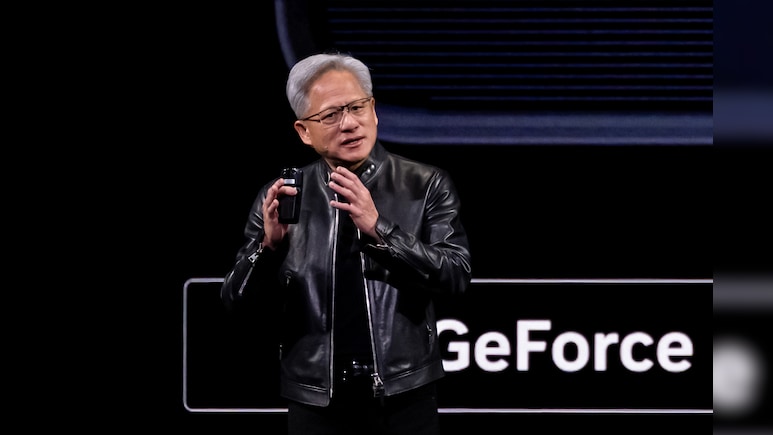
Nvidia Corp. Chief Executive Officer Jensen Huang, addressing crowds at the company's biggest annual event, unveiled a variety of new products while predicting that its flagship AI processors would help generate $1 trillion in sales through 2027.
During a 2 1/2-hour keynote address, Huang announced plans to push deeper into central processing units — Intel Corp.'s home turf — and introduced semiconductors made with technology acquired from startup Groq. The company even said it was developing chips for data centers in outer space.
At the heart of Huang's message: Demand for computing power continues to soar, and Nvidia is uniquely equipped to meet the challenge.
Also Read | Layoffs Are Rising In Tech, But These Skills Are Helping People Unlock Better Pay
“I believe that computing demand has increased by 1 million times in the last two years,” he said. “It is the feeling that we all have. It is the feeling every startup has.”
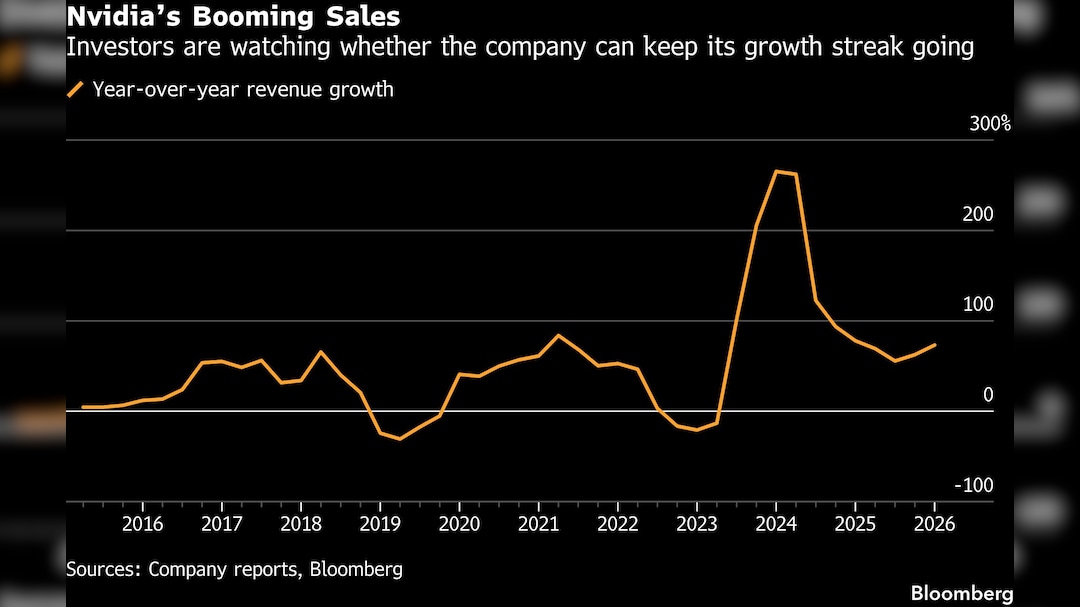
Huang is contending with increasingly skeptical investors, who want more evidence that Nvidia's booming sales growth will last. The trillion-dollar sales forecast, fueled by orders from the company's Blackwell and Rubin chips, offered evidence that demand remains solid.
Still, the outlook doesn't represent a major acceleration in sales growth. The company had previously forecast that data center gear would bring $500 billion in sales through the end of 2026. The latest forecast extends the outlook another year, doubling the cumulative amount.
After initially rising as much as 4.8%, the shares soon pared their gains on Monday. The stock was up 1.6% to $183.19 at the close in New York.
“The update should ease fears of a pullback in 2027 as Rubin enters the cycle, though it may also reset market expectations higher and raise the bar again,” Bloomberg Intelligence analyst Kunjan Sobhani said in a note.
New products and partnerships were a highlight of GTC, an annual gathering that draws fervent crowds to San Jose, California. The new Groq chip is designed to boost the responsiveness of artificial intelligence systems. The company also showed off a computer made up of general-purpose CPUs. That opportunity is “for sure” a multibillion-dollar business, Huang said.
The GTC rollout is Nvidia's latest bid to promote artificial intelligence computing and keep customers loyal to its technology. The company uses the event to announce partnerships with companies in a range of industries, aiming to show the increasing benefits of AI.
Nvidia discussed new or expanded pacts with companies such as International Business Machines Corp., Hewlett Packard Enterprise Co. and Adobe Inc. It also strengthened ties with Uber Technologies Inc., saying it was planning a fleet of Nvidia software-driven autonomous vehicles by 2028.
A flood of spending on AI chips has turned Nvidia into the world's most valuable company. But it's facing mounting competition from rivals like Advanced Micro Devices Inc., as well as its own customers attempting to produce in-house chips to handle AI.
Feynman Chip
Nvidia has accelerated its technology development in recent years, seeking to replace its entire product lineup on an annual basis while adding new components. The next design of its flagship AI processors — appearing in the second half of 2026 — is called Vera Rubin, named for the pioneering astronomer whose observations provided evidence supporting the existence of dark matter.
Rubin will be followed by a generation named after Richard Feynman, the American physicist who died in 1988. It will have customized high-bandwidth memory, the company said, without giving further details.
While Nvidia continues to post sales growth that's the envy of the chip industry, its stock rally has stalled in recent months. The shares were down 3.4% this year heading into the GTC presentation, leaving the company's market value at a still-unrivaled $4.4 trillion.
ALSO READ: Nvidia To Invest $2 Billion In AI Data Center Specialist Nebius
Huang announced that the Groq 3 LPU will now be part of Nvidia's product catalog. An LPU, or language processing unit, is a specialized chip that's good at accelerating large language model inference — the process of generating responses to AI prompts.
Such semiconductors have fast memory built onto the chip that helps them generate text almost instantly. Nvidia will offer it as a coprocessor, complementing work done by its accelerators. The latter components are better at dealing with more complex, multistage tasks.
In December, Nvidia announced what it called a licensing deal with Groq that gave it the rights to use certain technologies and designs. While the startup still exists, its founders and a big chunk of its engineers joined Nvidia in what was practically an acquisition.
Nvidia has accelerated the engineering work done by Groq to bring its product to market more quickly. The chip will be manufactured by Samsung Electronics Co., with Groq-based systems coming in the second half, Huang said.
Samsung is using its 4-nanometer manufacturing technique to make the processor. The South Korean company also unveiled a next-generation version of its high-bandwidth memory chip, HBM4E, at the GTC event. Shares of Samsung climbed more than 4% in Seoul trading on Tuesday.
CPU Push
Nvidia said that its forthcoming CPU, branded Vera, is more capable than previous versions of that chip. As AI data centers become increasingly complex, the orchestration of work divided between various types of computers and software — a job performed by general-purpose CPUs — is becoming more important, Nvidia said.
Vera will combine the attributes of CPUs used in data centers, gaming PCs and laptops, the company said. It will be able to deal with many inputs simultaneously while quickly handling single complex ones. It also will require less electricity, according to Nvidia.
New Tactic
The company also plans to start selling computers made up entirely of the CPUs, a new approach for the chip giant. Such machines can be used in combination with other Nvidia-based computers or work independently.
Nvidia has pushed beyond its hallmark of graphics processing units, or GPUs, which are used to train and run artificial intelligence software. It now offers complete computer systems featuring processors, networking and software.
The chipmaker also provides AI models and other software on an open-source basis, meaning that customers can tinker with the technology as they see fit. The company even offers versions tailored for specific uses, aiming to help industries that it sees as ripe for disruption by AI.
Nvidia got its start in data center computing by offering versions of its computer graphics chips specially adapted to accelerate certain types of work. Over time that type of chip has overtaken the traditional dominance of the CPUs sold by Intel and AMD.

While that's made Nvidia by far the largest provider of chips used in data centers, as software matures, many companies are exploring using CPUs to run the services that have been trained on the more specialized accelerator chips. CPUs are generally cheaper, can be used for other purposes and are usually less power-hungry.
Nvidia has so far only offered its CPUs tightly integrated with its other chips. In a recent agreement with Meta Platforms Inc., Nvidia indicated that it's ready to sell its processors as a standalone product, and Huang has said repeatedly that a new version of the line will have greater capabilities.
ALSO READ: Challenge To Nvidia Chips? Human Brain Cells Run New Data Centers In Singapore, Melbourne
A broader offering of processors by Nvidia may represent another challenge for Intel in what has long been its most lucrative business. It also brings in more competition for in-house efforts such as Amazon.com Inc.'s Graviton lineup.
SoftBank Group Corp. and its affiliate Arm Holdings Plc have been expanding their capabilities in that area as well. Though Arm would benefit from Nvidia's entry into the field — because it licenses technology to the bigger company — that income is potentially less than what would accrue from direct sales of its own designs and chips.
Essential Business Intelligence, Sharp Market Insights, Practical Personal Finance Advice, Daily Fuel, Gold and Silver Prices and Latest Stories — On NDTV Profit.