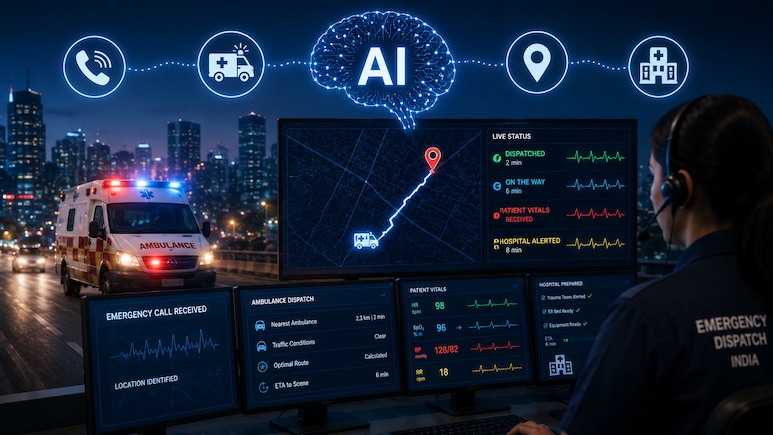
India's emergency response system is shifting from an ambulance-led model to an AI-enabled network designed to detect emergencies faster, dispatch resources more efficiently and begin treatment before patients reach hospital.
The need is clear. The Ministry of Road Transport and Highways recorded 4.87 lakh road accidents and 1.77 lakh deaths in 2024, equivalent to nearly 20 deaths every hour. In Delhi, road deaths reached 1,617 in 2025, the highest since 2019.
About one-third to two-fifths of road deaths occur within the first hour after an accident. That period, known as the golden hour, can determine whether rapid intervention saves a life.
Also Read | Layoffs Are Rising In Tech, But These Skills Are Helping People Unlock Better Pay
Emergency medical services (EMS) have traditionally focused on transporting patients to hospitals. The model is now expanding into what the industry calls Emergency Response Infrastructure, or ERI, which combines AI, connected vehicles, digital command centres, telemedicine and trained responders.
AI can help command centres assess distress calls based on clinical urgency. GPS-enabled systems can identify and dispatch the nearest available ambulance, while connected devices can send patient vital signs to hospitals before the vehicle arrives. Doctors can then prepare for treatment before the patient reaches the emergency department.
"India's emergency response ecosystem is entering a new era where healthcare, mobility and AI are converging," said Rupal Sinha, CEO of BVG India.
Market Expands
India's emergency response services market was worth Rs 58.27 billion in FY2025 and is projected to grow at an annual rate of 16.3%, reaching Rs 124.08 billion by FY2030, according to estimates from the Press Information Bureau, National Health Mission and Frost & Sullivan.
Government programmes, including the National Health Mission, and higher spending are driving the market. Better medical facilities inside ambulances are also increasing costs.
The investment is moving beyond the vehicles themselves. Operators are adding command centres, computer-aided dispatch systems, vehicle tracking, predictive deployment models, Internet of Things-enabled devices and telemedicine.
The objective is to reduce response times and improve clinical outcomes.
The trend extends beyond India. The global EMS products and services market is estimated at about $35 billion in 2026 and could reach $49 billion by 2031.
Spending on computer-aided dispatch software is expected to more than double, from about $2.8 billion in 2026 to more than $6 billion by 2035, according to estimates from Mordor Intelligence and Global Growth Insights.
AI Dispatch
Automated dispatch systems are already widely used.
Nearly seven in 10 emergency communication agencies worldwide use some form of automated dispatch. Most ambulance operators also use at least some digital software. Together, these systems cover several hundred thousand ambulances and support responses to more than 100 million emergency incidents each year.
Evidence from cardiac-arrest response shows why AI-assisted dispatch is gaining attention.
In Copenhagen, human call-takers correctly identified cardiac arrest from a caller's voice about 73% of the time. An AI system developed by Danish company Corti, analysing the same calls, correctly flagged cardiac arrest in about 93% to 95% of cases.
The AI system was also often faster.
The European Emergency Number Association, which has members in more than 80 countries, has since piloted the technology in France, Italy and other cities. Early results indicate that it can reduce detection times, including calls where the final diagnosis does not change.
The timing matters because the chances of surviving cardiac arrest fall by about one-tenth with each passing minute.
Drones Join
The shift is also reaching emergency hardware.
Researchers at Karolinska Institutet conducted a drone trial in western Sweden involving automated external defibrillators. The drones reached patients before ambulances in about two-thirds of eligible cardiac-arrest calls.
They arrived one to three minutes earlier, depending on the study year, and most landed within metres of the patient.
The median ambulance response time for cardiac arrest in Sweden was about 11 minutes. The additional time gave dispatchers an opportunity to guide bystanders in retrieving and using the defibrillator before paramedics arrived.
India Builds
Indian emergency operators are developing similar systems.
GVK EMRI operates government-supported emergency systems across several states and has extensive operating experience. Ziqitza Healthcare has expanded through public-private partnerships and invested in paramedic training.
BVG India is combining AI-enabled command centres with connected ambulance fleets.
"Technology is the greatest force multiplier in emergency care," Sinha said.
She said emergency care is moving beyond simply getting ambulances to patients faster and towards systems that can predict demand, dispatch appropriate resources, optimise routes and allow clinicians to begin intervention before a patient reaches hospital.
AI-enabled systems, Sinha said, are turning emergency response from a reactive service into proactive, data-driven public health infrastructure.
Beyond AI
The effectiveness of the model will depend on more than technology.
AI systems need to work alongside trained paramedics, standardised clinical protocols and coordination between hospitals, police and emergency agencies. Together, these elements can reduce response times and create a more resilient emergency response network.
The need is increasing as Indian cities expand and road traffic grows.
India's digital infrastructure has already reshaped other parts of the economy. Digital payments expanded financial inclusion, while highways improved physical connectivity.
Emergency response could become another part of that infrastructure, with AI providing continuous support from the first emergency call through dispatch, on-road intervention and hospital preparation.
Disclaimer: The views expressed in this article are solely those of the author and do not necessarily reflect the opinion of NDTV Profit or its affiliates. Readers are advised to conduct their own research or consult a qualified professional before making any investment or business decisions. NDTV Profit does not guarantee the accuracy, completeness, or reliability of the information presented in this article.
Essential Business Intelligence, Sharp Market Insights, Practical Personal Finance Advice, Daily Fuel, Gold and Silver Prices and Latest Stories — On NDTV Profit.