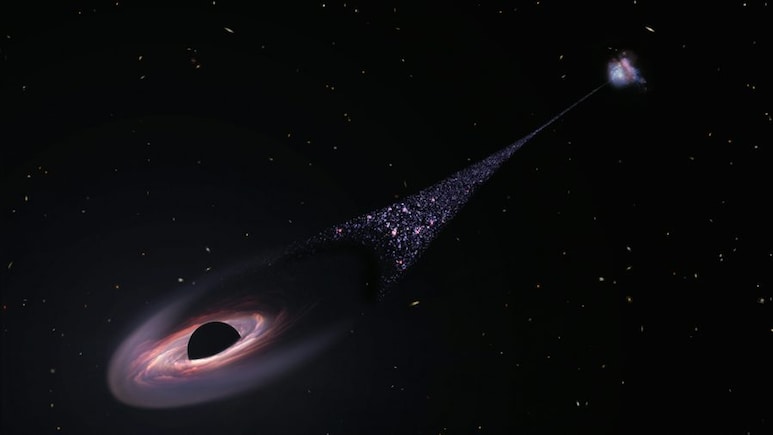
Astronomers have identified what could be the strongest candidate yet for a rare cosmic object known as a “microblazar”, offering new insights into how black holes release energy into space. The discovery centres on a binary system called IRAS 18293-0941, located approximately 12,000 light-years from Earth in the Milky Way.
Astronomers spent more than 30 years chasing a phantom, a specific class of stellar black hole pointing a relativistic jet directly at our solar system. The international research team, involving scientists from Spain, the Netherlands and Argentina, has submitted a study detailing the object that has been accepted for publication in the journal Astronomy & Astrophysics.
What Is A Microblazar?
A microblazar is considered a smaller counterpart of a blazar, an energetic astronomical object powered by a supermassive black hole at the centre of a galaxy. Unlike conventional blazars, microblazars involve stellar-mass black holes that draw matter from a nearby companion star.
Also Read | Layoffs Are Rising In Tech, But These Skills Are Helping People Unlock Better Pay
As material falls towards the black hole, some of it is channelled into powerful jets of charged particles that shoot out from regions near its poles at a substantial fraction of the speed of light.
The phenomenon becomes particularly striking when one of these jets points almost directly towards Earth, making the system appear exceptionally bright to observers.
ALSO READ | Four Astronauts, One Dragon, 237 Days Later: Crew-12 Prepares To Head Home
Relativistic Beaming Makes the Jet Appear Brighter
The apparent brightness is caused by an effect known as relativistic beaming, or Doppler boosting. When particles move towards an observer at extremely high speeds, the radiation they emit can appear significantly brighter than it would if the jet were pointing in another direction.
This alignment gives a microblazar the appearance of a cosmic spotlight, even though its orientation, rather than an increase in its total energy output, accounts for much of the enhanced brightness.
The system identified by researchers contains a black hole and a stellar companion that orbit each other approximately every 11 days. The black hole is estimated to have a mass roughly 10 times that of the Sun, while observations indicate that its jet travels at about 75% of the speed of light.
The jet's interaction with surrounding material makes the system particularly valuable for studying how black holes transfer energy to their environments.
Why the Discovery Matters
If confirmed, the microblazar could provide a nearby laboratory for investigating extreme astrophysical processes and help scientists understand the origins of some highly energetic particles and gamma rays in the galaxy.
Despite the jet's apparent alignment towards Earth, researchers have identified no threat to our planet. At a distance of around 12,000 light-years, the system is scientifically significant rather than a cause for concern.
Further observations will help establish whether IRAS 18293-0941 meets the criteria for a microblazar, potentially expanding astronomers' understanding of black holes and relativistic jets.
ALSO READ | SpaceX Falcon 9 Launches SDA's Fourth Tranche 1 Mission
Essential Business Intelligence, Sharp Market Insights, Practical Personal Finance Advice, Daily Fuel, Gold and Silver Prices and Latest Stories — On NDTV Profit.