If things go as reported, in September, Indian insurance buyers will be able to do something they have not been able to do before: buy pure term plans from multiple insurers on a digital marketplace that takes the agent commission out of the transaction. Bima Sugam, the Insurance Regulatory and Development Authority of India-promoted electronic insurance exchange, will reportedly begin phased operations from July with motor insurance. Health plans will follow in August, and term-life in September.
According to IRDAI briefings reported by the media in March 2026, insurers committed in-principle to offer zero-commission products on the platform, with agent payouts replaced by a nominal user fee. The final commission framework has not yet been notified. When it is notified, it could be a watershed moment for the Indian insurance industry.
The Footnote In LIC's May 2024 Deck
In its annual investor presentation on May 27, 2024, LIC said a sub-segment breakdown of its non-par individual book split it into savings, annuity, protection and ULIP. A footnote read: "Bifurcation of Individual non par business was not provided in FY23 presentation is provided now." The protection line has been a part of every deck since then, and the number has barely moved: 0.72% of individual APE in fiscal 2022–23 (published retrospectively in May 2024), 0.61% in fiscal 2023–24, 0.6% in fiscal 2024–25, and 0.64% in the nine months through December 2025. For nearly two years, the country's largest insurer has been telling its investors that its protection business is almost a rounding error on its books.
ALSO READ: LIC Launches Special Campaign To Revive Lapsed Policies
Of every Rs 100 of new individual annualised premium that LIC wrote in the first nine months of fiscal 2025–26, 64 paise went towards protection. In rupee terms, that is Rs 176 crore out of Rs 27,552 crore. The remaining 99% went into endowment, non-par savings, ULIPs and annuities, which are products that bundle a fraction of life cover with a mediocre investment product.
(LIC's sub-1% figure is by premium and by policy count. It does not publish a sum-assured split by product, and because a rupee of term premium buys many times more cover than a rupee of endowment premium, protection's share of LIC's sum assured is almost certainly higher.)
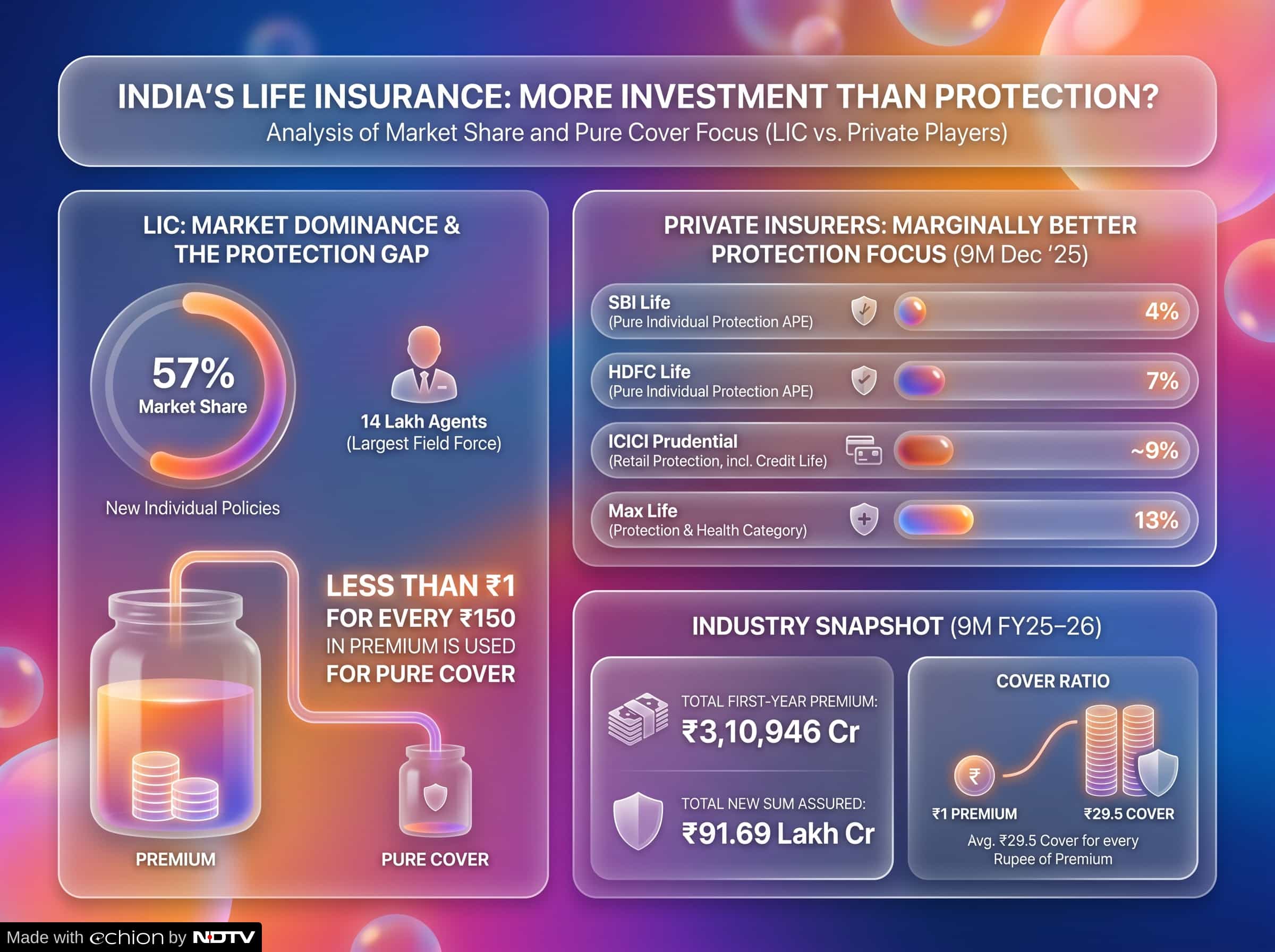
LIC sells more than half (57%) of all new individual life insurance in India. Its 14 lakh agents are one of the largest field-sales forces in any service industry in the country. Less than Rs 1 in every Rs 150 they bring in is being used to cover a life.
The picture at four leading private insurers is better, but not by much. For the nine months through December 2025, pure individual protection accounts for about 4% of individual APE at SBI Life and 7% at HDFC Life, while ICICI Prudential's retail protection line (which includes credit life) runs near 9% and Max Life's combined "Protection & Health" category reaches 13%. In the first nine months of fiscal 2025–26, India's life insurers collected Rs 3,10,946 crore of first-year premium and wrote Rs 91.69 lakh crore of new sum assured. That works out to Rs 29.5 of cover for a rupee of premium.
A pure term policy for a healthy 35-year-old delivers roughly Rs 650 to Rs 800 of cover for every rupee. The real comparison looks worse if you strip out group term (the product is priced as pure risk and carries high sum-assured multiples), leaving individual business at something closer to Rs 15 to Rs 20 of cover per rupee. That is the protection deficit: a 20-to-40-fold gap between what Indian households get per rupee of premium and what the same rupee would buy if it were spent on the product they need.
Swiss Re put a number on it in 2020. India's mortality protection gap, the difference between what families would need and what they have if the breadwinner dies, was $16.5 trillion.
ALSO READ: IRDAI Member Urges Insurers To Cut Costs And Fix Mis-selling For Affordability
Indians Are Buying More Insurance, But Not The Right Kind
The problem is not that Indian households do not buy life insurance. In fiscal 2023–24 (the most recent year for which savings data is available), 17% of every rupee they saved went into the life insurance fund, or roughly Rs 5.89 lakh crore in a year, according to the RBI Handbook of Statistics on Indian Economy, 2024–25 edition, Table on Household Financial Savings. Forty years ago, in 1983–84, that share was 7%. Insurance's share of savings has more than doubled in a generation, and over the same period the country's protection gap has grown to $16.5 trillion.
I know this story from personal experience. My first life insurance policy was a money-back plan, bought the standard Indian way, from an avuncular neighbour. The sum assured was small and the returns were marginal, but the cashbacks every few years made it feel like clever financial planning. I had not heard the phrase internal rate of return. A life insurance policy was simply how an Indian household moved beyond FDs. The cover was almost incidental.
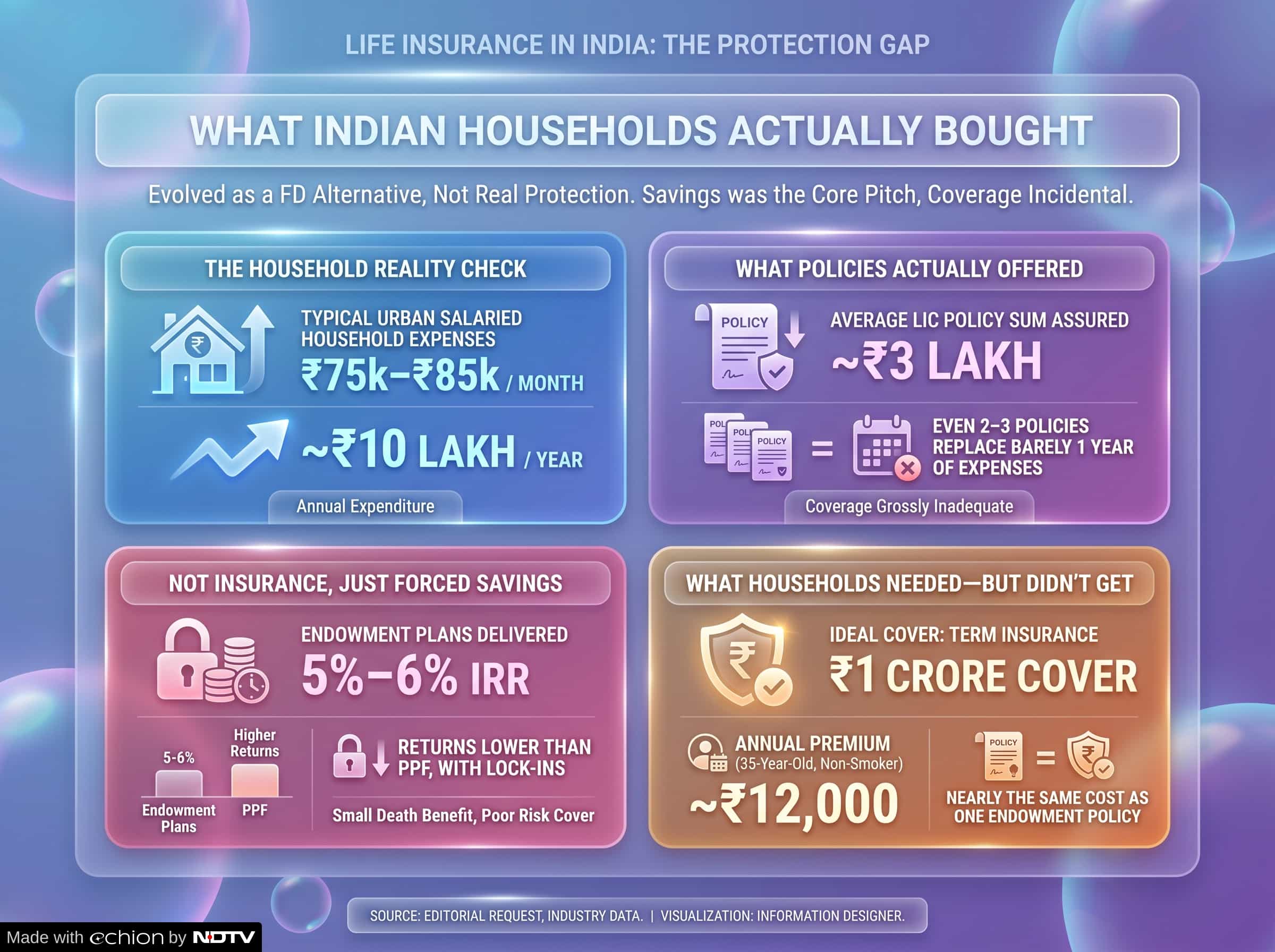
Let's look at this from the perspective of an Indian household. A typical salaried urban household has monthly outgoings of around Rs 75,000 to Rs 85,000, or close to Rs 10 lakh a year. LIC's own new business numbers put the average individual policy at roughly Rs 3 lakh of sum assured. Even a household holding two or three such policies has just about enough cover to replace a year of expenses. The policies were never insurance. They were a forced savings plan with a small death benefit and a 5% to 6% internal rate of return that the household could have beaten with a Public Provident Fund account.
Agents did not sell them the product they needed, pure term cover of Rs 1 crore for the same household, which would have cost around Rs 12,000 a year for a non-smoking 35-year-old. This is roughly the same money that would have bought one of the endowment policies in the drawer.
The agent's incentive is the explanation. A term plan with Rs 12,000 in annual premium yields the agent a few hundred rupees in commission. An endowment with Rs 50,000 in premium yields many multiples of that. Which one would the agent sell?
The IRDAI's moves have unwittingly made this worse. In April 2023, IRDAI abolished product-specific commission caps and left each insurer free to set its own schedule, subject to an overall expense ceiling at the company level. So, endowment commissions stayed fat and term commissions stayed thin.
Things may change. In December 2025, Parliament passed the Sabka Bima Sabki Raksha Act, giving IRDAI broader powers over distribution and expense management. Draft commission norms are expected within months, with media reported a framework loosely modelled on SEBI's approach to mutual funds.
ALSO READ: GST Relief Boosts Health Insurance As Coverage Jumps 30%
Failing To Persist
In fiscal 2024–25, Indians forfeited Rs 8.7 lakh crore of sum assured they had already paid for by allowing 86 lakh individual non-linked policies to lapse. Industry-wide persistency data is reported as a single blended number, but HDFC Life Insurance Co. is the one listed Indian life insurer that publishes a split by product (protection, traditional savings, and unit-linked).
The story is the same every year. At month 61, the first month a ULIP holder can actually touch the money, 48% to 50% of HDFC Life's ULIP customers exit. For buyers of protection products at the same insurer, the figure is 73% to 74% still paying. The gap has held for three consecutive years.
The exit timing is not an accident. A ULIP carries a mandatory five-year lock-in. A customer who stops paying within those five years sees the fund value moved into a Discontinued Policy Fund earning the savings-bank rate; her cover ceases, and the money is held until the end of year five. She does not get liquidity by leaving and her insurance-cum-investment sits in a low-yield holding account. Even though she knows the ULIP she bought is the wrong product, she continues it until the moment she can redirect the premium or withdraw the fund value. That is why ULIP persistency at month 61 is low. A term buyer can stop paying whenever she wants, with nothing held back, so the three-quarters still paying at month 61 are indeed the ones who want the product.
None of this explains the third product on the table. Endowment and par persistency at HDFC Life Insurance Co. sits at roughly 69% to 72% at month 61, within a few points of term. The explanation is not that endowment customers are happy with the product. It is that they have no way to discover they are unhappy. A ULIP publishes a daily NAV that disappoints. An endowment policy is opaque, with just a promise of a maturity cheque after 20 years, and a surrender value table that turns leaving into a loss.
ALSO READ: Health Insurance Is Now Cheaper! But Terms And Conditions Apply*
How Banks Accelerated The Process
In the early 2000s, the Reserve Bank of India permitted Indian banks to sell insurance under the bancassurance model. By the close of fiscal 2024–25, the bancassurance channel (bank branches selling life insurance to bank customers) accounted for 33% of all new individual life premium at the industry level, 50% at private insurers, and 4% at LIC, as per IRDAI's Annual Report 2024–25.
A retail bank's distribution incentive is to sell the largest possible single ticket through the path of least customer resistance, and that path is a unit-linked or non-par savings policy, frequently sold to fixed deposit customers seeking "tax saving" without the customer fully understanding what they have just bought. A family friend recently went to a branch of one of India's top public sector undertaking banks to open a Senior Citizen Savings Scheme; the bank representative discouraged her from doing that and instead pitched a deferred annuity product that she did not need.
1Finance, a private wealth advisory, estimated in its "Mis-selling Menace" investigation that India's top 15 banks earned roughly Rs 21,773 crore in commissions in 2024 from selling third-party financial products, of which insurance is the largest single line.
Bancassurance is not the only non-agency mis-selling channel. A company's direct sales force is equally guilty.
A Cluster Of Complaints
In fiscal 2024–25, 59% of entertainable life insurance complaints escalated to the Council for Insurance Ombudsman (7,491 out of 12,631) were classified under Rule 13(1)(d), misrepresentation of policy terms, up from 59% the year before. Five private insurers (Bharti AXA, IndiaFirst Life, PNB MetLife, Edelweiss Life and Reliance Nippon) sat inside a 70% to 84% mis-selling band across both years, and Bharti AXA alone accounts for 27% of all industry mis-selling complaints.
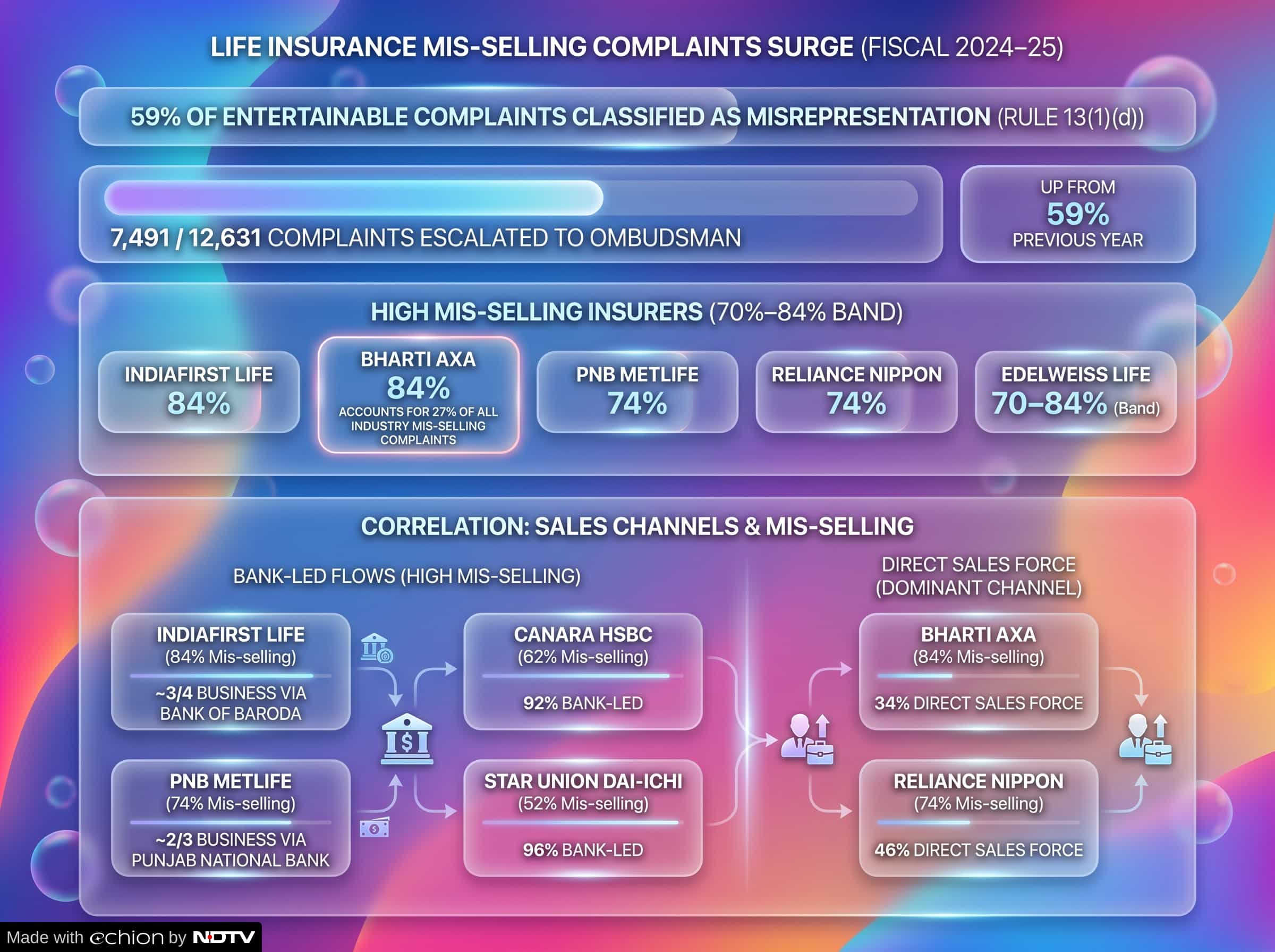
The ombudsman data clearly shows how a large non-agency book correlates with higher complaints. For IndiaFirst Life (84% mis-selling in fiscal 2024–25) and PNB MetLife (74%), roughly three-quarters and two-thirds of new business flows through Bank of Baroda and Punjab National Bank branches. For Bharti AXA (84%) and Reliance Nippon (74%), the dominant channel is the company's own direct sales force, which writes 34% and 46% of their books respectively. Canara HSBC, at 92% bank-led, carries a 62% mis-selling rate. Star Union Dai-ichi, at 96% bank-led, sits at 52%.
That 59% mis-selling statistic reveals a deeper insight. Life is the only type of insurance in India where mis-selling is the dominant escalation. In health and general insurance, 95% of ombudsman complaints are about claim rejection, a dispute over whether the insurer honoured the contract. In life insurance that number is 16%. The rest are about whether the contract the customer signed was the contract the customer thought they were signing. Inside that same life pool, LIC is a mirror image with just under 10% mis-selling and 51% claim repudiation. That is because 94% of its book comes from individual agents, who have deep relationships with their customers that absorb doubt before it becomes a complaint. Disputes surface only when a death claim is declined.
ALSO READ: Does Life Insurance Cover Death In War Zone? Essential Factors To Know
Britain Has Been Here Before
In the late 1980s and through the 1990s, the UK built its residential mortgage market on the same product Indians are now stuck with. Lenders bundled an interest-only home loan with an "endowment mortgage", a savings-cum-insurance policy whose maturity, in theory, would be enough to repay the principal at the end of the term. By 2002, eight million UK families held endowment mortgages whose maturity values were well short of what was promised.
The UK Financial Services Authority launched a mis-selling review between 2002 and 2006 which resulted in more than £2.2 billion in compensation payouts to consumers, the largest mis-selling settlement in British financial history at the time.
Endowment mortgages were not banned, but they were driven out of the market and replaced by term assurance plus a separate investment vehicle. India is now arriving at the same realisation, and the regulators seem to be moving in the right direction.
What Needs To Change
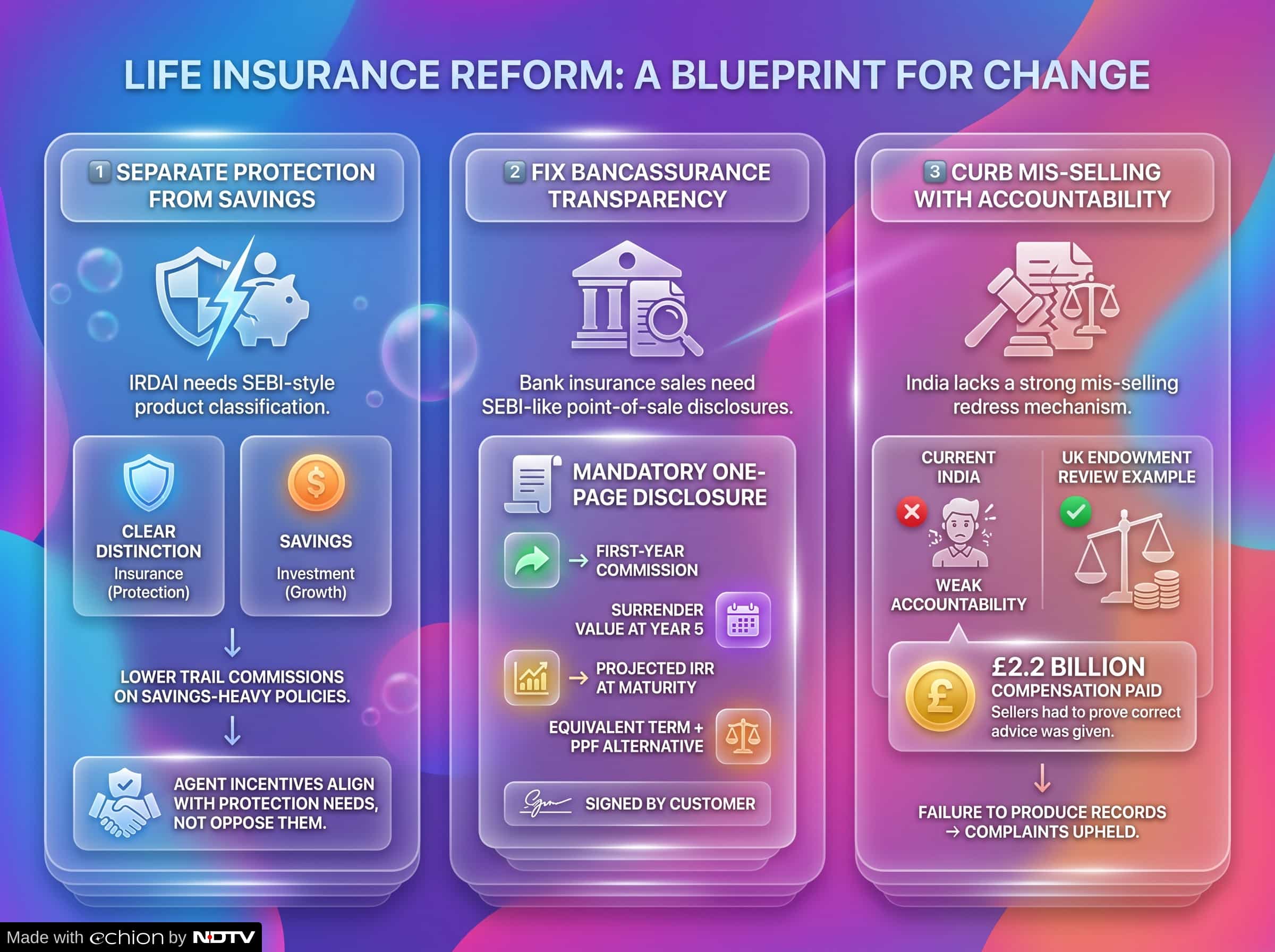
First, the IRDAI should adopt a SEBI-style structure that explicitly differentiates protection from savings, with materially lower trail commissions on the latter. Whatever the final number, the principle has to be that the agent's economic interest moves at least partly into alignment with the policyholder's protection need, not against it.
Second, the bancassurance channel needs the same point-of-sale disclosure regime that the SEBI-regulated distribution side has had since 2018. A bank branch employee selling a non-par savings policy to a fixed-deposit customer should be required to disclose, on a single sheet of paper signed by the customer, the first-year commission, the surrender value at year five, the projected internal rate of return at maturity, and the equivalent term-plus-PPF alternative.
Third, India needs a mis-selling redress framework with teeth. The UK's FSA endowment mortgage review produced £2.2 billion in compensation because sellers had to demonstrate, from their records, that they had given the right advice. When firms could not produce those records, the ombudsman upheld the complaint. India's insurance ombudsman has no equivalent obligation. The customer must prove they were misled, but the mis-selling happens through verbal assurances, and the signed proposal form is treated as evidence of informed consent.
The Direct Mutual Fund Moment For Indian Insurance
IRDAI is expected to publish its draft commission norms in the coming months, and Bima Sugam is scheduled to open its motor window in July and its term-life window in September. If the framework emerges the way insurers committed to (as reported by several media outlets), an Indian buyer will be able to compare term plans across every insurer in one place, at a platform fee, without an agent commission embedded in the premium. And that could well become Indian insurance's ‘direct mutual fund' moment.
(Ashok Hegde is the founder of Gyansurance.com, a site that seeks to educate and inform Indian insurance buyers with data-backed insight and analysis.)
ALSO READ: Protection From Medical Inflation: Can Rs 10 Lakh Health Insurance Come To The Rescue?
Essential Business Intelligence, Continuous LIVE TV, Sharp Market Insights, Practical Personal Finance Advice and Latest Stories — On NDTV Profit.