The Securities and Exchange Board's crackdown on alleged manipulation of trades in the Closing Auction Session has pushed the vulnerabilities of the mechanism to the spotlight.
The question goes beyond what happened in the case of Copthall Mauritius Investment Ltd and Mansi Share and Stock Broking Pvt and centres itself around why activity in the closing auction matter so much more on settlement days?
For context, SEBI's order relates to trading on August 13, when the SENSEX was due to settle weekly derivative contracts. SEBI has named Copthall Mauritius Investment Ltd and Mansi Share and Stock Broking Pvt Ltd as noticees, alleging that both used aggressive orders in the cash market to influence the index and benefit positions in SENSEX options.
The answer lies in the link between the cash market and derivatives, according to Shai Coelho, a derivatives trader, and the founder and director of Vtrender. He said that the episode should be viewed through the mechanics of the auction rather than simply as a case involving two firms.
Under the Closing Auction Session, or CAS, the closing prices of stocks with derivative contracts are determined through a 20-minute auction from 3:15 p.m. to 3:35 p.m. The mechanism was introduced on Aug. 3 to improve price discovery at the close.
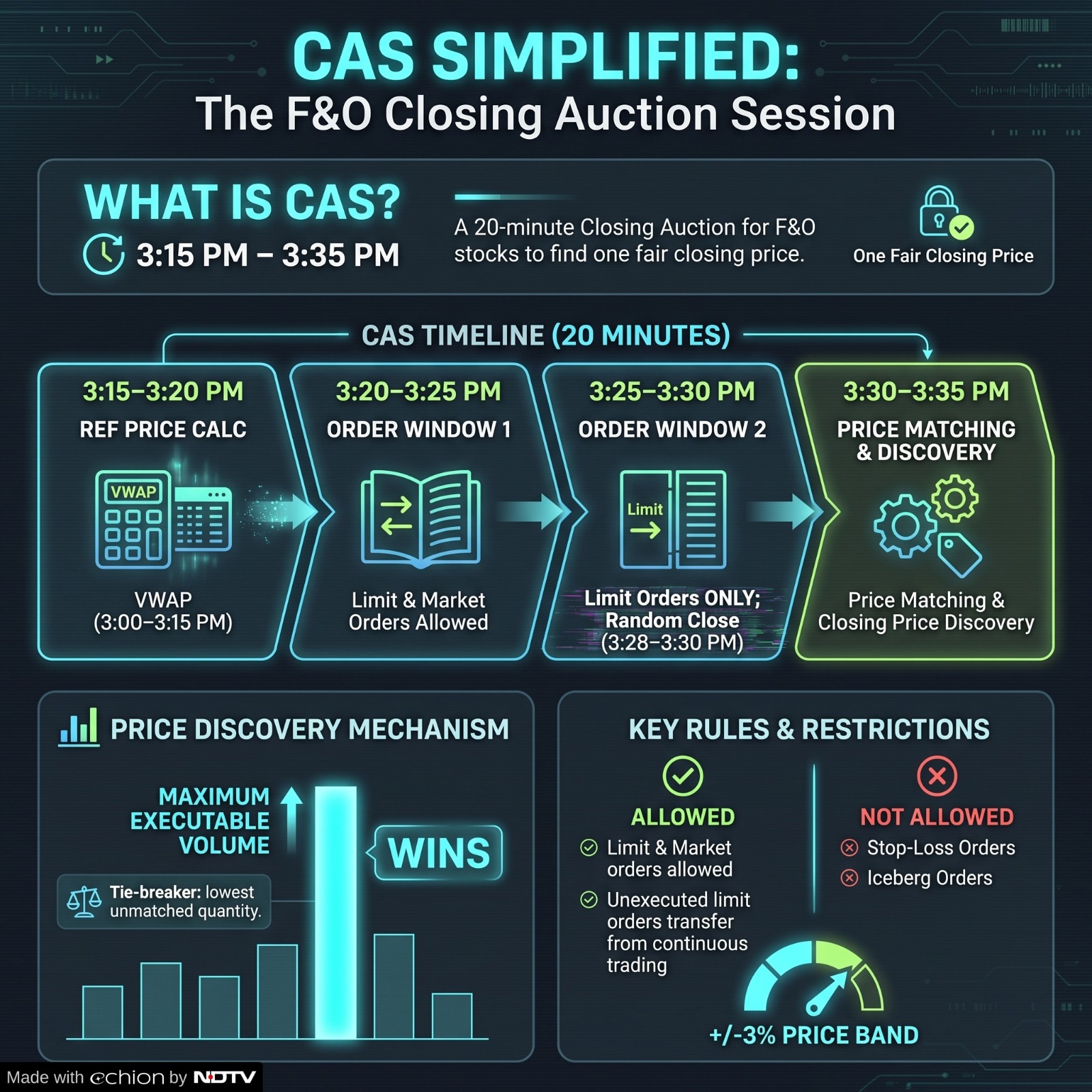
On ordinary days, changes in individual stock prices during the auction may have limited consequences beyond the closing price itself, explained Coelho.
However, he added that on a derivatives settlement day the closing levels of the underlying stocks can directly affect the value of positions in futures and options.
The difference creates a notable market-structure link: an order placed in the cash-market auction can have an economic payoff in a much larger derivatives position.
ALSO READ: SEBI's First CAS Manipulation Crackdown: Two Firms Banned For Gaming SENSEX Expiry Options
Two Books, Opposite directions
Coelho underlined how SEBI's order does not prima facie point to both these entities working in tandem, but exposes "different signatures in the same auction."
While Copthall's tell was buy-side concentration with 99.91% and 96.09% of buy-order value in the first two IEP spikes — placed aggressively across all 30 Sensex constituents. Mansi's tell was cancellation: a large sell block positioned below reference to hold the IEP down, then pulled within seconds once its options were squared off
"Two unrelated participants exerting opposite pressure on the same expiry auction is a market-structure question, not a single-actor one," Coelho said.
ALSO READ: SEBI To Allow After-Market Orders During 3:15-3:20 PM CAS Window: Sources
Why Settlement Days Matter & What Traders Should Watch Out
Higher CAS settlement is not, by itself, evidence of manipulation. The concern arises when large cash-market orders have a clear economic link to derivatives positions.
"The Rs 3.68 crore is not the story — the speed and the forward risk are," Coelho said. He elucidated that cash-market orders placed during the 20-minute auction can move the IEP while the economic payoff sits in a much larger options book.
Coelho said a sharp front-expiry implied volatility dislocation against a relatively stable next-week series can indicate that risk is concentrated in the settlement event rather than in forward volatility.
"IV behaviour alone does not establish manipulation," he said.
Instead, such a divergence can be a signal to examine the underlying cash-market activity, IEP movements and derivatives positioning together.
As CAS becomes a regular part of India's market structure, the more important question on settlement days may therefore not be turnover alone, but how cash-market orders interact with derivatives positions at the point of price discovery.
Essential Business Intelligence, Sharp Market Insights, Practical Personal Finance Advice, Daily Fuel, Gold and Silver Prices and Latest Stories — On NDTV Profit.