- CASA ratio dropped to 24%, with deposits growing via costlier term and FCNR(B) funds
- Excluding FCNR(B), deposits shrank 1%, and loan growth was closer to 30% YoY
- Bank expects slower growth, thinner margins, higher costs; valuations remain elevated
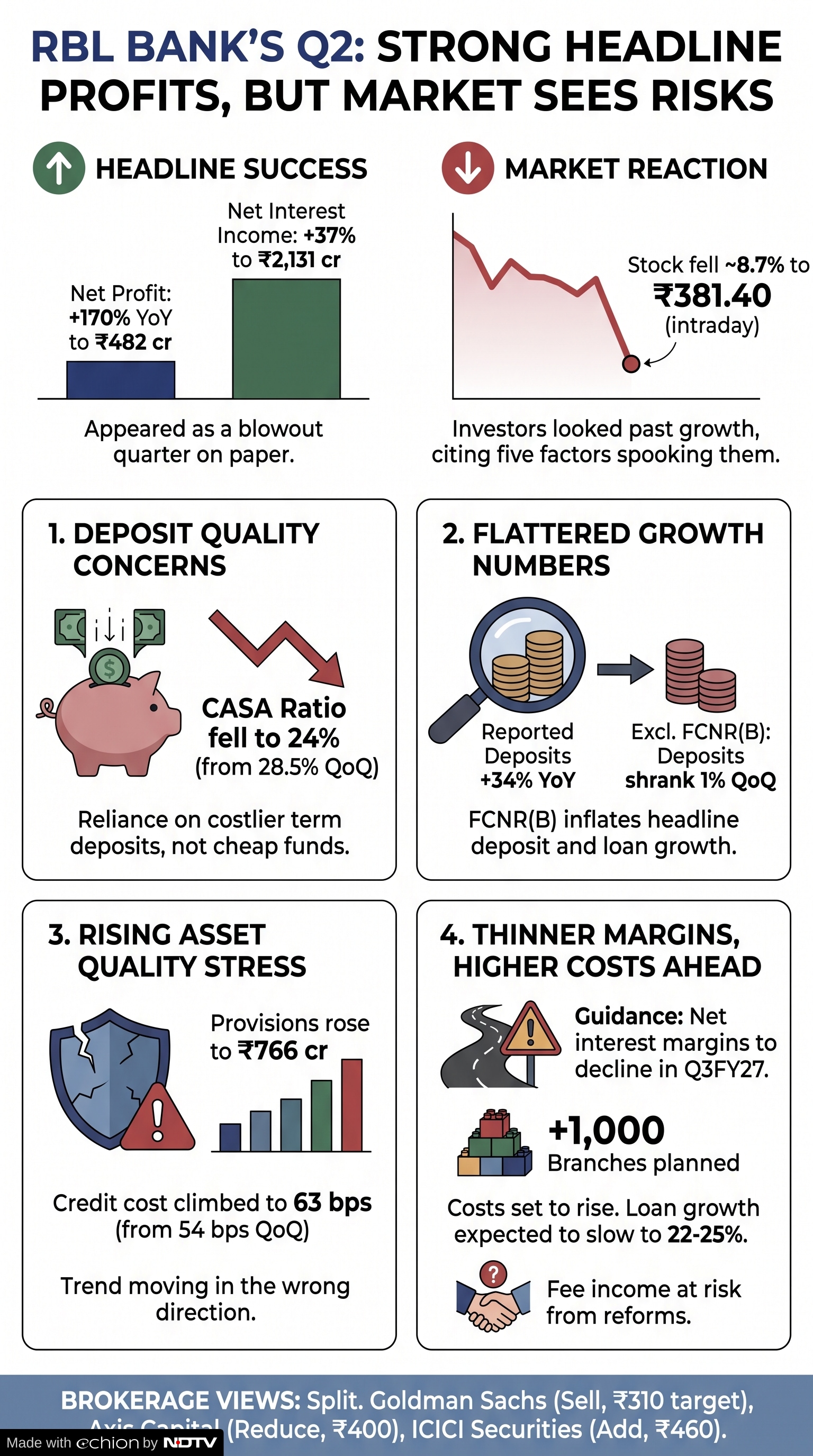
On paper, RBL Bank's September quarter looked like a blowout. Net profit jumped 170% year-on-year to Rs 482 crore, and net interest income rose 37% to Rs 2,131 crore. However, the market didn't buy it.
On Tuesday, the stock fell as much as 8.69% to an intraday low of Rs 381.40 against its previous close of Rs 417.70. At 1:55 pm it was still trading at Rs 389.75, down 6.69%. The selling suggests investors looked past the growth and found less to like underneath.
Here's a look at the five factors spooking investors.
Also Read | Layoffs Are Rising In Tech, But These Skills Are Helping People Unlock Better Pay
The first problem is the quality of the bank's deposits. RBL Bank's CASA ratio, the share of low-cost current and savings deposits, fell to 24%, down from 25.2% a year ago and a much sharper drop from 28.5% just a quarter earlier. The bank is growing its deposit base, but it is doing so through costlier term deposits and FCNR(B) deposits rather than the cheap, sticky funds that support margins.
That reliance on FCNR(B) money also flatters the headline growth. Reported deposits rose an impressive 34% year-on-year. Strip out FCNR(B) deposits, though, and deposits actually shrank 1% from the previous quarter. The same pattern runs through the loan book. Advances grew 42% year-on-year, but excluding FCNR(B)-linked loans, underlying credit growth was closer to 30%. That is still healthy, but well short of what the headline suggests.
Asset quality offers little comfort either. Provisions rose to Rs 766 crore, higher both sequentially and year-on-year, and credit cost climbed to 63 basis points from 54 basis points in the previous quarter. For a bank that has spent the past few years trying to put stress behind it, the trend is moving in the wrong direction.
A fifth, less visible risk sits in fee income. RBL Bank earns about Rs 300 crore a year from bancassurance, and if the proposed insurance distribution reforms are implemented in their current form, 50-60% of that stream could be at risk.
ALSO READ: RBL Bank Q2 Results: Net Profit Nearly Triples To Rs 482 Crore, Asset Quality Improves
Guidance Points To Thinner Margins, Higher Costs
The bank management's own guidance, issued post the release of Q2 results, did little to reassure the market. The lender expects net interest margins to decline in Q3FY27 as it puts its surplus FCNR(B) liquidity to work in wholesale and secured retail loans, segments that typically earn lower yields.
Costs are set to rise as well, as RBL Bank plans to add 1,000 branches over the next two and a half to three years. Management also described Q2's 42% loan growth as an “exception” and expects growth to settle at 22-25%. Put together, the outlook is for slower growth, thinner margins and higher costs.
That leaves valuation as the sticking point. RBL Bank trades at 1.41 times book value today, and 1.13 times on a one-year forward basis, well above its five-year average of 0.9 times. At those levels, the market has little patience for anything short of clean execution.
What Brokerages Project
Brokerages are split on the stock. Goldman Sachs remains the most bearish, retaining its 'Sell' rating even as it raised its target to Rs 310 from Rs 285. Axis Capital kept its 'Reduce' rating and Rs 400 target unchanged. ICICI Securities is more constructive, with an 'Add' rating and a target raised to Rs 460 from Rs 430.
| Brokerage | Rating | Target Price (Rs) | Previous Target (Rs) |
|---|---|---|---|
| Goldman Sachs | Sell | 310 | 285 |
| ICICI Securities | Add | 460 | 430 |
| Axis Capital | Reduce | 400 | 400 |
Essential Business Intelligence, Sharp Market Insights, Practical Personal Finance Advice, Daily Fuel, Gold and Silver Prices and Latest Stories — On NDTV Profit.