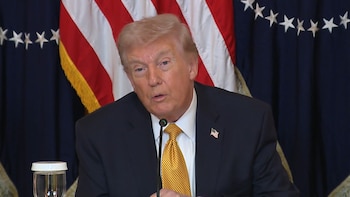
The US Federal Reserve kept its benchmark policy rate unchanged at 3.5-3.75% for the fifth straight meeting, in line with Street estimates amid the current geopolitical risk premium. The Federal Open Market Committee (FOMC), in its second meeting under the chairmanship of Kevin Warsh, voted to pause the benchmark lending rates. The monetary policy verdict was driven by the looming concerns over inflation, which has stayed above the Fed's medium-term target of 2%.
The voting was not unanimous, as nine members backed the decision to hold rates steady, whereas three differed with the majority's opinion. The dissenters, Fed regional presidents Beth Hammack, Neel Kashkari and Lorie Logan pitched for raising "target range for the federal funds rate by 1/4 percentage point. FOMC's statement was largely unchanged from the previous meeting, acknowledging solid economic activity alongside strong investment and productivity growth.
ALSO READ: US Fed Verdict: Five Biggest Takeaways As Kevin Warsh Keeps Interest Rates Unchanged
Also Read | Layoffs Are Rising In Tech, But These Skills Are Helping People Unlock Better Pay
It also reiterated the FOMC's intent to deliver price stability, emphasizing that the Fed under Warsh will be laser-focused on bringing down inflation amid the current global headwinds. During the post-policy press conference, Fed Chair Kevin Warsh stressed that the central bank remains fully committed to restoring price stability. Warsh also highlighted that the Fed "won't hesitate to act where necessary and appropriate" if inflation fails to move towards its 2% target.
US Fed verdict implications
Market analysts pointed out that Fed Chairman Warsh reiterated such focus in the press conference (''will deliver price stability'') and, interestingly, also welcomed the rise in US Treasury yields since the last meeting as a sign that "market participants are learning to play the ball, not the referee", reacting to economic developments and not 'Fedspeak'.
Given Warsh's preference for less communication from the Fed, it is likely that volatility in markets will rise around FOMC meetings under his tenure. This will also be influenced by the complete lack of forward guidance, which is likely to be the norm in Warsh's Fed,'' said Madhavi Arora. Lead - Economist, Emkay Global Financial Services Ltd.
The Federal Reserve appears to be stepping back from its traditional role of proactively guiding markets, instead allowing market forces to dictate outcomes. This shift is not particularly reassuring. It introduces a layer of uncertainty across asset classes, evident in the recent divergence where equity markets, including the Dow, have softened while Treasury yields have moved higher. Such signals reflect a lack of clear directional confidence, according to analysts.
''At the same time, the US Fed continues to maintain a hawkish tone without decisive action, suggesting a possible element of political calibration. With US midterm elections approaching, there is a perception that the central bank is delaying aggressive rate actions, potentially prioritizing stability over inflation control in the near term. In the short run, this dynamic may work in favor of emerging markets like India,'' said Ajitabh Bharti, Co-founder and Executive Director, Capital XB.
How will the Indian stock market move after US Fed's verdict?
The GIFT Nifty, an early indicator of benchmark's Nifty 50's performance, traded at 24,275.50. Indian equity benchmarks, the Sensex and Nifty 50, ended Wednesday's session on a strong note, led by gains in IT and metal stocks. The NSE Nifty 50 gained 1.1% to close near 24,250, while the BSE Sensex advanced over 800 points, or 1.1%, to settle above 77,600.
This comes after Asian stock markets traded mixed as investors assessed the US Federal Reserve's decision to leave the key interest rates unchanged while monitoring renewed tensions in the Middle East that lifted oil prices. Japan's Nikkei 225 benchmark gained 1.74%, South Korea's Kospi rose 1.50% after opening, while Australia's ASX 200 slipped 0.50%.
''A relatively weaker dollar could ease pressure on the rupee and provide some breathing room for capital flows and external balances. However, the medium-term risks remain significant. If inflation in the US persists or re-accelerates due to delayed policy action, the eventual correction could be sharper and more disruptive, transmitting volatility across global markets, including India,'' said Ajitabh Bharti of Capital XB.
Investor's focus remained on the Fed decision after policymakers voted 9-3 to keep the benchmark federal funds rate unchanged. The split decision highlighted growing differences among officials, as three Fed policymakers favoured an interest-rate increase amid persistent inflation concerns. FOMC faces strong internal pressure to hike rates further due to rising energy costs and persistent inflation. The Indian market construct indicates a breakout trend, said experts.
''The potential breakout is being constrained by many headwinds. The spike in Brent crude again to near $90 following the escalation of the US-Iran conflict is a strong headwind. Feds decision to pause rates yesterday, though expected, turned out to be negative for equity markets since the decision was a 9-3 split decision with three members voting for a rate hike to control inflation. This split decision indicates that a rate hike may come soon,'' said Dr. VK Vijayakumar, Chief Investment Strategist, Geojit Investments Ltd.
''Consequently bond yields increased impacting equity markets which saw a 1.52% sell off in S&P 500. The Indian market is likely to respond differently since the sell off in chip stocks and FPIs turning buyers in India, so far in July, are turning favourable for Indian market. KOSPI is down 31 % during the last one month and FPIs have turned big sellers in chip stocks. Indian economy continues to be resilient and this will provide fundamental support to the market,'' added Dr. VK Vijayakumar.
Essential Business Intelligence, Sharp Market Insights, Practical Personal Finance Advice, Daily Fuel, Gold and Silver Prices and Latest Stories — On NDTV Profit.