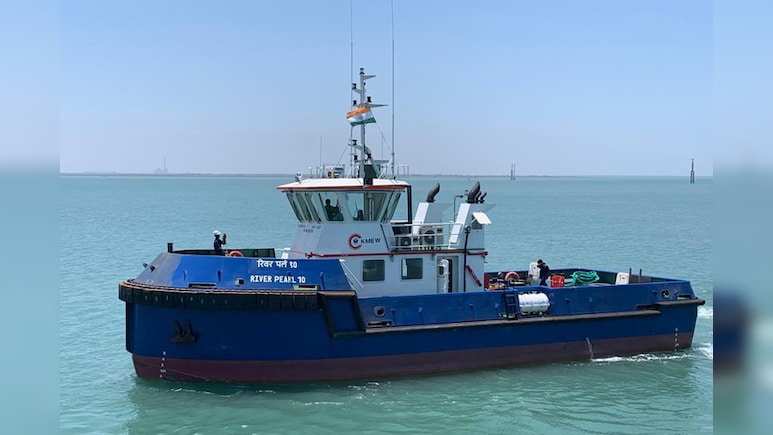
Knowledge Marine & Engineering Works (KMEW) provides an end-to-end maritime ecosystem. It operates across shipbuilding, chartering, and marine contracting. The company's operations are structured across three primary business segments: dredging, port ancillary crafts, and shipbuilding, repair, and refitting.
Within dredging services, KMEW undertakes both capital and maintenance dredging to ensure waterways remain navigable. This involves removing sediment and debris from the bottom of water bodies to maintain or increase the depth of navigation channels, anchorages, and berths. The company executes these projects across ports, rivers, lakes, and fishing harbours.
Alongside this, the company owns and leases auxiliary vessels that support daily port operations. It also operates a commercial shipbuilding segment, where it designs, builds, repairs, and refits marine crafts. These vessels are supplied to third-party government clients such as the Inland Waterways Authority of India and port authorities.
Also Read | Layoffs Are Rising In Tech, But These Skills Are Helping People Unlock Better Pay
ALSO READ: Marico Q4 Results: FY26 Volume Growth Highest In Seven Years; Final Dividend Declared
Riding the Sagarmala and Maritime India Vision 2030 Wave
KMEW today sits at the intersection of multiple growth levers driven by policy tailwinds. The Sagarmala programme envisions port-led development through 839 projects worth around Rs 5.8 lakh crore. This initiative focuses on establishing new mega ports and modernising existing ones, leading to a sharp rise in demand for both capital and maintenance dredging.
This is further supported by Maritime India Vision 2030, which aims to upgrade infrastructure to handle larger vessels and higher cargo volumes. This ensures sustained demand for KMEW's dredging and port ancillary services. With specialised equipment such as suction hopper dredgers, tugs, and patrol boats, KMEW is well-positioned to bid for and execute a wide range of projects under these initiatives.
To capitalise on this demand, KMEW has significantly scaled its operational capacity. In a single year, the company expanded its fleet from 16 to over 40 marine assets and currently owns and operates 45 crafts. This includes 16 dredgers, 15 port ancillary crafts, 11 support vessels, and 3 hopper barges. The fleet is operating at 100% utilisation, reflecting strong underlying demand.
In addition, KMEW has acquired Kamal Marine & Engineering Works, marking its entry into commercial shipbuilding and repair. The shipbuilding order book currently stands at Rs 230 crore. This integration allows the company to build its own fleet more efficiently while also executing third-party orders.
To meet rising demand, KMEW is investing Rs 100 crore to upgrade its shipyard, enabling it to construct vessels up to 100 meters long. Through this segment, the company is targeting a shipbuilding revenue of Rs 500 to 700 crore over the next three years.
ALSO READ: War Cost Pressures Aside, Ather Energy Looking At Profitibility Soon, Says CEO
Disrupting Monopolies: The Rs 700 Crore Green Tug Opportunity
Another key growth lever is the decarbonisation of the maritime sector. India has mandated converting 50% of all tugs to green tugs by 2030 and achieving 100% green maritime operations by 2047. This segment has historically been dominated by a few players. KMEW has recently broken this monopoly by securing 15-year contracts worth approximately Rs 700 crore.
These contracts involve constructing and chartering 60-tonne bollard pull green tugs for the Visakhapatnam and VOC ports. This creates long-term revenue visibility for the company. It is also participating in upcoming tenders at major ports like Paradip, Cochin, and Mumbai. This positions it to capture a meaningful share of the Rs 1,000+ crore opportunity in this segment.
Dominating India's Inland Waterway Expansion
Inland cargo movement presents another structural growth driver, given its cost efficiency and environmental advantages. India currently has 111 National Waterways spanning 20,375 kilometers across 24 states. Inland cargo traffic has increased eightfold over the past decade, reaching 133 million metric tonnes in FY25.
This rise in cargo movement requires continuous fairway dredging, creating a large domestic opportunity. To support this, more than 16 river dredging projects worth Rs 1,045 crore are underway across major rivers such as the Ganga, Brahmaputra, Krishna, and Barak. In addition, the government plans to make 20 more national waterways fully navigable.
The Rs 5,000 Crore Market Potential
As a result, the river dredging market in India is expected to grow from approximately Rs 1,500 crore to nearly Rs 5,000 crore. A key initiative driving this expansion is the Jal Marg Vikas Project, which focuses on enhancing cargo movement capacity.
Under this World Bank-supported project, KMEW has secured a 26% share of the order pool on National Waterway 1. This includes long-term fairway maintenance for a 365-kilometer stretch from Haldia to Varanasi, out of the total 1,390-kilometer stretch.
To align with this opportunity, KMEW has positioned itself as the largest private owner-operator in inland dredging. A major strategic development in FY25 was its entry into the cutter suction dredger segment. The company acquired and deployed nine specialised cutter suction dredgers designed for shallow river operations across NW 1 and NW 16.
This fleet creates a strong competitive advantage. Established competitors such as the state-owned Dredging Corporation of India currently have no dredgers operating in rivers, as their investments are focused on deep-sea vessels.
At present, KMEW's dredging revenue is less than Rs 200 crore. However, with a dedicated shallow-draft fleet, limited direct competition, and increasing government support for private participation, the company has strong long-term revenue visibility as the inland waterways scale up.
Beyond these structural growth drivers, KMEW has also entered the Maritime Tourism sector through MP Tourism projects to build and operate a luxury cruise ship on the Narmada River. KMEW estimates revenue visibility of up to Rs 800 over a 20-year period with these segments.
ALSO READ: Global Markets Are Getting Numb To Geopolitics | The Reason Why
Financial Performance: High Margins and the Tonnage Tax Catalyst'
On the financial front, consolidated revenue grew by 23% year-on-year to Rs 200 crore. EBITDA increased by 66% to Rs 83 crore, with margins at 41.6%. Net profit rose by 61% to Rs 50 crore. The company reported a return on equity of 28% and a return on capital employed of 24%.
The trend continued into 9MFY26. Revenue grew 23% year-on-year to Rs 188 crore. Operating profit grew by 27% to Rs 79 crore, while margins expanded by 150 basis points to 42%. Net profit rose by 44% to Rs 56 crore. A key structural change during this period was the transition to the tonnage tax scheme.
KMEW was approved under this framework from Q3FY26. As a result, its effective tax liability fell below 1% of total turnover, reflecting over 90% reduction compared to standard corporate tax rates. This significantly improves its cost structure. Lower tax outgo allows the company to bid more competitively for contracts without pressure on profitability. It also creates additional free cash flow that can be reinvested into expansion.
The Rs 1,500-Crore Order Book
As of February 2026, KMEW's order book stands at Rs 1,500 crore. This includes Rs 409 crore for dredging, Rs 863 crore for chartering and green tugs, and Rs 230 crore for shipbuilding. It provides revenue visibility for the next 4 to 5 years.
At Rs 1,837 per share, KMEW trades at a price-to-earnings multiple of 70, double its 5-year median of 32. This premium valuation reflects KMEW's robust historical earnings performance and the near-term catalysts. However, the company remains subject to structural risks, including reliance on government budgets, extended project lifecycles, and a high client concentration.
Disclaimer: The views expressed in this article are solely those of the author and do not necessarily reflect the opinion of NDTV Profit or its affiliates. Readers are advised to conduct their own research or consult a qualified professional before making any investment or business decisions. NDTV Profit does not guarantee the accuracy, completeness, or reliability of the information presented in this article.
Essential Business Intelligence, Sharp Market Insights, Practical Personal Finance Advice, Daily Fuel, Gold and Silver Prices and Latest Stories — On NDTV Profit.