- SEBI unveiled reforms including a regulatory framework for debt brokers and bond tokenisation pilot
- India's bond market faces low liquidity, limited retail participation, and concentration in top-rated issuers
- SEBI plans bond ETFs and derivatives to enhance liquidity and provide hedging tools to institutions
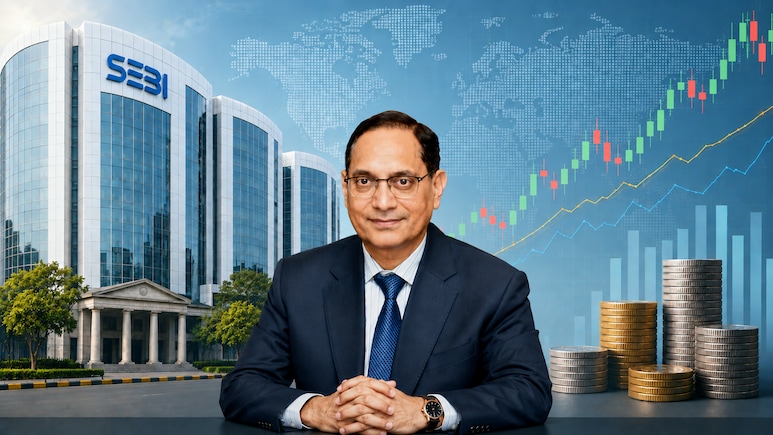
Tuhin Kanta Pandey on Tuesday, May 26, unveiled a fresh set of forward-looking reforms for India's corporate bond market, including a separate regulatory framework for debt brokers, a pilot for tokenisation of corporate bonds, expansion of bond ETFs and derivatives, as well as a review of compliance rules for debt-only listed entities. Speaking at the CareEdge Debt Market Summit, the SEBI chief said the regulator is now working with the RBI, Ministry of Finance and market participants on a broader market-making framework aimed at improving liquidity, reducing trading frictions and deepening participation in corporate debt markets.
The push comes as SEBI believes India's bond market, despite growing sharply in size, remains structurally weak in several areas. Pandey pointed out that secondary market liquidity is still shallow, most bonds are held till maturity instead of actively traded, retail participation remains below 1%, and nearly 85-90% of issuances are concentrated among top-rated AA and AAA issuers.
The regulator also sees overdependence on bank-led financing as a long-term constraint for India's growth ambitions. Pandey reiterated that infrastructure, urbanisation, energy transition and long-gestation projects cannot rely only on bank credit, arguing that India needs a deeper bond market capable of becoming the economy's "second engine of credit".
Also Read | Layoffs Are Rising In Tech, But These Skills Are Helping People Unlock Better Pay
ALSO READ: Corporate Bonds Carry Risk, SEBI Chief Warns As Regulator Pushes Debt Market Reforms
As part of the next phase of reforms, Pandey said SEBI is examining a distinct regulatory classification for debt brokers to reduce compliance costs and encourage specialised intermediaries focused purely on fixed-income markets. He also said the regulator will review whether debt-only listed entities should face the same disclosure and compliance burden under LODR norms as equity-listed companies. One of the most closely watched proposals announced was SEBI's plan to explore a pilot framework for tokenisation of corporate bonds. The regulator believes tokenisation could potentially lower transaction costs, improve settlement speed, increase transparency and enable more efficient servicing and traceability of bond instruments.
Pandey, however, stressed that innovation would be approached cautiously and within a strong regulatory framework, reiterating that SEBI would not compromise on investor protection or market integrity. The SEBI chief also flagged liquidity enhancement as a central policy priority. He said the regulator is pushing ahead with development of bond ETFs and derivatives linked to corporate bond indices, which could help improve secondary market trading and provide institutions with tools to hedge interest-rate risk.
On investor participation, Pandey acknowledged that corporate bonds remain poorly understood among retail households despite rising flows into equities and mutual funds. He said investor education under Project Jagruk would now include dedicated bond-market awareness campaigns across the country. SEBI and stock exchanges will also conduct issuer outreach programmes targeted at companies and SMEs that are eligible for listed debt markets but have not yet accessed them.
ALSO READ: F&O Corner: SEBI Plans Real-Time Addition Of Option Strike Prices Amid Sharp Market Moves
Pandey further said SEBI is reviewing the municipal debt securities framework to facilitate pooled financing structures and increase retail participation in municipal bonds, while also aligning securitised debt rules with RBI's securitisation framework to improve regulatory clarity and ease restrictions. The SEBI chief noted that the regulator's earlier reforms are already beginning to show results. Secondary market bond trades and RFQ volumes have risen sharply between FY25 and FY26, while Online Bond Platform Providers have seen a rapid increase in retail participation and transaction values.
Pandey said India's corporate bond market has grown from roughly Rs 17.5 lakh crore in FY15 to nearly Rs 59 lakh crore now, with annual debt fundraising significantly exceeding equity mobilisation in recent years. But he cautioned that "scale alone is not enough", saying the next phase must focus on liquidity, diversity, transparency and wider participation.
Essential Business Intelligence, Sharp Market Insights, Practical Personal Finance Advice, Daily Fuel, Gold and Silver Prices and Latest Stories — On NDTV Profit.