- India's forex reserves mainly consist of borrowed liquidity, not earned surpluses
- Foreign outflows hit $78 billion over FY25-26, causing capital account deterioration
- Domestic SIP flows have cushioned equity markets but not prevented rupee weakness
India is walking a tightrope by trying to defend both the rupee and the stock market at the same time. It is an expensive ambition, and one that veteran investor Shankar Sharma says the country simply cannot sustain.
Writing in the Mint, Sharma explains the structural fragility underpinning India's current macro position. The problem, he argues, begins with a fundamental misreading of what India's forex reserves actually represent. Unlike China's war chest of earned surpluses, much of India's reserve buffer is borrowed liquidity — assembled from foreign portfolio flows, FDI, borrowings, and overseas remittances rather than sustained current account surpluses. "True earned reserves come from sustained current account surpluses. India rarely runs one," he writes. That distinction, benign in calm times, becomes critical when global stress hits and capital looks for the exit.
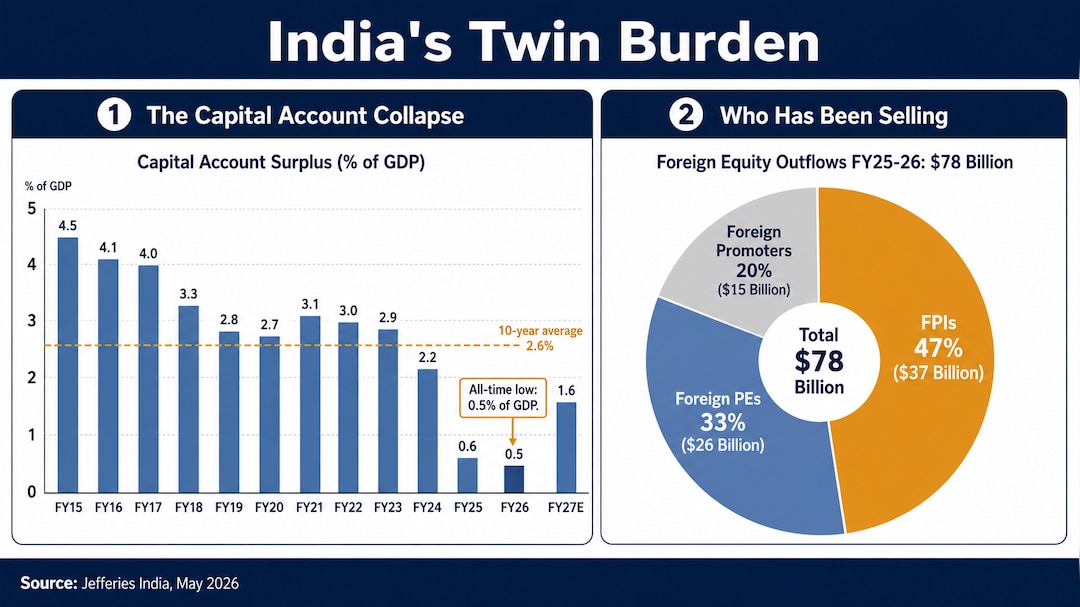
And capital has been exiting, in size. A Jefferies India strategy note estimates total equity capital market-driven foreign outflows over FY25-26 at $78 billion, split across FPIs, foreign private equity, and foreign promoters. FPI net equity outflows alone hit a record $21 billion in FY26 and remain negative into FY27. The consequence has been a steady hollowing out of India's capital account, with the surplus collapsing to just 0.5% of GDP over FY25-26, the lowest ever recorded, and a sharp deterioration from the prior ten-year average of 2.6%.
Also Read | Layoffs Are Rising In Tech, But These Skills Are Helping People Unlock Better Pay
The Indian economy is dealing with multiple headwinds
Photo Credit: NDTV Profit
SIP Cushion Is Masking a Currency Crisis
The backstop, so far, has been domestic SIP flows. The systematic and sustained channelling of household savings into mutual funds has absorbed wave after wave of FII selling, preventing a sharper correction in Indian equities in rupee terms. But Sharma is clear-eyed about what this has actually achieved — and what it has not. "The ballast provided by SIP flows has prevented a substantial fall in Indian equities in rupee terms. But the boil has merely surfaced elsewhere, in the rupee's brittle performance," he writes. FII equity outflows in the trailing twelve months to May 2026 stand at roughly Rs 4.05 lakh crore, and the estimated FY26 balance-of-payments deficit sits at $30 billion, with Jefferies projecting it to widen further to $18 billion in FY27.
Mahesh Nandurkar, Head of Research and MD at Jefferies India, does not expect any meaningful FPI return to Indian equities in the near term. The Jefferies note pointedly observes that strong domestic flows have provided foreign capital with an easy exit from what it viewed as an expensive market — in effect, DII-driven inflows have functioned as an orderly checkout counter for departing foreign investors rather than a signal of renewed conviction.
This brings Sharma to the harder question at the heart of his argument: which is the lesser evil — a collapsing stock market or a collapsing currency? A stock market correction, however painful, does limited lasting damage to the real economy. A currency crisis is a different beast entirely. It touches every household, raises the country's cost of capital, erodes perceptions of stability, and as Sharma notes, "almost never recovers fully." With India's import cover adjusted for outstanding forward positions now at roughly nine months per Jefferies estimates, below the historical average, and the RBI unable to burn reserves defending the rupee without cost, the room to manoeuvre is narrowing.
"India cannot afford to offer foreign capital fully convertible currency exits amid a massive balance of payments deficit. A price must be extracted for exits. A crashing stock market is that price," Sharma writes. It is a provocative framing, but the data makes it difficult to dismiss.
With the FY27 BOP deficit projected at $70 billion and the rupee already down sharply against the dollar, Sharma's conclusion carries the weight of arithmetic behind it: "Sensible forex policy is predictive and proactive. Otherwise, it is just hopeful astrology."
Essential Business Intelligence, Sharp Market Insights, Practical Personal Finance Advice, Daily Fuel, Gold and Silver Prices and Latest Stories — On NDTV Profit.