- South Korea’s Kospi index dropped 7.4%, hitting its lowest since July amid AI chip stock selloff
- Samsung Electronics and SK Hynix fell sharply, dragging the heavily weighted Kospi down
- China’s ChangXin Memory announcement sparked fears of tougher competition in memory market
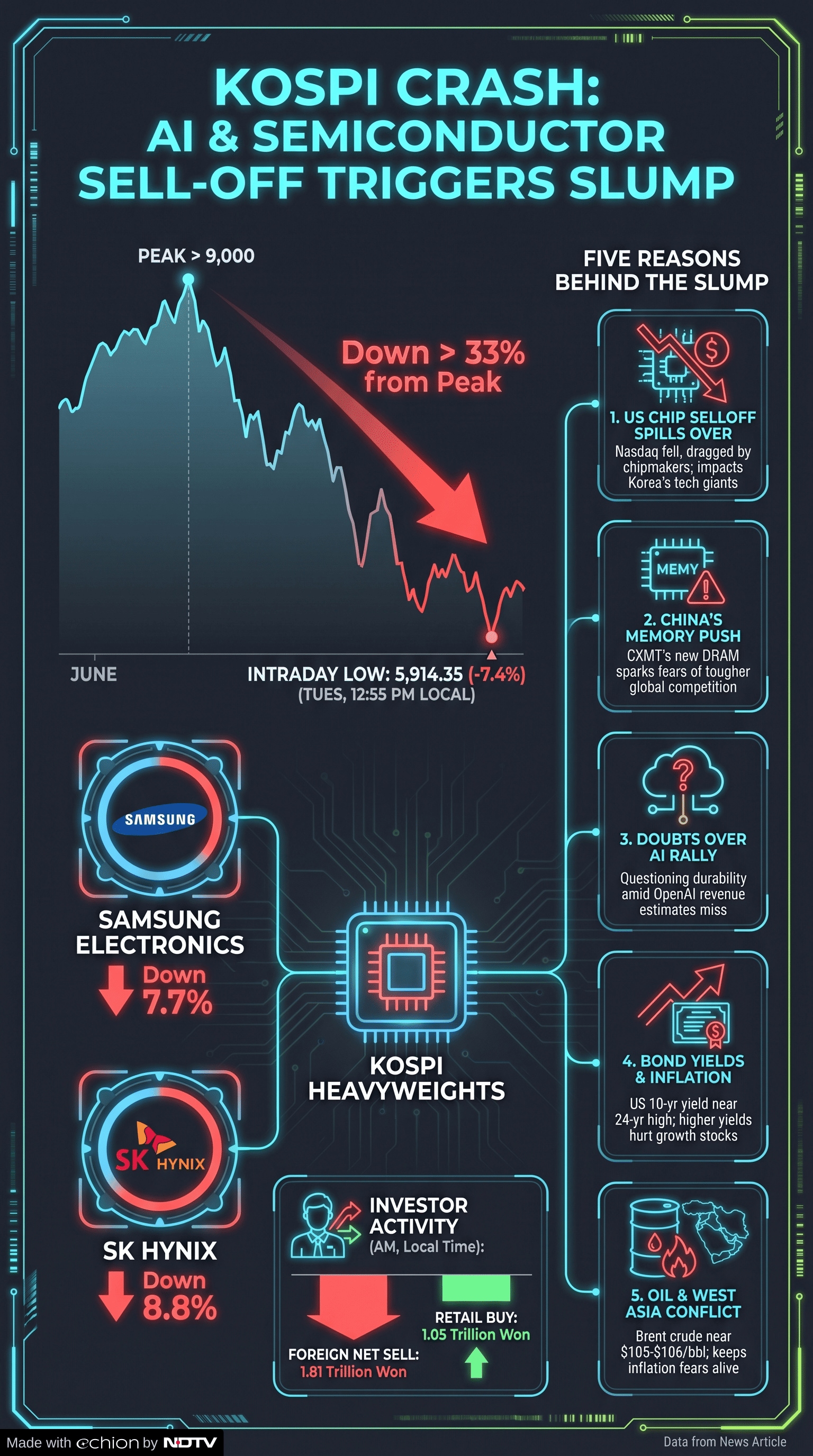
A worsening sell-off in AI and semiconductor stocks dragged South Korea's Kospi index by as much as 7.4% to 5,914.35 on Tuesday. The rout, which pushed the index to its lowest level since late July, had a ripple effect in other Asian markets as well, with Japan's Nikkei and Hong Kong's Hang Seng slipping into the red.
The Korean benchmark index marginally pared the losses to trade 6.4% lower at 5,972.91 at 12:55 pm (local time). Samsung Electronics and SK Hynix, the two stocks that carry more than half of Kospi's weightage, were down 7.7% and 8.8%, respectively.
The Kospi, notably, had crossed 9,000 in June on the back of the global AI boom. This means that the current crash has dragged the index by at least more than a third from its peak.
Also Read | Layoffs Are Rising In Tech, But These Skills Are Helping People Unlock Better Pay
Here are five reasons behind the slump.
1. A US chip selloff spills over
The immediate trigger came from Wall Street. The Nasdaq fell about 0.5% overnight, dragged down by chipmakers, even as the Dow and S&P 500 ended in the green. “A lot of it has to do with the chip selloff we saw on Wall Street overnight,” Reuters quoted Kyle Rodda, senior analyst at Capital.com, as saying.
Korea's market leans heavily on two names, Samsung and SK Hynix, so a chip rout there becomes an index rout. Other leading semiconductor scrips were also in a freefall, with SK Square sinking nearly 12% and Samsung Electro-Mechanics plunged about 9% at one point in the morning.
2. China's memory push worries investors
The second reason is closer to home. The selloff, according to analysts, is tied to China's ChangXin Memory Technologies (CXMT), which said it would unveil next-generation server DRAM products within the year.
That raised fears of tougher competition in the global memory market, the business that has driven the earnings of both Samsung and SK Hynix.
The CXMT announcement was the reason behind the selloff in US chip stocks as well last night, with Micron, Nvidia, AMD, Intel, SanDisk and others slumping up to 6%.
3. Doubts over the AI rally
The third is a broader worry about how long the AI trade can run. Investors are questioning the durability of the rally amid heightened US-China competition. The Korean market sentiment already worsened on Monday, when Kospi slumped 3% intraday, after OpenAI told investors that its annualised revenue was reaching $50 billion, which is $20 billion lower than the estimates of $70 billion.
After a run that took the Kospi above 9,000, a market priced for sustained AI demand has little cushion when that story is questioned.
ALSO READ | LIVE: Sensex, Nifty 50 Trade Higher; HCL Tech Jumps 4%, TCS, HDFC Bank, TechM Lead
4. Bond yields near multi-decade highs
The fourth is the cost of money. The 10-year US Treasury yield was at 5.214% in Asian hours, close to last week's 24-year high of 5.364%. The dollar was near an 18-month high, with the yen at 158.50.
Higher yields hurt richly valued growth stocks the most, and chipmakers sit at the top of that list. Investors are also waiting on US bank earnings, with JPMorgan Chase, Goldman Sachs, Citigroup and Wells Fargo due to report later in the day.
5. Oil and West Asia keep inflation fears alive
The fifth is crude. Brent was around $105 to $106 a barrel, near a two-week high, as a widening conflict in West Asia and attacks on Saudi Arabia kept supply risks in focus.
Higher oil keeps inflation, and therefore interest rates, elevated. That feeds directly into the yield worry above.
How the fall was amplified
Foreign investors led the selling. They net sold 1.81 trillion won on the main board by 10:40 am Seoul time, while retail investors bought 1.05 trillion won and institutions 598.7 billion won, Seoul Economic Daily reported.
The Kosdaq, the tech-heavy second board, fell more than 4%.
What it means for India
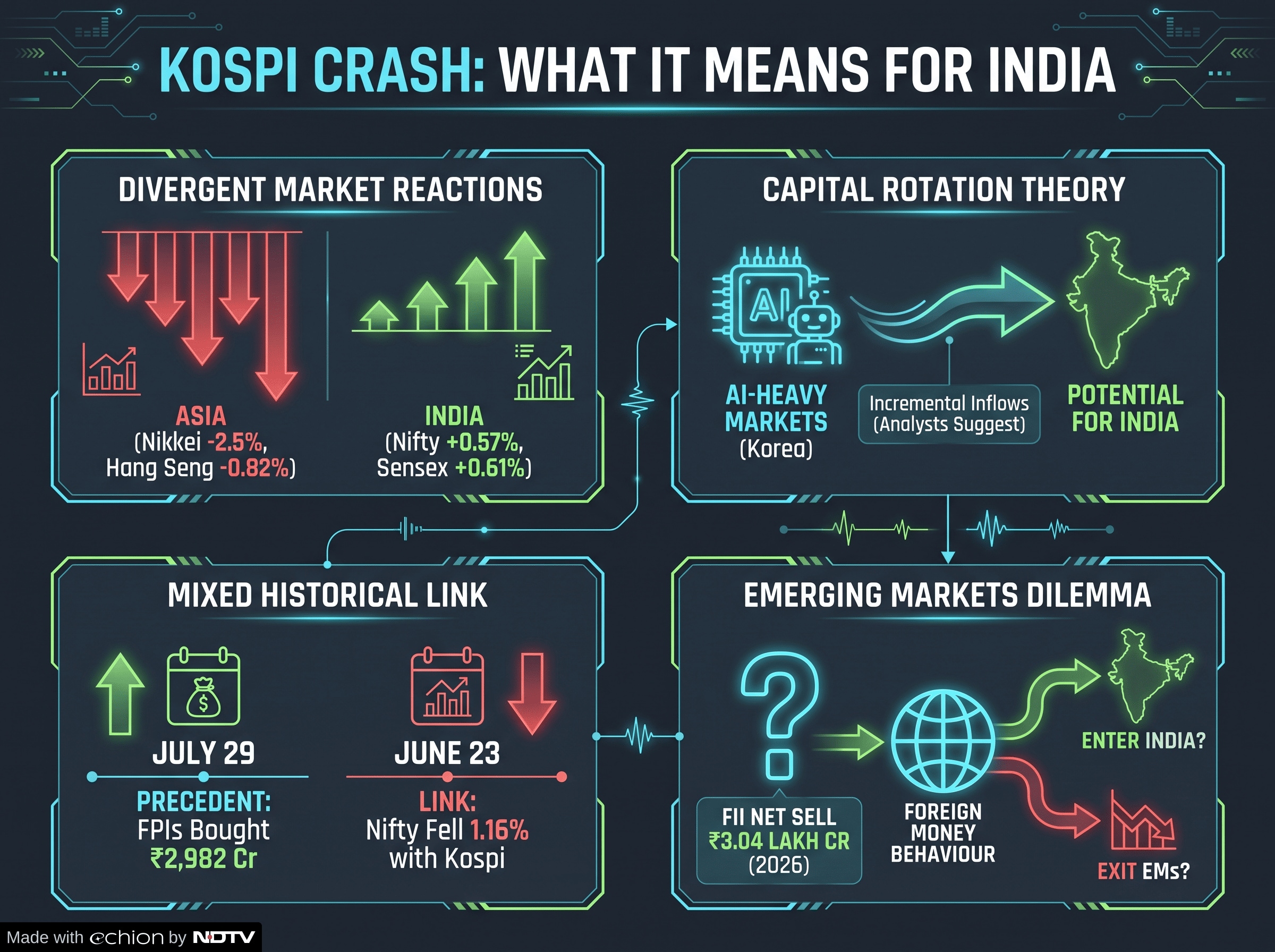
Asian markets whose time zones are more aligned with Korea witnessed a selloff. The Nikkei fell about 2.5% and the Hang Seng 0.82%, while MSCI's Asia-Pacific index excluding Japan lost about 2% in early trade.
The Indian markets, however, opened strongly with Nifty 50 up 0.57%, or 126.70 points, at 22,490.05 and Sensex rising 0.61%, or 440.92 points, to 72,365.6 at 9:35 am IST.
Does Korea's pain mean India's gain? Analysts say it can, but not in a straight line.
The case for India is one of rotation. If foreign investors rebalance away from AI-heavy markets, “India stands to benefit from incremental capital inflows,” Siddharth Purohit, fund manager at InvestValue, told Goodreturns in July. He had then pointed to the Nifty trading at about 20 times one-year forward earnings, which he called relatively attractive.
There is a precedent. On July 29, after the Kospi lost 16.2% over two sessions, FPIs bought Rs 2,982 crore of Indian equities, their biggest one-day purchase since June 19, and the Nifty had its best day in more than six weeks.
But the link has not always worked that way. When the Kospi plunged as much as 10% on June 23, the Nifty fell 1.16% and Nifty IT lost more than 2%.
Foreign money's behaviour towards emerging markets is the bigger variable. WealthMills Securities' director for equity strategy, Kranthi Bathini, told NDTV Profit on Monday that the “Korea trade” is a key reference point for foreign investors, and that “money has been exiting several emerging markets relentlessly”.
FIIs have already sold a net Rs 3.04 lakh crore of Indian equities in 2026, per NSDL. Whether the Korea rout sends some of that money back to India, or pushes investors out of emerging markets altogether, is the question for the coming sessions.
ALSO READ: 'Hot Money Leaving Emerging Markets': Five Reasons Behind FII Exodus Crossing Rs 3 Lakh Crore
Essential Business Intelligence, Sharp Market Insights, Practical Personal Finance Advice, Daily Fuel, Gold and Silver Prices and Latest Stories — On NDTV Profit.