- Indonesia plans to raise $1.5 billion via panda bonds in yuan by year-end with 3-7 year terms
- Panda bond yields are 3-4 times cheaper than Indonesian rupiah bonds, easing borrowing costs
- Rupiah has depreciated 16.2% against yuan in 12 months, risking higher effective debt costs
In the backdrop of the MSCI-triggered market crash that wiped out about one-tenth of m-cap from its equity universe, Indonesia has decided to use the Shanghai route to raise capital that looks cheaper than what it could've risen in the domestic market.
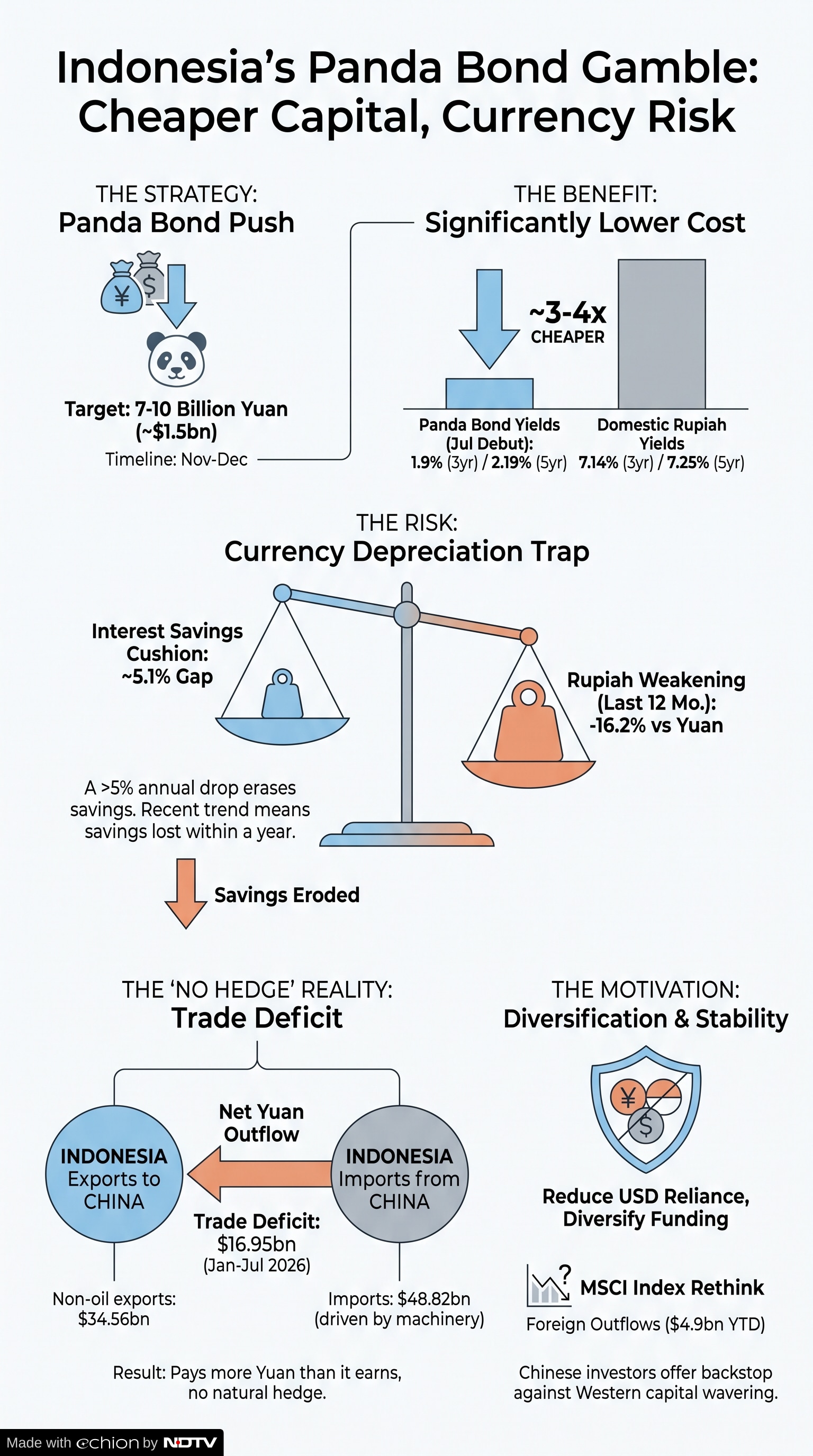
The Southeast Asian nation intends to between 7 billion to 10 billion yuan, or up to $1.5 billion, via the panda bond route between November and December, an Indonesian finance ministry official told Bloomberg on Thursday. There will be three-, five- and seven-year maturities attached with the offering.
The case for raising capital in Chinese currency looks lucrative for now. In its maiden panda bond raise in July, Jakarta raised 5.6 billion yuan with three-year maturity and a 1.9% coupon rate, along with 1.4 billion five-year bond at 2.19%. In comparison, the yields are three-to-four times higher in the domestic market. A three year-bond in Indonesian currency of rupiah carries a 7.14% coupon rate, whereas the same with five-year maturity is at about 7.25%.
Also Read | Layoffs Are Rising In Tech, But These Skills Are Helping People Unlock Better Pay
After the equity market crash this week, the 10-year yield soared to a high of 7.45%, marking a climb of 1.45 percentage points from the year-ago period.
On paper, it appears to be a win-win scenario for Indonesia, having borrowed at approximately a quarter of the cost in the domestic market. However, the catch is that China's currency continues to turn stronger among most of its Southeast Asian peers. Jakarta will have to eventually pay back in yuan, and the depreciating currency may wipe out the gain that is being seen for now.
The 5% Line
The July deal, when Indonesia made its panda bond debut, 80% of the bond raise comprised of the three-year tranche. For Jakarta, the cushion here is the current gap between panda coupon and domestic yields, stretching at about 5.1 percentage points a year. So if the rupiah weakens by more than 5% a year against yuan, then this cheaper Chinese loan would no longer be cheap. For coupons with three-year maturities, the break-even depreciation stands at about 15%.
Now, the question is whether the 5% line is a reasonable cushion for the Indonesian currency market. If one goes by the data for the last 12 months, then it might be not. The rupia has lost 16.2% against the Chinese unit over the past 12 months, per the data available with Trading Economics. If the same trend continues, then three years' worth of interest savings will be lost within a year, and Indonesia may have to end up paying more to the bonholders as compared to what it could've raised from the domestic market.
The July bonds are already under pressure. When the panda band was first reported, local media had used the conversion rate of 2,654 rupiah per yuan to report the overall amount of capital raised in local currency. But at the present conversion rate, the principal already costs about 2% more in rupiah. In other words, this means that five months of yields saving has been already wiped out in three months.
The broader macro elements further add to the jitters, as the rupiah has slumped to around 18,040 against the dollar. Rising crude oil prices, currently above $110 a barrel, and fears of foreign investor outflows due to MSCI's rethink on Indonesia's emerging market status, threatens to further weaken the local currency. On the flip side, the Chinese currency is at its strongest level in about four years.
ALSO READ: MSCI Pressed By Investors To Justify Drastic Indonesia Warning
No Natural Hedge
The usual defence for borrowing in yuan is that Indonesia trades heavily with China. If it earns yuan from exports, it can use them to repay yuan debt.
The trade data points the other way. China was Indonesia's largest source of trade deficit from January to July 2026, at $16.95 billion, after a deficit of $20.5 billion with China for all of 2025. In the first half of this year, Indonesia's non-oil exports to China were $34.56 billion while its imports from China were $48.82 billion, driven largely by machinery.
That means Indonesia already pays more yuan to China than it earns. Panda debt adds to that outflow rather than offsetting it.
Researchers have flagged this risk for sovereign borrowers generally. The Paris-based Finance for Development Lab argued in March that headline panda yields can mislead, because issuers must either pay to hedge against yuan appreciation or carry a significant unhedged risk. The note added that a country can only naturally hedge yuan debt with yuan revenue if it runs a trade surplus with China, and estimated that, even after hedging, emerging-market sovereigns pay about 100 basis points more to borrow in yuan than in dollars.
Bankers who arrange these deals see it differently. One told Malaysia's The Star that issuers should compare the fully swapped, all-in cost, and that on that basis panda funding remains competitive in most cases.
Why Borrow Anyway
Cost is not the only reason. Finance Minister Purbaya Yudhi Sadewa has described the panda programme as a way to diversify funding and reduce reliance on the US dollar, with part of the July proceeds going to cover the 2026 budget deficit.
The timing also matters. MSCI said on October 15 it would consult on moving Indonesia to “standalone” status, which would remove it from the emerging and frontier indices that passive funds track. Feedback is open until April 30, 2027, and a final decision is due by the end of June 2027. Foreign investors had already pulled $4.9 billion from Indonesian equities this year up to October 15, according to OCBC.
Chinese onshore investors don't benchmark to MSCI, so their money won't leave on an index decision. That makes them a useful backstop when Western capital is wavering.
Indonesia is also building a sizeable yuan debt stack. It issued its first offshore yuan bond, worth 6 billion yuan, in October 2025, then raised another 9.25 billion yuan offshore in February before the 7 billion yuan panda debut. If the new deal reaches the top of its range, total yuan borrowing in about 14 months will exceed 32 billion yuan, or nearly $5 billion. Of its 30 billion yuan panda quota for 2026–2028, Indonesia would have used more than half in the first year.
For comparison, Indonesia sold five-year dollar bonds in January at a 4.40% yield and 10-year bonds at 5%. Those yields are higher than the panda coupons, but dollar debt brings dollar risk. Yuan debt simply swaps one currency risk for another, and over the past year, the yuan has been the costlier currency to owe.
ALSO READ: Indonesia Eyes Panda Bond As It Confronts MSCI Risk
Essential Business Intelligence, Sharp Market Insights, Practical Personal Finance Advice, Daily Fuel, Gold and Silver Prices and Latest Stories — On NDTV Profit.