Credit Profile Of Cement Manufacturers Intact Despite Falling Volumes
.jpg?downsize=1010:568 "Credit Profile Of Cement Manufacturers Intact Despite Falling Volumes")
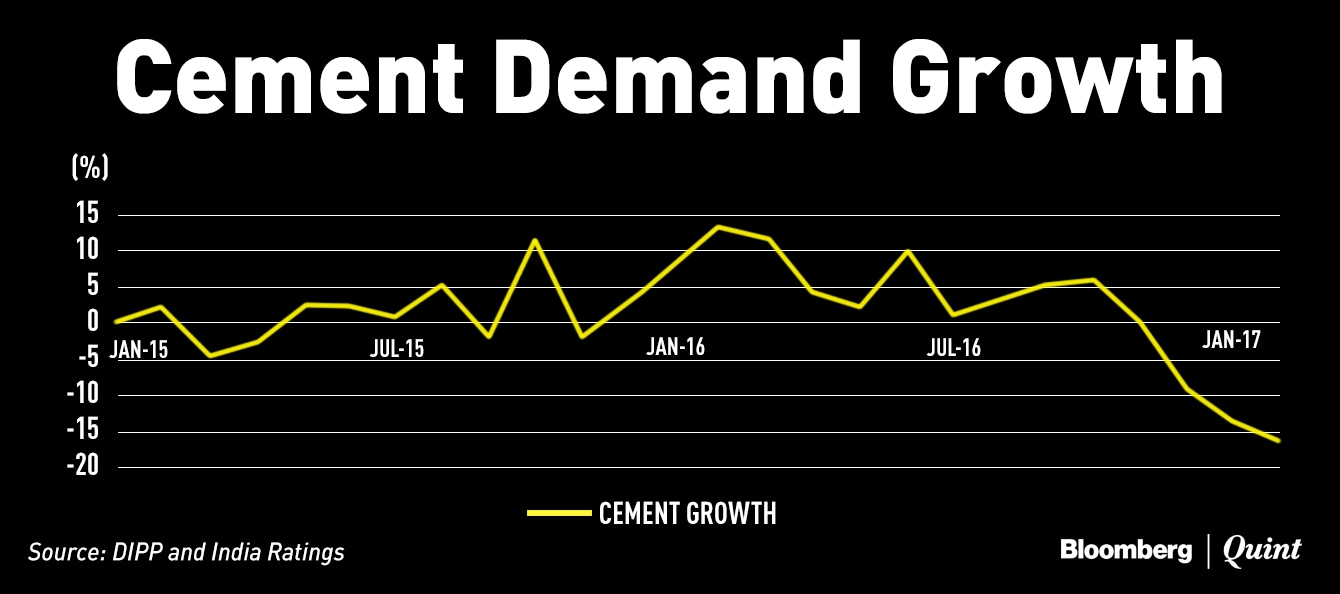
The lagged impact of the cash crunch and polls will take a toll on cement production in fourth quarter of financial year (FY) 2016-17. Latest data shows cement volumes in February 2017 declined 15.8 percent year-on-year, the most in over a decade, says India Ratings and Research.
Volumes have declined 5 percent month-on-month. India Ratings notes that the decline in cement growth is also on account of a high base last year. During January-March 2016, cement production grew by 9.2 percent, 13.5 percent and 11.9 percent year-on-year respectively. India Ratings estimates cement production to be muted in Q4FY17.
On the prices front, the wholesale price index of grey cement and slag cement has shown a softening trend through November 2016-January 2017. Cement players got some respite on the cost front, with pet-coke and coal prices showing moderation in January and February 2017, after pet-coke prices almost doubled since March 2016.
Volumes of pan-India cement players in Q3FY17 contracted 5 percent year-on-year; while those for central and north based players fell 3 percent and 6 percent respectively. The southern region in contrast showed strong volume growth of 21 percent. Growth in the southern region is led by an increase in government expenditure in the state of Andhra Pradesh and Telangana.
An analysis of the financials of cement companies in Q3FY17 by India Ratings showed that the median EBITDA per tonne of pan-India players declined marginally in Q3FY17 compared to the previous quarter, though it remained comfortable at around Rs 975 per tonne.
Median power, fuel and freight cost per tonne in Q3FY17 increased from Q2FY17 levels to Rs 977 and Rs 1,217 respectively. While the median EBITDA per tonne of the rest of India's players declined quarter-on-quarter in Q3FY17 to Rs 878; while power, fuel and freight cost per tonne in Q3FY17 declined marginally to Rs 771 and Rs 867 respectively.
India Ratings expects EBITDA per tonne of pan-India players to remain comfortable at around Rs 975-1,000; while that of players with a presence in rest of India's is likely to be around Rs 850-875 in FY18.
The credit profile, in terms of EBITDA interest coverage for pan-India players declined marginally in Q3FY17 but remained comfortable at around 11 times. The EBITDA interest coverage ratio of the rest of India cement players was stable at around 2 times at the end of Q3FY17.
On the policy front, due to the recent measures announced by the Ministry of Railways that require long term agreements/contracts for industries like cement, steel and fertilisers, cement companies may see an improvement in demand.
As per the policy, the Ministry of Railways will provide a minimum guaranteed volume linked discount, on the basis of incremental growth in gross freight revenue, in return for a commitment to provide a minimum guaranteed quantity of traffic. The discounts will range from 1.5 percent to 35 percent, as per the incremental growth in gross freight revenue.
India Ratings believes that these initiatives will increase the transport of cement through rail and cement manufacturers will be able to control freight cost more effectively. However, India Ratings notes that rake availability during peak season and railway network are likely to act as constraint to this policy.
(India Ratings and Research a wholly owned subsidiary of Fitch Group is a SEBI and RBI accredited credit rating agency operating in the Indian credit market.)

-
Unhedged Position: Can India See An Indonesia-Style Time Correction?

The Nifty is trading below levels it first clocked in 2024. Is there, then, as I have suggested in the headline, potential that the current time correction drags on painfully for the next three-five, even ten years?
-
Navigating Friction And Energy Realities: An Analysis Of Marco Rubio's October Visit To India
Occurring at a critical juncture marked by stalled trade negotiations and escalating geopolitical pressures over global energy supplies, the visit offers a profound window into modern US-India relations.
-
India Exports Capital. Why Not Export Trusteeship?
The big question, then, is whether India can build an institution that global borrowers, investors, banks, and lawyers can trust, even without an Indian connection.
-
France's Economy & Politics Are In Crisis | The Reason Why
Let's look at how the French economy and politics evolved under Nicolas Sarkozy, Franois Hollande and Emmanuel Macron.
-
You May Inherit The Business. You Must Earn Its Credibility.
Succession tests the founder's ability to share authority as much as it tests the next generation's readiness to assume it.
-
Signing Deals Is One Thing; Making Them Work Is Another | The Week In Whys
Sometimes, things don't turn out as planned. Indian companies have lost some bids to rivals, some projects won't produce until 2030.
-
FOMC Wall, PERM Suspension, Hospital Stocks | Talking Points This Week
A PERM suspension would directly affect green-card sponsorship rather than H-1B visas, so the near-term earnings impact could remain relatively limited. The key question is whether this marks a new phase in US scrutiny of Indian IT.
-
Everything, Everywhere, All At Once: Dalal Street's Week To Forget | Joining The Dots
Visa curbs, a Starlink spat and cancer drug caps: what connects this week's shocks for Indian markets
-
India Is Going Abroad For Critical Minerals. But It May Take Years To Pay Off | The Reason Why
Although India's steps are in the right direction, they remain modest compared with India's growing dependence.
-
When Everyone Has AI, What Gives You An Edge?
India's young workforce is entering an uncertain world of work where powerful AI tools are becoming widely accessible. The advantage will belong to those who combine deep expertise with digital fluency, and the distinctly human capabilities that technology cannot manufacture.