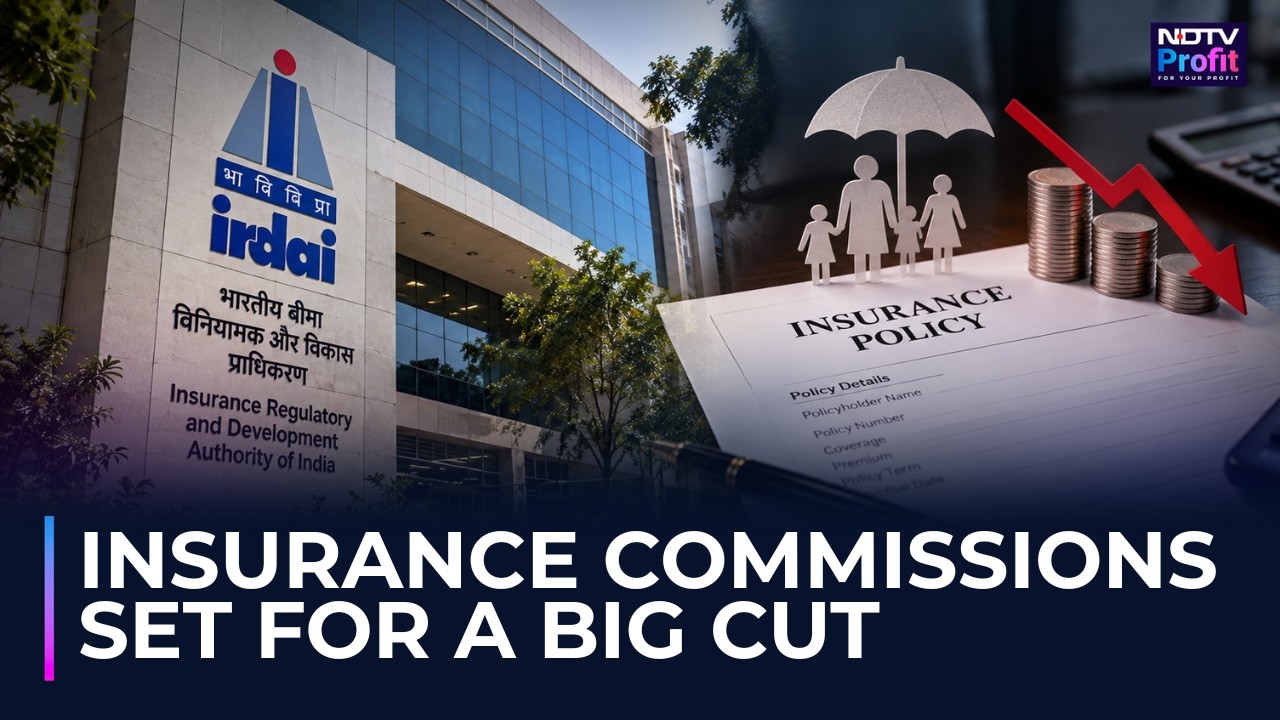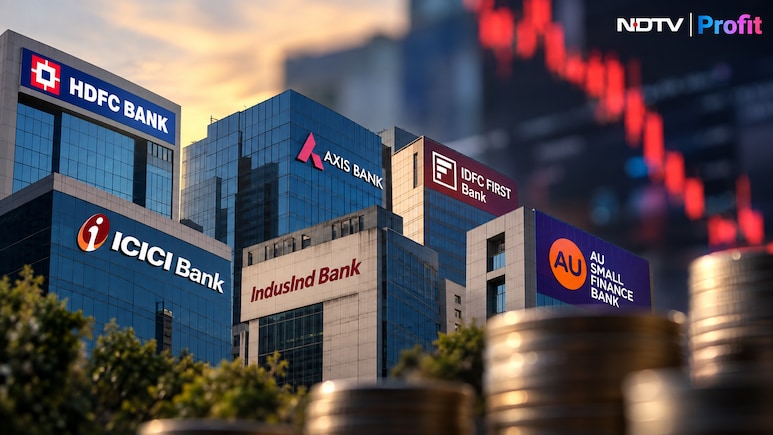
Bank Stocks Today: Bank stocks came under pressure on Thursday after the Insurance Regulatory and Development Authority of India (IRDAI) proposed tighter caps on insurance commissions and distribution-related payouts from FY28, raising concerns over the impact on banks' bancassurance income and loan-linked insurance economics.
AU Small Finance Bank shares fell 4.75% to Rs 1,003, while IndusInd Bank declined 4.69% to Rs 914.30. IDFC First Bank dropped 3.86% to Rs 84.51, while Axis Bank fell 3.49% to Rs 1,199.80. Yes Bank declined 2.67% to Rs 22.62.
Among large private lenders, HDFC Bank fell 1.42% to Rs 726.80, while ICICI Bank was marginally higher at Rs 1,342.30. Kotak Mahindra Bank declined 1.63% to Rs 406.50. PSU banks also traded mostly lower, with State Bank of India down 0.81%, Bank of Baroda 0.99%, Canara Bank 0.96% and Punjab National Bank 0.64%.
Also Read | Layoffs Are Rising In Tech, But These Skills Are Helping People Unlock Better Pay
The proposed changes could reduce the fee pool banks earn from distributing insurance products, particularly credit-protection and other loan-linked policies that typically carry relatively high commissions.
ALSO READ: Track All Stock Market Live Updates Here
Banks With Higher Insurance Income Exposure Could Face Greater Sensitivity
The potential earnings sensitivity varies across banks, based on their contribution from insurance income. FY26 data shows that insurance income accounted for 16.1% of pre-provision operating profit (PPOP) at Yes Bank, followed by IDFC First Bank at 13.7%, Axis Bank at 11.3%, IndusInd Bank at 11.2% and AU Small Finance Bank at 10.2%.
Kotak Mahindra Bank's insurance income accounted for 10.2% of PPOP, while HDFC Bank and Federal Bank reported ratios of 6.9% and 6%, respectively. ICICI Bank had the lowest exposure among the banks in the data, with insurance income accounting for 1.5% of PPOP.
In absolute terms, HDFC Bank had the highest FY26 insurance income at Rs 8,235 crore, followed by Axis Bank at Rs 4,824 crore and Federal Bank at Rs 4,325 crore. However, the percentage of PPOP provides a better indication of the potential sensitivity of earnings to changes in insurance-related income.
Jefferies: Tighter Commission Norms A Slight Earnings Risk For Banks
Jefferies said the proposed changes are likely to be slightly negative for banks' bancassurance fees, with credit-protection premiums facing particular pressure as these products are largely single-premium policies with relatively high commissions.
The brokerage noted that the IRDAI has proposed tighter caps on insurance commissions from FY28. The regulator has sought public feedback on the draft norms over the next month, with the proposed rules applying prospectively.
Based on FY26 bancassurance commissions as a proportion of normalised FY27 profit, Jefferies sees IndusInd Bank and IDFC First Bank as having relatively higher exposure. ICICI Bank and PSU banks, meanwhile, have comparatively lower exposure.
Citi: Commission Crunch To Hit Banks, NBFCs
Citi said the proposed framework could adversely affect the economics of bancassurance and credit-life products for banks and NBFCs.
According to the brokerage, the changes could reduce insurance fee pools earned from credit-life, property and other loan-linked insurance products. Proposed commission caps could compress payouts on some loan-linked insurance products to below 5%.
Citi also highlighted other provisions, including a proposed ban on compulsory bundling of insurance with other products, a requirement for customers to pay premiums directly from their own bank accounts and an all-inclusive definition of commission.
These measures could limit the ability of banks and NBFCs to generate additional insurance-related income through loan-linked products.
What Has IRDAI Proposed?
The IRDAI consultation paper on distribution reforms proposes a five-year glide path to tighten company-level Expenses of Management (EoM) limits.
For life insurers, the regulator has proposed bringing the EoM cap down to 12.5% of Gross Direct Premium Income (GDPI), compared with the existing product-level framework. For general insurers, the proposed EoM cap is 20% of GDPI, compared with the current 30%.
The regulator has also proposed mandatory cost audits and public disclosure requirements, along with explicit caps on distributor commissions and rewards.
The proposed framework would link permissible commissions to factors such as product complexity, the effort required to sell the product, the distribution architecture and the relevant product or line of business.
Importantly, all payments made to distributors would be considered under the proposed framework, limiting the scope for insurers to circumvent commission caps through separate rewards or incentives.
Why Banks Are Watching The IRDAI Proposals
The proposals matter for banks because bancassurance has become an important source of fee income, particularly through credit-linked insurance products.
If implemented in their proposed form, lower commission caps and restrictions on distribution practices could reduce the economics of these products for banks and NBFCs. The impact, however, is likely to vary across lenders depending on their dependence on bancassurance commissions and the mix of products distributed through their networks.
The FY26 insurance-income data also highlights this variation. While IndusInd Bank and IDFC First Bank have been specifically identified by Jefferies as having higher exposure to the proposed changes, several other lenders derive a meaningful share of PPOP from insurance income.
What Happens Next
The proposed changes are currently under consultation and are slated to apply prospectively from FY28. IRDAI has invited public and stakeholder feedback before finalising the framework.
Essential Business Intelligence, Sharp Market Insights, Practical Personal Finance Advice, Daily Fuel, Gold and Silver Prices and Latest Stories — On NDTV Profit.