- South Korean stocks fell 2.45% due to AI doubts, oil price rise, and foreign selling pressure
- OpenAI's lower revenue figure raised investor caution on AI earnings quality in Q3 reports
- Oil price surged after Houthi attacks, raising inflation and US rate hike concerns
South Korean stocks fell sharply on Monday as doubts over the AI boom, a jump in oil prices and persistent foreign selling combined to pressure the market's chip-heavy benchmark.
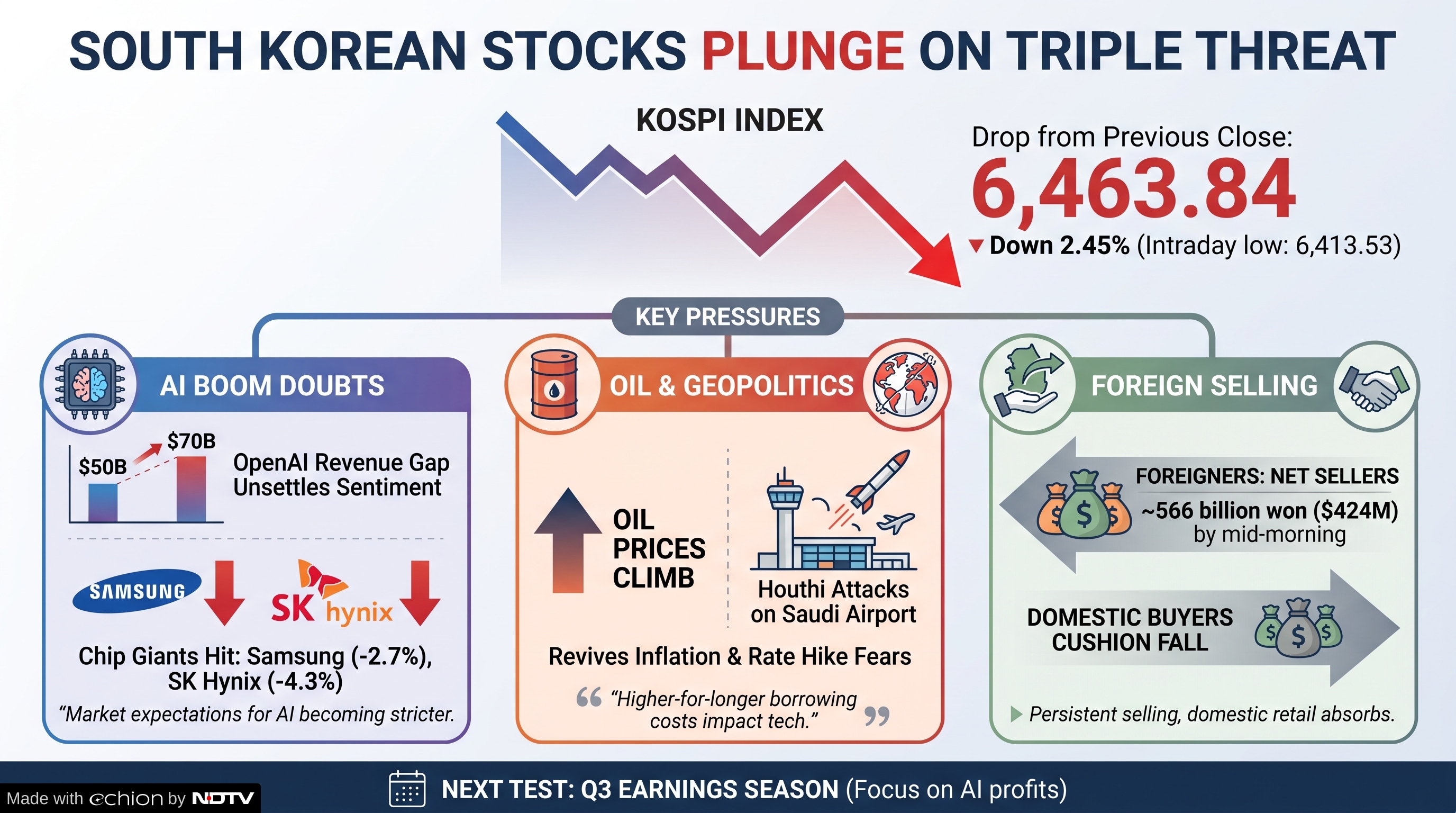
The Kospi was down 2.45%, or 162.09 points, at 6,463.84 as of 1:36 p.m. in Seoul, from a previous close of 6,625.93. It opened at 6,578.17 and hit an intraday low of 6,413.53. In early trade the index was down more than 3%.
The selloff comes despite a firm Friday on Wall Street, where the Dow Jones Industrial Average rose 0.83% and the Nasdaq Composite gained 0.64%. That suggests Seoul is reacting to its own set of pressures, not simply following US tech lower.
Also Read | Layoffs Are Rising In Tech, But These Skills Are Helping People Unlock Better Pay
1. OpenAI revenue question unsettles AI sentiment
The most direct AI trigger was OpenAI's disclosure on October 8 that its annualized revenue at the end of September was close to $50 billion. The figure was well below the roughly $70 billion that had been widely cited. OpenAI said the gap reflected differences in how revenue is recognized, not an actual fall in sales.
Analysts largely agreed the episode is more noise than substance, but said it still matters. Han Ji-young, a researcher at Kiwoom Securities, told The Chosun the episode shows that market expectations for AI are becoming stricter, and that investors should prepare for greater sensitivity to earnings quality during the third-quarter reporting season.
The market's two heavyweights felt it most. By mid-morning, Samsung Electronics was down about 2.7% at 255,250 won and SK Hynix was down about 4.3% at 1.609 million won. Together the two companies account for more than half of the Kospi's weight, so even modest moves in either can swing the whole index.
ALSO READ: 'Hot Money Leaving Emerging Markets': Five Reasons Behind FII Exodus Crossing Rs 3 Lakh Crore
2. Oil and Middle East tensions revive inflation fears
The second factor is outside tech. Oil prices climbed after renewed Houthi attacks on Saudi Arabia's main airport over the weekend. A broader regional conflict could disrupt energy supplies, stoke inflation and add pressure on the US Federal Reserve to raise interest rates.
That matters for richly valued growth and technology stocks, which are especially sensitive to the prospect of higher-for-longer borrowing costs. It also explains why the weakness was not confined to chipmakers. Shipbuilder HD Hyundai Heavy Industries and defense firm Hanwha Aerospace both fell in the morning session. Some energy-sensitive names bucked the trend: shipping line HMM jumped more than 5% and carmaker Kia rose.
Momentum stocks, partocularly those benefitting from the AI trade, could be the first in the line of fire if yields go higher, said Kranthi Bathini, director - equity strategy, WealthMills Securities, while speaking to NDTV Profit. As US Treasury yields hit two-decade highs, the stocks that rose on cheap money face the biggest test, he explained. “If yields rise beyond 6%, it's going to have an adverse impact on global equity universe. The stocks that have seen momentum in recent period, particularly the chip stocks, will come under pressure and the AI trade is likely to slow down."
3. Foreign investors keep selling
The third factor is the steady retreat by overseas investors. Foreigners have been net sellers of Korean stocks every day this month, and they continued on Monday. Data from the Korea Exchange showed they had net sold about 566 billion won ($424 million) by 10:30 a.m.
Domestic buyers cushioned the fall. Individual investors were net buyers of roughly 313.7 billion won, while institutions added about 69.3 billion won. The pattern, in which retail investors absorb what foreigners sell, has been a recurring feature of Korea's volatile trading this year.
The won, by contrast, was not under visible pressure. It traded around 1,335 per dollar, stronger than the previous session's close, which suggests the selling was driven by sector and global sentiment, not a currency scare.
In the near future, traders will look to the third-quarter earnings season for clearer evidence on whether the AI-driven rally can be justified by profits. Memory chipmakers such as Samsung and SK Hynix have been among the biggest beneficiaries of the AI spending wave, and their results will be read as a barometer for the hardware side of the trade.
ALSO READ: AI Trade's Weak Link Isn't Chips, It's Debt: Who Is Most Exposed If Yields Keep Climbing
Essential Business Intelligence, Sharp Market Insights, Practical Personal Finance Advice, Daily Fuel, Gold and Silver Prices and Latest Stories — On NDTV Profit.