When I was eleven, my father, K.C. Pant, told me that sustaining a brand comes down to two things. First, do only what you are best at. Second, be consistent: never step outside the boundary that the first rule defines. He said it the way he said most important things, briefly and once. It took me decades in boardrooms to recognise that he had handed me an algorithm, and longer still to see that he had been describing his own father.
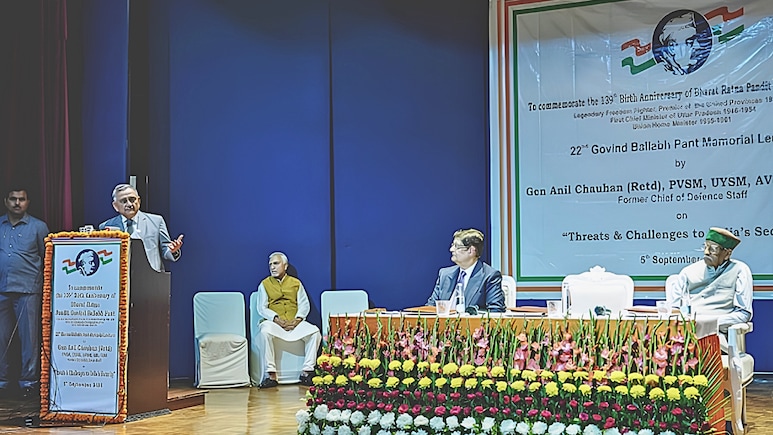
September 10, 2026, was the 139th birth anniversary of Bharat Ratna Pandit Govind Ballabh Pant. By mid-morning the Chief Minister of Uttar Pradesh had laid flowers at his statue at Lok Bhavan in Lucknow, recalling the young lawyer who defended the Kakori revolutionaries in 1925. The Chief Minister of Uttarakhand had remembered his campaigns against coolie begar and zamindari. Tributes came from Haryana, Rajasthan and beyond. Five days earlier, on 5 September, General Anil Chauhan, who retired as Chief of Defence Staff in May, delivered the 22nd Pant Memorial Lecture to a full auditorium at Teen Murti Bhawan, on Threats and Challenges to India's Security.
The question that has stayed with me, mid-clause, for years is simple to state and hard to answer. How does a legacy that began in the Kumaon hills before the First World War remain live, not merely honoured, more than a century later? Most Indian political reputations decay into street names within a generation. This one is still summoned to the table whenever the country talks seriously about its security. I want to test my father's algorithm against that century of evidence, and against the best global thinking on why some brands outlast the people who built them.
Also Read | Layoffs Are Rising In Tech, But These Skills Are Helping People Unlock Better Pay
The algorithm, and those who later wrote it down
Marketing science reached my father's two rules long after he did. In 1998 Al and Laura Ries published The 22 Immutable Laws of Branding. Their Law of Contraction holds that a brand grows stronger as its focus narrows; their Law of Consistency holds that brand success is "measured in decades, not years." In Good to Great, Jim Collins borrowed Isaiah Berlin's hedgehog, the creature that knows one big thing, and showed that enduring companies find the single thing they can be best in the world at and decline everything else. Earlier, with Jerry Porras in Built to Last, Collins had compressed the mechanics of longevity into one instruction: "preserve the core and stimulate progress."
Kevin Lane Keller's Brand Report Card names the tension every legacy must manage: a strong brand must stay consistent and it must stay relevant, and the two pull in opposite directions. Jean-Noel Kapferer resolves the tension by separating a brand's kernel, which must never move, from its peripheral traits, which must. Douglas Holt, studying how brands become icons, adds the insight most relevant to public life: icons embody a story that resolves an anxiety of their era. And Nassim Nicholas Taleb supplies the arithmetic of survival in the Lindy effect: for things that do not perish, every year survived lengthens life expectancy.
Taken together, these ideas yield a proposition that can be tested. A legacy endures when it owns one function, its kernel; when that function answers a permanent anxiety of the nation, its category; and when each generation of custodians changes the instruments while refusing to change the function. Consistency, in other words, is transmission, not repetition. Now the evidence.
What G.B. Pant was best at
It is tempting to say he was best at service or nation-building. Both are true and both are useless, because they belong to everyone. The discipline of the first rule is specificity. Read end to end, Pant's life was organised around one capability: holding a vast and fractious polity together without breaking it. His function was the internal integrity of the Union, which is to say order secured by consent.
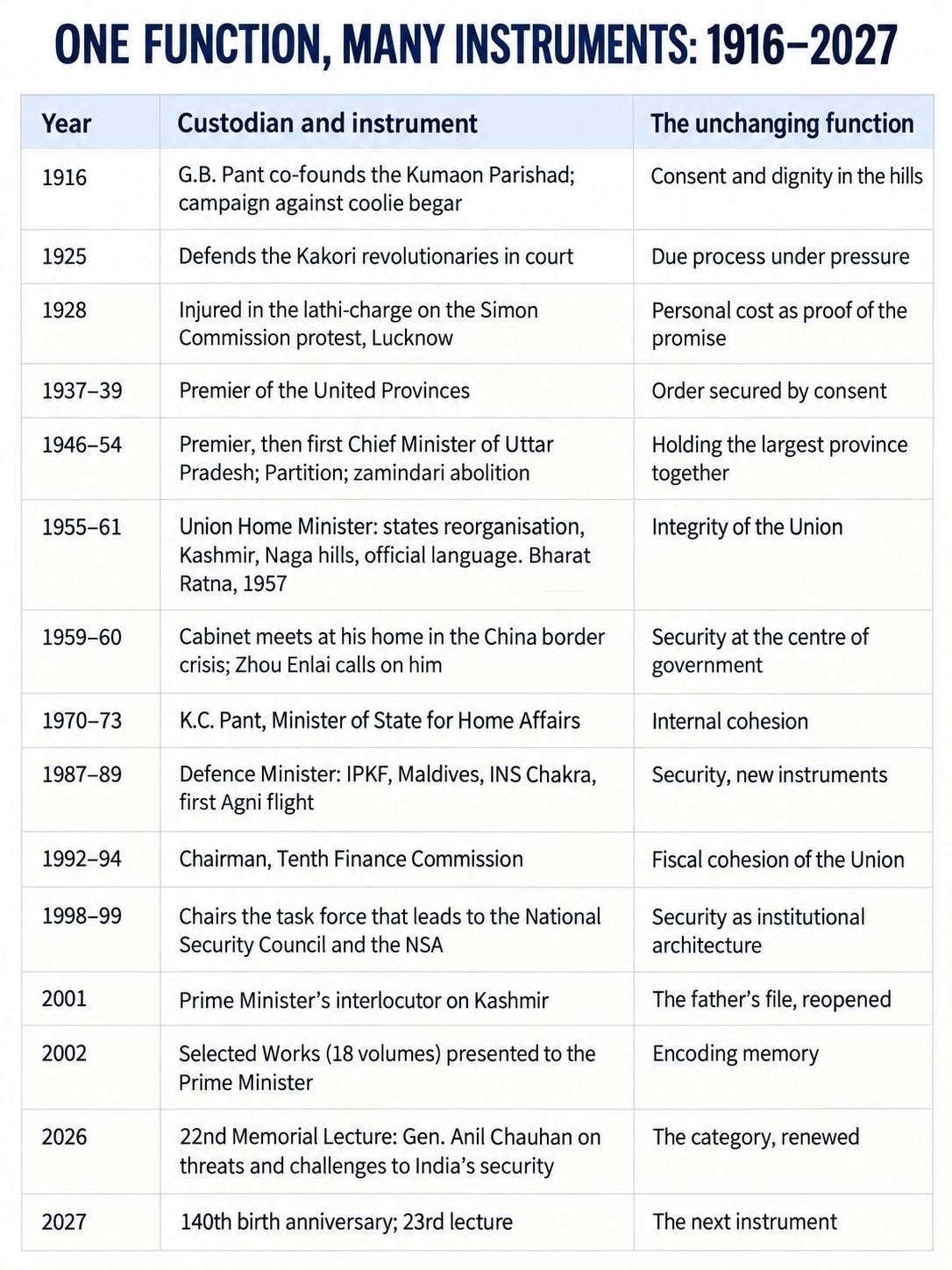
The pattern is visible early. In 1916 he helped found the Kumaon Parishad, which went on to fight the forced-labour system of coolie begar. In 1925 he defended the Kakori revolutionaries in court, a lawyer's faith in procedure put to the service of rebellion. In 1928 he took the police lathis at the Simon Commission protest in Lucknow, injuries that troubled him for the rest of his life. As Premier of the United Provinces from 1937, and again from 1946 as the province became Uttar Pradesh, he governed India's most populous region through Partition and carried zamindari abolition through the legislature: a revolution in land relations delivered by statute rather than by street.
Then, from 1955 to 1961, the Home Ministry: the reorganisation of states on linguistic lines, Kashmir, the Naga insurgency, the official-language settlement. Each was a stress test of whether the young Republic would hold. The Bharat Ratna came in 1957.
The most revealing document in our archive is not Indian. On 10 November 1959, as the border dispute with China turned violent, The New York Times profiled him as India's tower of strength, borrowing Nehru's own description. The paper reported that Nehru's Cabinet had just met in emergency session on the border crisis at Pant's home, a choice it suggested nobody thought twice about. It described a parliamentarian who "often defeats but never humiliates his political adversaries."
In brand terms, that sentence is the personality facet of Kapferer's identity prism: firmness without contempt. It is also a precondition of the function. Nobody holds a country together by humiliating the people he defeats.
Five months later, in April 1960, Zhou Enlai came to Delhi for boundary talks and called on the Home Minister. The file on the table was a frontier that had never been jointly defined.
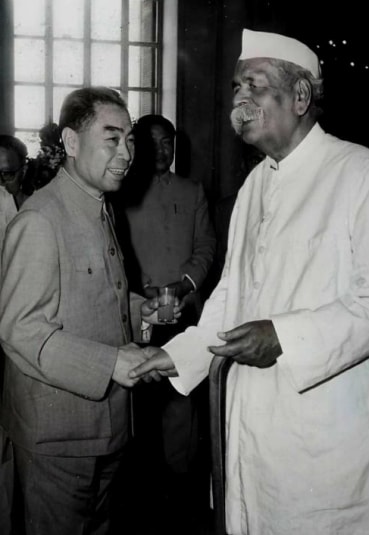
Pandit Govind Ballabh Pant receives a visiting leader in New Delhi.
Photo Credit: Pant family archive.
The oft-told story of the tea bill belongs here too, because brands are proven in small change. As Chief Minister, the story goes, Pant allowed the government to pay for the tea served at an official meeting but refused to pass the charge for the snacks, which he had ordered himself, and paid for them from his own pocket. The treasury, he told his officials, belonged to the people. A few annas is not policy. It is evidence that the boundary was real.
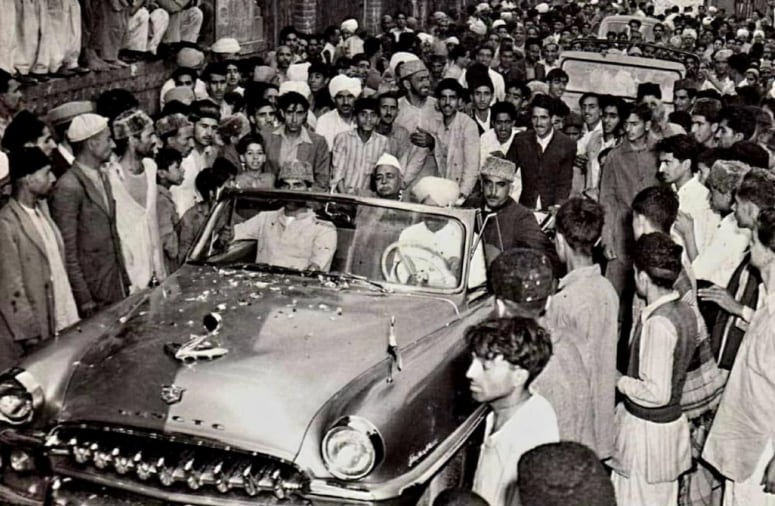
Pandit Pant amid a welcoming crowd.
Photo Credit: Pant family archive.
The second generation: consistency is not repetition
The hardest test of the second rule is succession. Most legacies fail it in one of two ways. Either the heir freezes, imitating the founder in a world that has moved on, or the heir stretches, spending the name on things it was never about. Marketers call the second failure line extension, and Al Ries has spent a career arguing that it is the commonest way strong brands die.
My father did neither. He served in the Home Ministry only as a Minister of State, in the early 1970s, and he never traded on the name for its own sake. Instead he carried the same kernel, the security and integrity of the Union, into instruments his father never had. As Defence Minister from 1987 to 1989 he oversaw the IPKF in Sri Lanka and the rapid deployment that reversed a coup in the Maldives. In January 1988 the Navy commissioned INS Chakra, the leased Soviet boat on which Indian crews learnt to operate a nuclear-powered submarine. On 22 May 1989 he was at Chandipur when the first Agni flew. As Chairman of the Tenth Finance Commission he worked on the fiscal compact between the Union and the states, the cohesion question in its budgetary form. In 1998, the year of Pokhran-II, the Vajpayee government asked him to chair the task force whose recommendations produced India's National Security Council and the office of National Security Adviser. In 2001 he became the Prime Minister's interlocutor on Kashmir, the file his father had carried as Home Minister.
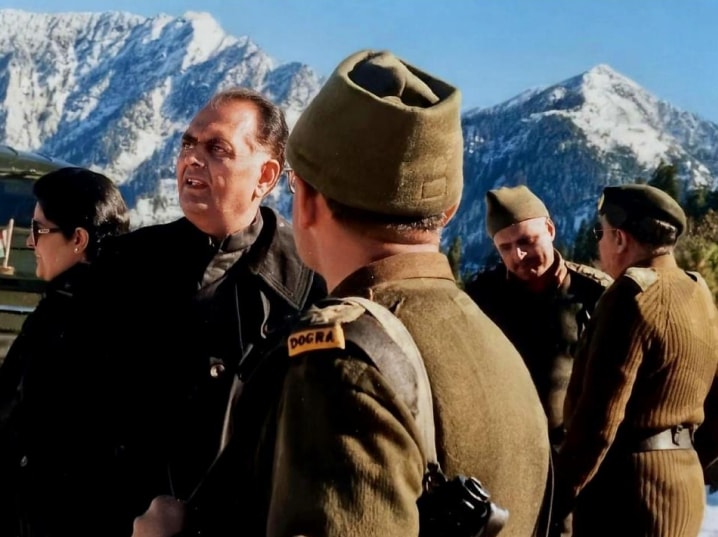
K.C. Pant with troops of the Dogra Regiment in the high mountains.
Photo Credit: Pant family archive.
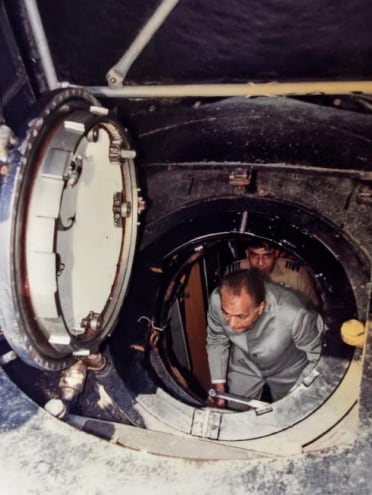
K.C. Pant climbs through a submarine hatch.
Photo Credit: Pant family archive.
That career changed parties and portfolios. It never changed category. It is Collins and Porras's formula in practice: the founder's instrument was the Home Ministry; the son's were missiles, submarines, fiscal federalism and institutional design. The kernel did not move, while the periphery moved a great deal. Consistency of this kind has a price, paid in the attractive detours one declines.
There is a subtler lesson in the fact that the security-council task force was commissioned by a government led by a party my grandfather never belonged to, and that so many of today's tributes came from the same side of the aisle. A brand anchored to a faction rises and falls with that faction. A brand anchored to a national function becomes, over time, a public good that every government can draw upon. That is Holt's point translated into Indian politics: the story Pant embodies, steadiness in upheaval, is not a party's story. It belongs to the Republic.
Teen Murti, 5 September 2026
Which brings me to last Saturday. General Chauhan, India's second Chief of Defence Staff, spoke in the house where Nehru lived, now a museum of all our prime ministers. He drew a distinction I found as useful for boardrooms as for barracks. A threat, he said, is immediate, visible and identifiable, and it demands action. A challenge is long-term, diffuse and evolving; it may not need an immediate military answer, but if neglected it matures into a threat. In his framing Pakistan remains a threat for the foreseeable future, one that a new trilateral defence pact with Saudi Arabia and Turkiye risks making overconfident. China is the longer and more comprehensive challenge. He noted that there is still no mutually agreed definition of the Line of Actual Control. Sixty-six years after Zhou Enlai called on the Home Minister, the file remains open.
He went further. He warned of what he termed cognitive colonialism, the effort to shape how a society understands itself, whom it trusts and how it imagines its future, targeting minds rather than territory. He described the conflicts ahead as "a different kind of war", fought through cyber, electronic, space, economic, legal and information instruments that often substitute for physical attack. And he argued that a nation's attractiveness is insufficient without strength, which he defined not as aggression but as the capacity to protect, deter and decide well, so that a secure country can engage the world without losing its identity.
I did not choose the lecture's subject to prove a thesis about brands, yet the thesis proved itself. Asked to honour Pandit Pant, a former Chief of Defence Staff reached naturally for India's security; introducing him, I found myself recalling the council my father had helped design. After twenty-two editions, with a single speaker each year and no separate chief guest, the lecture has become what Byron Sharp and Jenni Romaniuk would call a distinctive asset: a fixed ritual, in a fixed season, in a fixed register, that keeps a legacy mentally available without a rupee of advertising.
Seven propositions for legacy brands
What generalises beyond one family? I offer seven propositions, drawn from this evidence and tested against a working life spent advising boards and family enterprises. If I had to compress them into a single line for a board, it would be this: durability is the product, not the sum, of three things, namely the clarity of the kernel, the permanence of the category and the restraint of the custodians. Because it is a product, a zero in any one of them is fatal, however large the others.
First, own a function, not a fame. Fame is a rented asset; function is owned. The Rieses argue that a brand should own a word in the mind, as Volvo owns safety. The Pant name owns something close to steadiness under stress. Every heir and every enterprise should be able to name its word, and should worry if it takes more than one.
Second, choose a category the country cannot outgrow. Brands tied to a passing need die with it. The security and integrity of the Union is a permanent national anxiety, and General Chauhan's taxonomy of threats and challenges shows the category renewing itself with every generation of technology. Longevity is a property not only of the brand but of the question the brand answers.
Third, treat consistency as a transmission protocol, not a costume. The second generation should not re-enact the first; it should carry the kernel into new instruments. The Home Ministry of 1955 and the National Security Council of 1999 look nothing alike. They answer the same question.
Fourth, encode the legacy in institutions, because people perish and institutions compound. G.B. Pant's name is carried by India's first agricultural university at Pantnagar, by a hospital in Delhi and by a Himalayan environment institute; his words live in eighteen volumes of Selected Works, presented to Prime Minister Vajpayee in December 2002. K.C. Pant's most durable monument is an organisation chart. The Lindy effect works only for things that do not perish, and institutions are how a mortal reputation becomes non-perishable.
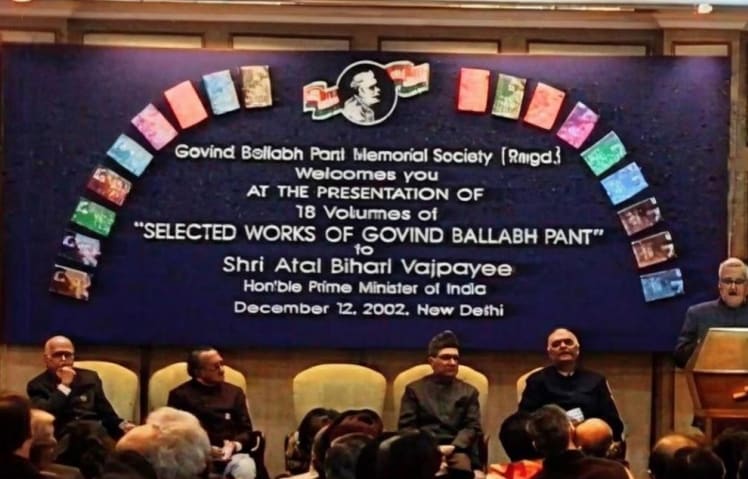
The presentation of the 18-volume Selected Works of Govind Ballabh Pant to Prime Minister Atal Bihari Vajpayee, New Delhi, 12 December 2002.
Photo Credit: Pant family archive.
Fifth, prove the promise in small change. Citizens, like customers, do not audit strategy; they audit incidents. The tea bill persuades more than any manifesto. For a company the equivalent is how it treats a small supplier's invoice or a minority shareholder's letter.
Sixth, make restraint the custodian's first duty. My father's second rule applies with most force to heirs. Legacies seldom die by attack; they die by over-extension, when a descendant spends the name on ventures, causes or claims it was never about. The Rieses' law of mortality holds that no brand lives forever. In families, that law is usually enforced from the inside.
Seventh, welcome contestation and fear evasion. Pant's record has contested chapters. Even in 1959 the Times noted that some younger Congressmen thought him a reactionary, and historians still argue over the official-language settlement and over the events at Ayodhya in 1949, during his chief ministership. A legacy that can be discussed honestly is sturdier than one that can only be celebrated. Cognitive colonialism, in a family as in a nation, begins when others are left to narrate your story because you would not.
What my father meant
Applied to reputations, General Chauhan's distinction is clarifying. The threats to a legacy are visible: scandal, misappropriation, vulgarisation. Families generally know how to respond to those. The challenges are slower and more dangerous: forgetting, irrelevance, and the quiet rewriting of meaning by people with other purposes. Archives, lectures and honest scholarship are the only defences I know against challenges of that kind.
Next September will mark the 140th anniversary, and we are planning the 23rd lecture in Delhi. Its format will not change, because the format is part of the promise. Its subject will, because the world has. That is the entire algorithm, and I now understand why my father believed an eleven-year-old could hold it. Do only what you are best at. Never step outside that boundary. And if what you are best at is something your country will always need, the century will take care of itself.
A legacy is not what a family remembers. It is what a republic keeps using.
About the Author: This piece by Ranjan Pant, grandson of Bharat Ratna Pandit Govind Ballabh Pant and son of former Defence Minister K.C. Pant, explores a compelling question: Why do some brands, institutions and legacies endure across generations while others fade?
Ranjan Pant is a board director and independent CEO advisor. He organises the annual Bharat Ratna Pandit Govind Ballabh Pant Memorial Lecture.
Essential Business Intelligence, Sharp Market Insights, Practical Personal Finance Advice, Daily Fuel, Gold and Silver Prices and Latest Stories — On NDTV Profit.