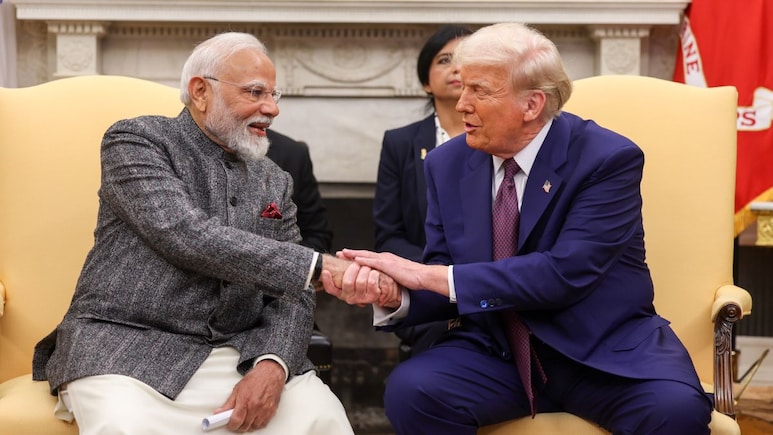
Prime Minister Narendra Modi is set to meet US President Donald Trump in France on the sidelines of G7 summit, the White House announced Saturday.
The summit, to be held June 15 to 17 in the French town of Evian-les-Bains, will bring together leaders from the world's major economies.
It will be the first face-to-face meeting between the two leaders since the India-Pakistan conflict last year.
Also Read | Layoffs Are Rising In Tech, But These Skills Are Helping People Unlock Better Pay
A Trump administration official separately told local media that the two leaders will have an opportunity to discuss trade, and that the US is planning a trip to India to make progress on a bilateral trade deal.
PM Modi departed for France and Slovakia on Saturday.
Crucial For India-US Trade Deal
The meeting also comes at a significant moment in India-US trade relations.
Earlier, Trump said that Washington and New Delhi would finalise a comprehensive trade agreement.
"For years, India took advantage of the United States. They charged us tremendous tariffs and paid nothing," Trump told media, before adding that the dynamics had since shifted: "Now it is the exact reverse and we are making a lot of money with India."
Recently, a US delegation had concluded four days of trade negotiations in New Delhi with Commerce Ministry describing the talks as marked by "a spirit of cooperation and pragmatism,"
ALSO READ: 'We Have Good Relationship': Trump Praises PM Modi, Says India And US Will Get To Trade Deal
The two countries had struck a significant breakthrough in February, finalising a trade deal worth more than $500 billion under which the US agreed to reduce its reciprocal tariff on India from 25% to 18%, while India committed to bringing its tariffs and non-tariff barriers on American goods to zero.
US Supreme Court Struck Down Tariffs
The trade backdrop, however, shifted dramatically when the US Supreme Court struck down Trump's sweeping tariffs in a 6-3 ruling, dealing a significant blow to his trade agenda.
The court held that Trump had exceeded his authority by imposing the levies under the 1977 International Emergency Economic Powers Act (IEEPA), a law meant for use in national emergencies.
The Section 301 Hurdle
Moreover, even as both sides push toward a deal, a significant procedural hurdle remains.
The first phase of the India-US bilateral trade agreement unlikely to be finalised until the conclusion of two unilateral investigations launched against India by the US Trade Representative (USTR) under Section 301 of the US Trade Act of 1974, sources familiar with the matter said.
Section 301 is powerful provision that allows Washington to probe whether another country's trade policies are unfair or restrictive to American commerce.
India is currently under scrutiny on two counts: alleged failures in eradicating forced labour from global supply chains, and excess manufacturing capacity. On June 2, the USTR proposed imposing 12.5% tariffs on 54 countries, including India, on the forced labour count.
The second probe's findings are still awaited. The timeline carries urgency, the temporary 10% additional tariffs currently imposed by the US are set to expire on July 24, after which only standard MFN tariffs will apply.
If Washington wants further levies on Indian goods beyond that date, the Section 301 investigations will need to be wrapped up first.
ALSO READ: US Deal 'Won't Be Signed On Sunday', Iran Contradicts Pakistan's Claim On Peace Talks
Essential Business Intelligence, Sharp Market Insights, Practical Personal Finance Advice, Daily Fuel, Gold and Silver Prices and Latest Stories — On NDTV Profit.