- HDFC Bank is the worst Nifty Bank performer, down 26% YTD, dragging Nifty by 915 points
- Mutual funds hold 37% of HDFC Bank shares, impacting nearly every diversified equity fund
- Top mutual funds have high HDFC Bank exposure, with Nippon Large Cap Fund at 9.91% AUM
HDFC Bank has emerged as the single biggest drag on the Nifty this year, with the stock down 26% on a year-to-date basis, making it the worst performer in the Nifty Bank index.
The scale of the damage is visible at the index level. Nifty has fallen 1,915 points YTD, and HDFC Bank alone has accounted for 915 points of that decline, a reflection of its outsized 10.3% weightage in the index. The stock is currently trading below all its key moving averages, with the RSI also sitting below the 40 mark.
Who Really Owns HDFC Bank?
HDFC Bank is entirely public-owned, with 45.3 lakh shareholders, of whom 44.4 lakh are individual investors. Mutual funds hold close to 37% of the stock through various schemes, with 59 mutual funds now owning shares in the counter, up from 51 in December 2025.
Also Read | Layoffs Are Rising In Tech, But These Skills Are Helping People Unlock Better Pay
The value of mutual fund holding in HDFC Bank stands at nearly Rs 4.1 lakh crore, which works out to 10.6% of total equity-oriented scheme AUM and 4.7% of the entire mutual fund industry's AUM. In other words, when HDFC Bank falls, it does not just move the index, it moves the value of nearly every diversified equity mutual fund in the country.
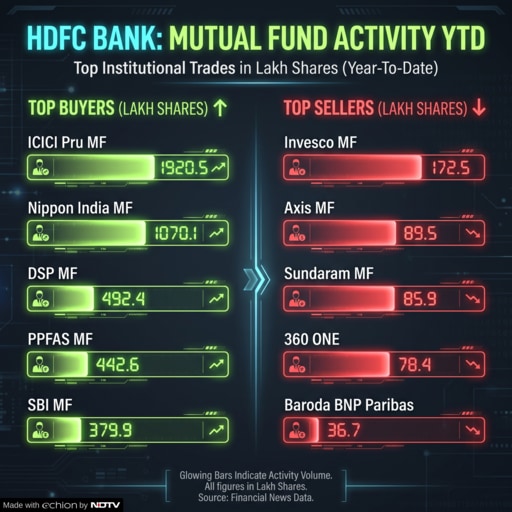
A host of mutual funds are exposed to HDFC Bank, as they have tried to buy the dip.
Photo Credit: NDTV Profit
Among the funds with the highest single-stock exposure to HDFC Bank are Nippon Large Cap Fund at 9.91% of AUM, Mirae Asset Large Cap at 9.43%, Parag Parikh Flexi Cap at 8.3%, SBI Large Cap Fund at 8.7% and HDFC Large Cap Fund at 7.92%.
Mutual Funds Bought The Dip, Some Got Out
On a YTD basis, mutual funds have net bought 55.4 crore shares of HDFC Bank, equivalent to a 3.6% stake. ICICI Prudential MF and Nippon India MF led the buying, adding 1,920.5 lakh shares and 1,070.1 lakh shares respectively, followed by DSP MF, PPFAS MF and SBI MF. On the other side, Invesco MF, Axis MF, Sundaram MF, 360 ONE and Baroda BNP Paribas were net sellers over the same period.
The Ownership Mix Is Also Shifting
FII holding in HDFC Bank has fallen from 48.8% in December 2025 to 41.8% in June 2026, while domestic institutional investors have picked up the slack, rising from 35.8% to 41.8% over the same period. Public shareholding has also edged up, from 15.2% to 16.3%.
Separately, the Reserve Bank of India has approved LIC's request to raise its stake in HDFC Bank from 4% to 10%, giving the insurer significant headroom to add to its holding.
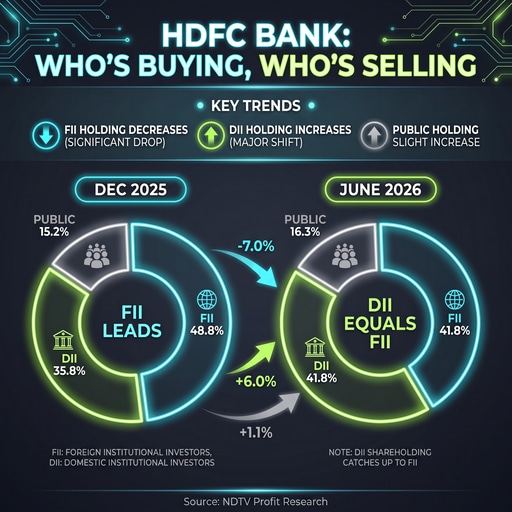
HDFC Bank ownership is changing.
Photo Credit: NDTV Profit
Why HDFC Bank Has Struggled
Several factors have weighed on the stock through the year: governance concerns following Chairman Atanu Chakraborty's exit, delay in clarity on chief executive Sashidhar Jagdishan's reappointment, a moderation in loan growth aimed at improving balance sheet metrics, changes in the funding mix that have slowed profitability, a continuous decline in low-cost deposits, range-bound margins, and yields on assets on a downward trend over the last five quarters.
But Analysts Remain Overwhelmingly Bullish
Despite the underperformance, 48 of 49 analysts tracking HDFC Bank, or 98%, have a BUY rating on the stock. The 12-month consensus target price stands at Rs 1,025, implying an upside of 41% from current levels. Analysts note HDFC Bank offers the highest return potential within the Nifty Bank index.
Valuations also appear attractive by historical standards. The stock's price-to-book ratio has fallen from 2.8x a year ago and a five-year average of 2.9x to 1.8x currently, with the one-year forward P/B at just 1.7x.
ALSO READ: LIC Receives RBI Nod To Raise HDFC Bank Stake To 9.99% — Details Inside
Essential Business Intelligence, Sharp Market Insights, Practical Personal Finance Advice, Daily Fuel, Gold and Silver Prices and Latest Stories — On NDTV Profit.