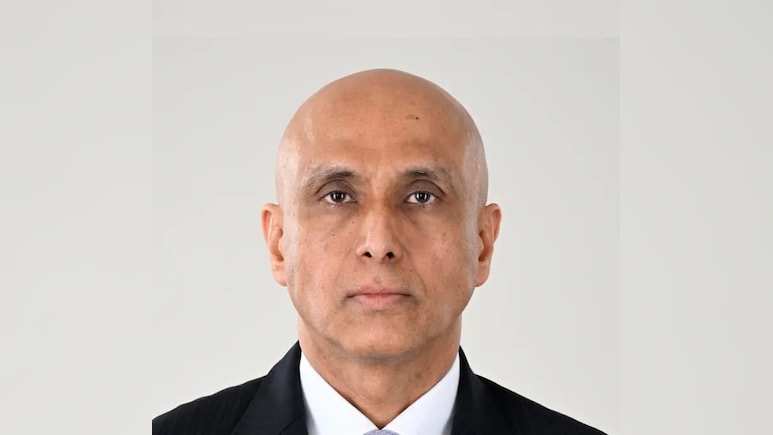
Adani Group Chief Financial Officer Jugeshinder Robbie Singh has pushed back against comparisons between artificial intelligence startup Anthropic's $1.5 trillion valuation and the combined market capitalisation of India's top 10 companies, calling it a "category error" in asset pricing.
In a post on X, Singh argued that traditional Indian blue-chip companies and frontier artificial intelligence firms operate in fundamentally different economic regimes, making a direct comparison misleading.
His remarks came in response to a post by Kotak Mahindra Bank founder Uday Kotak, who questioned whether India was undervalued or needed to catch up with the changing global economic landscape after Anthropic's reported valuation surpassed the combined market capitalisation of the country's 10 largest companies.
Also Read | Layoffs Are Rising In Tech, But These Skills Are Helping People Unlock Better Pay
ALSO READ: Thousands Of Anthropic Staff Poised To Become Millionaires Ahead Of $1.5 Trillion Nasdaq Debut
"Comparing Anthropic's $1.5T valuation to India's top 10 corporates as 'undervaluation' vs. 'catching up' is a textbook category error in asset pricing," Singh wrote.
Firstly, from @AdaniOnline congrats to @AnthropicAI Second, Cross-Regime Category Error: Why Legacy Bankers Can't Price Synthetic GDP Comparing Anthropic's $1.5T valuation to India's top 10 corporates as "undervaluation"vs. "catching up" is a textbook category error in asset pricing. It benchmarks a convex call option on synthetic Labor in a new economic substrate against discounted cash flow (DCF) claims on a human-constrained economy. 1. The Ceiling of Human-Economy Equities Traditional blue chips (banking, energy, staples) are linear yield vehicles anchored to biological human GDP. Growth is capped by demographics, credit penetration, physical consumption, and waking hours—priced via mean-reverting multiples (P/E, EV/EBITDA). Calling them "undervalued" next to frontier AI is like calling Mumbai real-estate undervalued next to the discovery of thermodynamics. 2. Anthropic as a Call Option on Synthetic GDP (Yₛ) Cognitive labor is decoupling from human population growth. Frontier models aren't SaaS tools; they are the "infrastructure of intelligence" for a parallel synthetic workforce (Yₛ) operating above human output (Y_Total = Yₕ + Yₛ). At $1.5T, markets aren't capitalizing EBITDA. Using Black-Scholes intiution Wall Street is pricing implied volatility and right-tail convexity of a 24/7 digital workforce scaling at the marginal cost of compute. @AdaniOnline , we are already operationalizing this reality through our cobotic workforce model—a dual-track organizational architecture weaving human creativity with autonomous AI agents and robotics across our utilities, ports, and operations, upskilling 11000+ professionals annually to lead a ybrid industrial paradigm. 3. The 1999–2020 Precedent: Euphoria Still Underprices Regime Shifts In 1999, Mary Meeker and Dow 36,000 were mocked as peak-bubble delusion when global e-commerce was ~$150B, internet penetration was 5% (277M users), and $1T tech firms seemed impossible. When the NASDAQ peaked at 5,048 in March 2000 and crashed 78% (wiping out ~$5T and bankrupting https://t.co/cTFPLaPK4w and Webvan), legacy finance declared the thesis dead. Yet by 2020, reality crushed 1999's wildest models: 4.5B+ internet users (57% of humanity), $4.2T+ in annual e-commerce, >60% digital ad share, and core winners (Apple, Microsoft, Amazon, Alphabet) compounding into a $16T+ asset class. Legacy allocators mistook the 2000 clearing event for a ceiling, missing a new digital GDP layer. 4. The Epistemological Blind Spot of Legacy Bankers & Capital This is classic lender-mindset orthodoxy: mistaking backward-looking accounting ratios for capital creation. Allocators trained in capital-scarce banking worship trailing multiples, static book value, and incremental yield—dismissing any paradigm-building capex cycle that breaks 20th-century spreadsheet as a "bubble." While legacy finance debates scoreboards in the rear-view mirror, we have laid out our $100B+ (₹10 lakh crore) roadmap for the "Infrastructure of Intelligence"—mastering the full physical-to-digital stack from Port to Power to Metals to Processor, integrating gigawatt-scale renewable energy, grid transmission, and hyperscale liquid-cooled AI data centers (scaling toward 5 GW). Because intelligence is written in code, but it runs on electrons and sovereign infrastructure. India's blue chips are neither undervalued nor "behind"—they are yield vehicles monetizing the physical human economy, while those building the energy-and-compute backbone are underwriting the new substrate of an add-on synthetic economy. You cannot measure a non-linear dimension with a static ruler built for the old world ( much like 2000, clearing out will occur here too). Scientifically, Ai is a bigger shift, akin to development of scientific method in 16th century thus an order of magnitude a greater opportunity.
— Jugeshinder Robbie Singh (@jugeshinder) November 19, 2026
He explained that traditional businesses, including banking, energy and consumer staples, generate returns within an economy constrained by population growth, consumption, credit penetration and human working hours. Their valuations are generally assessed through conventional measures such as price-to-earnings and EV/EBITDA multiples.
Anthropic, on the other hand, represents what Singh described as a "call option on synthetic GDP". He argued that advances in frontier AI models could create a digital workforce capable of operating around the clock, increasingly decoupling economic output from human population growth.
According to Singh, investors are not simply valuing the company's existing earnings but are also pricing in the possibility of a much larger market for AI-driven cognitive labour.
Singh also linked the AI opportunity to Adani Group's own business strategy, highlighting its plans to build infrastructure supporting the expansion of artificial intelligence.
He said the group was already implementing a "cobotic workforce model", combining human capabilities with autonomous AI agents and robotics across its utilities, ports and other operations. The group, he added, upskills more than 11,000 professionals annually to prepare for this industrial transition.
Singh pointed to Adani Group's $100 billion-plus (around ₹10 lakh crore) investment roadmap for what he called the "infrastructure of intelligence".
The plan involves developing capabilities across the physical and digital infrastructure chain, including ports, power, metals, renewable energy, grid transmission and hyperscale AI data centres. He also referred to ambitions to scale data centre capacity towards 5 GW, supported by gigawatt-scale renewable energy and liquid-cooled computing infrastructure.
"Because intelligence is written in code, but it runs on electrons and sovereign infrastructure," Singh wrote.
To support his argument, Singh drew parallels with the internet boom of the late 1990s and the subsequent expansion of the digital economy.
He pointed out that the Nasdaq's collapse in 2000, following its March peak of 5,048, wiped out trillions of dollars in market value and led many investors to question the long-term promise of internet businesses.
However, the following two decades saw internet adoption, e-commerce and digital advertising expand dramatically, with companies such as Apple, Microsoft, Amazon and Alphabet emerging as some of the world's most valuable businesses.
Singh argued that investors who interpreted the dot-com crash as the end of the internet opportunity failed to recognise the scale of the economic transformation that followed.
He acknowledged that a market correction could also occur in the AI sector, but maintained that this would not necessarily invalidate the broader investment opportunity.
Describing artificial intelligence as a shift potentially greater than previous technological transformations, Singh compared its significance to the development of the scientific method in the 16th century.
(Disclaimer: New Delhi Television is a subsidiary of AMG Media Networks Limited, an Adani Group Company.)
Essential Business Intelligence, Sharp Market Insights, Practical Personal Finance Advice, Daily Fuel, Gold and Silver Prices, Watch Business News Live and Latest Stories — On NDTV Profit.