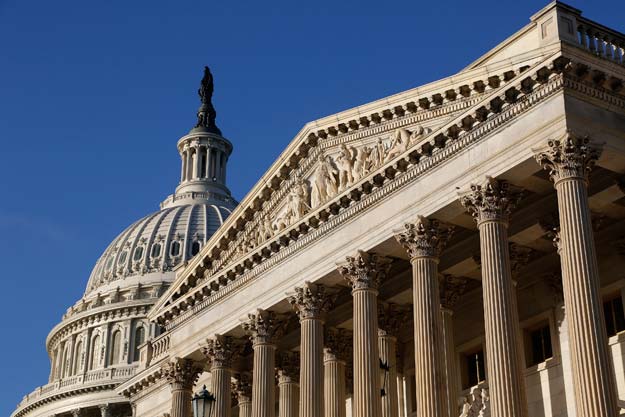
The U.S. Congress late on Wednesday approved bipartisan legislation to end a federal government shutdown and raise the Treasury Department's borrowing authority.
Passage of the hard-fought measure in the Senate and House of Representatives came on the 16th day that many federal agencies were closed due to a lack of funding from Congress.
Without quick action, the U.S. government risked a default as its credit limit would have been exhausted on Thursday.
The measure represents a defeat for conservative Republicans in Congress who had demanded major changes to the "Obamacare" healthcare law. They were using the debt limit and temporary government spending bills as leverage to delay or defund Obamacare. But in the end, enough Republicans joined with Democrats to end the stalemate.
Here are the provisions of the legislation, which Obama is expected to promptly sign into law:
1. Extends U.S. borrowing authority until February 7. The Treasury Department would maintain its ability to use "extraordinary measures" to temporarily avoid default if Congress does not again raise the debt ceiling by that date. House Republicans wanted to prohibit the use of such measures.
Under a device that allows lawmakers to assert they did not vote for raising the ceiling, President Barack Obama would notify Congress that he is raising the U.S. debt limit, giving lawmakers the opportunity to override him with a two-thirds vote of each chamber. But that is unlikely to happen.
2. Extends federal spending, at current levels, until January 15. The deal maintains the across-the-board spending cuts known as "sequestration" that began earlier this year. Democrats likely will try to remove or revise those automatic cuts in subsequent talks.
3. Creates a House-Senate bipartisan panel to try to come up with long-term deficit-reduction ideas that would have to be approved by the full Congress. Their work would have to be completed by December 13.
The panel is likely to look at potential savings to entitlement programs, such as Social Security, Medicare and Medicaid, as well as tax reforms that could raise revenues.
But there is nothing in the legislation forcing this panel to actually agree to anything. Democrats and Republicans have been far apart over raising taxes and cutting benefit programs.
4. Establishes measures to try to prevent federal subsidies from being paid under the "Obamacare" healthcare law to people whose incomes make them ineligible.
5. Delivers back pay to federal workers who did not receive their wages because of the government shutdown.
Copyirght: Thomson Reuters 2013
Essential Business Intelligence, Sharp Market Insights, Practical Personal Finance Advice, Daily Fuel, Gold and Silver Prices and Latest Stories — On NDTV Profit.