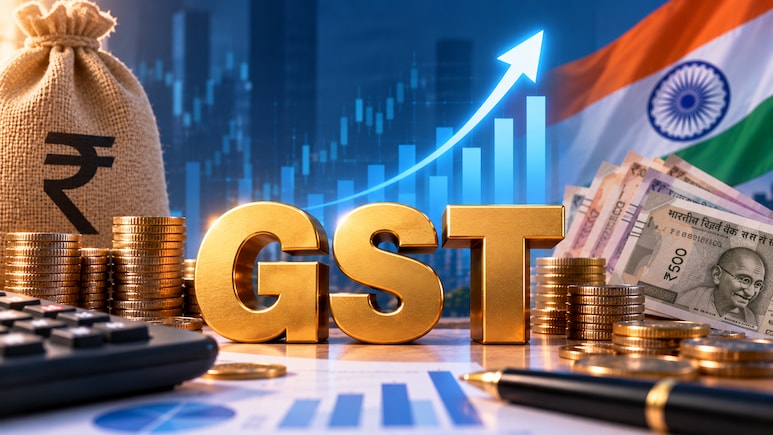
State Bank of India (SBI) Group Chief Economic Advisor Soumya Kanti Ghosh has responded to former Finance Secretary Subhash Chandra Garg's evaluation of India's GST collections, stating that including the GST Compensation Cess to FY26 collections does not indicate an “apple-to-apple” comparison under the restructured GST regime.
Ghosh highlighted the cess was introduced for a brief period to enable GST transition and was discontinued from April 2026 after the restructuring of GST rates.
His remarks come as Garg questioned the GST figures, saying the exclusion of GST cess for FY26 has made the headline numbers appear stronger. According to his assesment, including the cess would bring five-month gross GST growth to 4.08% and net GST growth to 1.30%.
Also Read | Layoffs Are Rising In Tech, But These Skills Are Helping People Unlock Better Pay
Refuting Garg's claim, Ghosh in a post on X said, "The argument of adding GST Compensation Cess to FY26 GST collections and then quoting a 4% number is not an apple-to-apple comparison. Why include GST series from old numbers that include compensation? In fact, the cess was a temporary levy introduced for the GST transition and was discontinued from April 2026 after the restructuring of GST rates, with the cess on several products subsumed into the new GST framework."
STORM IN A TEA CUP
— Soumya Kanti Ghosh (@kantisoumya) September 9, 2026
The argument of adding GST Compensation Cess to FY26 GST collections and then quoting a 4% number is not an apple-to-apple comparison. Why include GST series from old numbers that include compensation? In fact, the cess was a temporary levy introduced for… https://t.co/OXk1wseTN4
ALSO READ: 'Don't Compare Apples With Oranges' — Govt Clarifies Stance On GST Revenue Math
He added, "On closer examination, we observe that it is indeed a sleight of the left hand to discredit the GST collection numbers that are currently running in double digits."
According to Ghosh, the lower five-month average cited by the former Finance Secretary at 4% under the old GST series is largely a base-effect issue. GST growth stood at -3.4% in May 2026 under the old GST series as May collections reflect April activity, which is typically subdued. "But most interestingly, the low 4% figure was impacted by a high base in May 2025 due to a one-off telecom spectrum-related payment of around Rs10,000 crores. The author must be aware of this but has deliberately not to quote this number," he said.
Addtionally, the SBI Group CEA noted GST collections remain on a strong growth trajectory. Collections during the first five months of FY27 grew by an average 11.2%, higher than the Q1GDP nominal GDP growth at 10.3%. Even including cess, in the old series collections grew by 6% on average during April-August 2026, excluding the month of May.
He further argued, states are net gainers under the revised framework. As the Compensation Cess discontinued and Additional Excise Duty was introduced, States gain nearly Rs1.43 lakh crore in FY27 over FY26, after accounting for GST collections and their share in Basic Excise Duty.
"Thus, the relevant metric is the overall revenue accruing to States, which has increased significantly; comparisons based narrowly on the series after the discontinuation of the cess are therefore misleading and intended for a storm in a tea cup," Ghosh said.
ALSO READ: GST Council Meeting Likely To Be Rescheduled To Oct. 7 Over BRICS Summit Clash
Essential Business Intelligence, Sharp Market Insights, Practical Personal Finance Advice, Daily Fuel, Gold and Silver Prices and Latest Stories — On NDTV Profit.