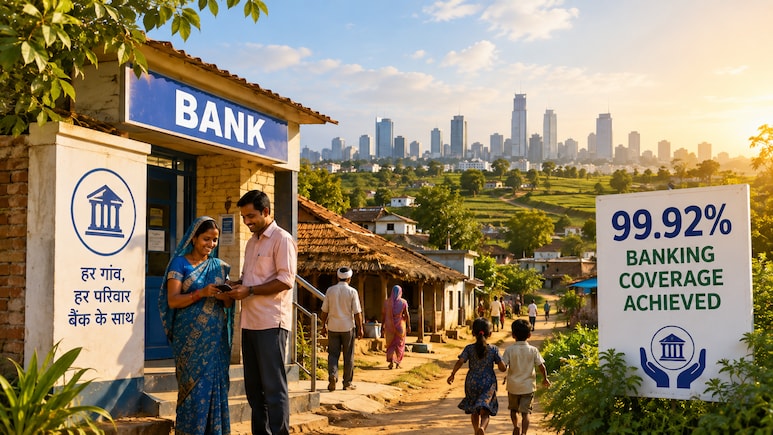
India has achieved near-universal banking coverage, with 99.92% of the country's inhabited villages now having access to a banking outlet within a 5-km radius, according to data shared by the government in the Lok Sabha.
As of July 17, 2026, banking access was available in 6,00,868 of the country's 6,01,328 inhabited villages. The data was uploaded by banks on the Jan Dhan Darshak (JDD) App.
The government's banking network has expanded through bank branches, Business Correspondents (BCs) and India Post Payments Bank (IPPB) centres. Together, these channels now provide a large physical banking network across rural and remote parts of the country.
Also Read | Layoffs Are Rising In Tech, But These Skills Are Helping People Unlock Better Pay
As of July 17, India had more than 1.81 lakh bank branches, 17.36 lakh Business Correspondents and 1.65 lakh IPPB centres.
The government's approach is to ensure that people in rural areas can access basic banking services within 5 km of their villages. The Reserve Bank of India (RBI) has also allowed commercial banks, small finance banks, payments banks, local area banks and regional rural banks to open branches anywhere in the country without prior approval, provided at least 25% of their branches are opened in unbanked rural areas.
ALSO READ: Why India's Banking System Is Entering 2026 On Its Strongest Footing Yet?
PMJDY Accounts Cross 58 Crore
The expansion of banking infrastructure has also supported financial inclusion through the Pradhan Mantri Jan Dhan Yojana (PMJDY).
As of July 17, 2026, there were 58.77 crore PMJDY accounts across the country. These accounts collectively held deposits worth Rs. 3,12,414 crore.
The government has also introduced digital platforms to improve access to credit, particularly for farmers. The Jan Samarth Portal acts as a single digital platform for government-sponsored loan and subsidy schemes, allowing eligible applicants to apply for credit and track the process.
Other initiatives include NABARD's e-KYC application, the KRISHIKA platform of the Department of Agriculture and Farmers Welfare, and the Kisan Rin Portal. The Kisan Rin Portal, launched in September 2023, supports Aadhaar-based verification and faster digital claim settlements for eligible Kisan Credit Card loans.
Government Steps Up Cyber Fraud Protection
Alongside expanding digital banking, the government and RBI are also working to improve the security of digital payments.
The government, in consultation with RBI, has set up the India Digital Payment Intelligence Corporation (IDPIC) to help banks and financial institutions share real-time information about fraud risks and alerts using technologies such as artificial intelligence, machine learning and big data analytics.
RBI has also issued digital payment security guidelines for banks covering internet banking, mobile banking and card payments.
The central bank has introduced an AI-based tool called MuleHunter to help identify money mule accounts, which are often used to move funds linked to financial fraud.
The Ministry of Home Affairs' Indian Cyber Crime Coordination Centre (I4C) is also working to identify illegal digital lending apps. Citizens can report cybercrime through the National Cybercrime Reporting Portal or the 1930 cybercrime helpline.
The government said these measures are aimed at ensuring that the rapid expansion of digital banking is supported by stronger safeguards against cyber fraud and financial crime.
ALSO READ: Motilal Oswal Says Credit Growth Has More Leg
Essential Business Intelligence, Sharp Market Insights, Practical Personal Finance Advice, Daily Fuel, Gold and Silver Prices and Latest Stories — On NDTV Profit.