- Gold loan market reached Rs 21.7 lakh crore by June 2026, growing rapidly
- 15-23% of gold loans in FY26 went to borrowers over 90 days past due
- Gold loan borrowers carry higher debt and increased delinquency risk
India's gold loan market has been booming, despite the inherent risks flagged by an array of analysts, and stakeholders. This market, as per the latest estimates, swelled into a Rs 21.7 lakh crore business as of the quarter ended June 2026, per a report released by the RBI's licenced credit bureau CRIF High Mark.
Now, one lender has raised a pertinent question that may force the stakeholders, including policymakers, to rethink about where the money raised is going.
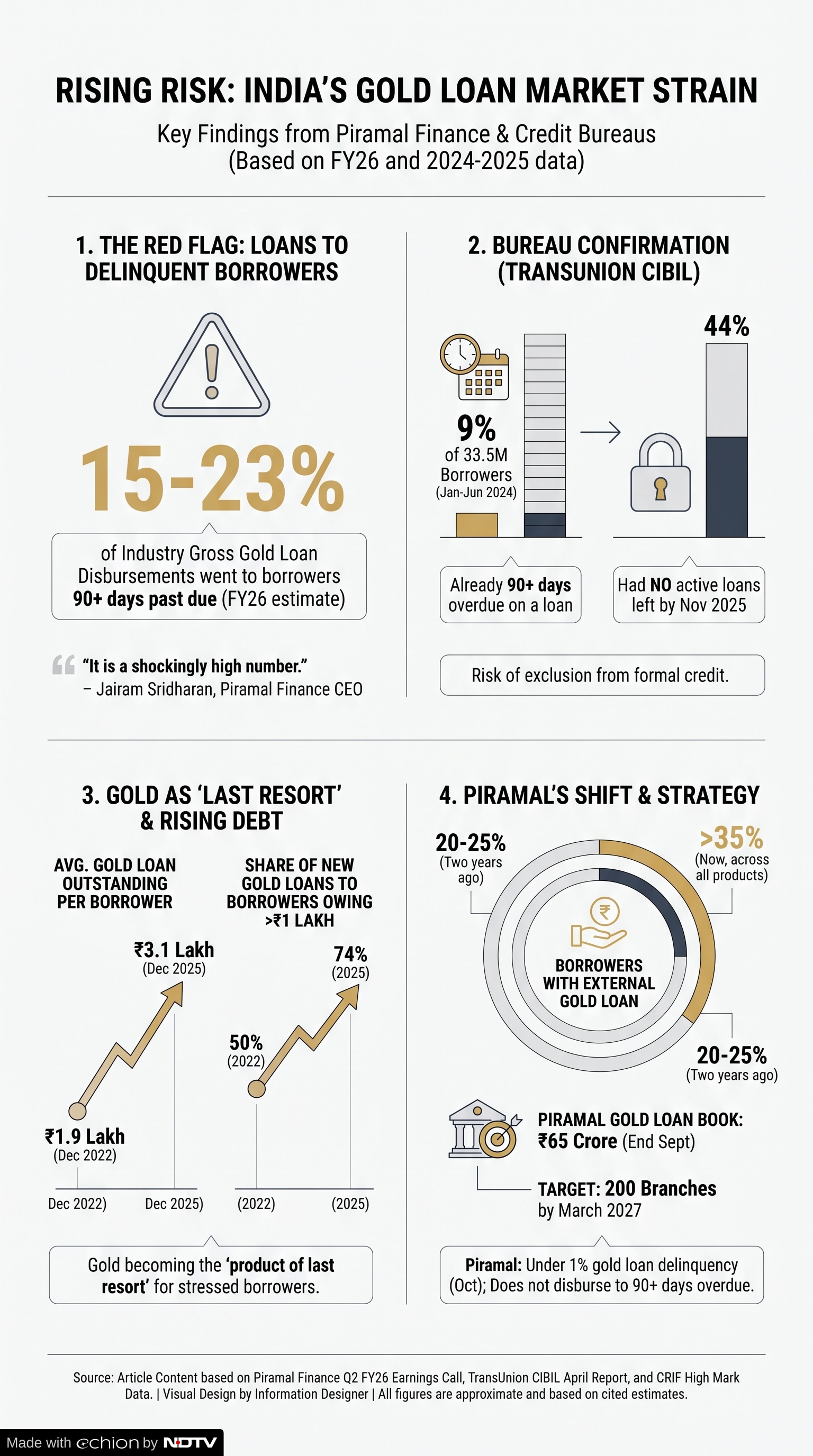
In its earnings concall on Oct. 19, Piramal Finance flagged the rapidly rising presence of gold loans on borrowers' credit files as an emerging risk, according to a transcript of the call published by Investing.com. Depending on how one counts, between 15% and 23% of the industry's gross gold loan disbursements over the past year went to customers who were already 90 days or more past due on at least one of their live loans, said Jairam Sridharan, the company's managing director and chief executive officer. "It is a shockingly high number," he added.
Also Read | Layoffs Are Rising In Tech, But These Skills Are Helping People Unlock Better Pay
In absolute terms, about Rs 4.7 lakh crore of gold loans were disbursed in FY26 to borrowers in such deep delinquency, Sridharan estimated during the concall. He said Piramal's own figure for October so far was under 1%, as the NBFC does not disburse gold loans to customers more than 90 days past due.
The estimate sits within the range implied by credit bureau data. CRIF High Mark's quarterly 'How India Lends' reports show lenders sanctioned about Rs 24 lakh crore of gold loans in FY26, excluding priority-sector gold loans, and roughly Rs 32 lakh crore including them. Rs 4.7 lakh crore is about 15-19% of those totals, according to our calculations. Sanction figures may also include renewals of existing loans, so the share of fresh credit going to delinquent borrowers could be lower.
On the same call, Sridharan also flagged a shift within Piramal's own customer base. Two years ago, 20–25% of its borrowers had a gold loan from another lender, depending on the product. That share is now above 35% across every product category. For now, he said, holding a gold loan is not a marker of higher risk in Piramal's portfolio.
Piramal is itself a new entrant to gold lending. Its own gold loan book was just Rs 65 crore at the end of September, across 100 branches, with a target of 200 branches by March 2027, its results presentation shows.
Bureau Data Tells A Similar Story
The trend is also reflected in an independent check, based on the data provided in April report of TransUnion CIBIL. Of the 33.5 million people who took at least one gold loan between January and June 2024, about 3.1 million, or 9%, had been 90 days or more overdue on a loan in the three months before borrowing.
That group fared worse later, as by November 2025, around 44% of them had no active loans left on their credit file, compared with 28% of borrowers who had not been seriously overdue. CIBIL described this as a risk of exclusion from formal credit. CIBIL said this indicates that for a section of stressed borrowers, gold has become "the product of last resort".
The credit bureau also found that gold loan borrowers are carrying more debt. Average gold loan outstanding per borrower rose from Rs 1.9 lakh in December 2022 to Rs 3.1 lakh in December 2025. In 2025, 74% of new gold loans went to people who already owed more than Rs 1 lakh in total, up from about half in 2022, and nearly half of borrowers held some unsecured debt at the time. Borrowers whose gold loan dues crossed Rs 2.5 lakh were about 2.2 times as likely to slip into delinquency as those below that level.
ALSO READ: Taking A Gold Loan? Know The Risks, Charges And Repayment Rules Before You Apply
How Big The Market Has Become
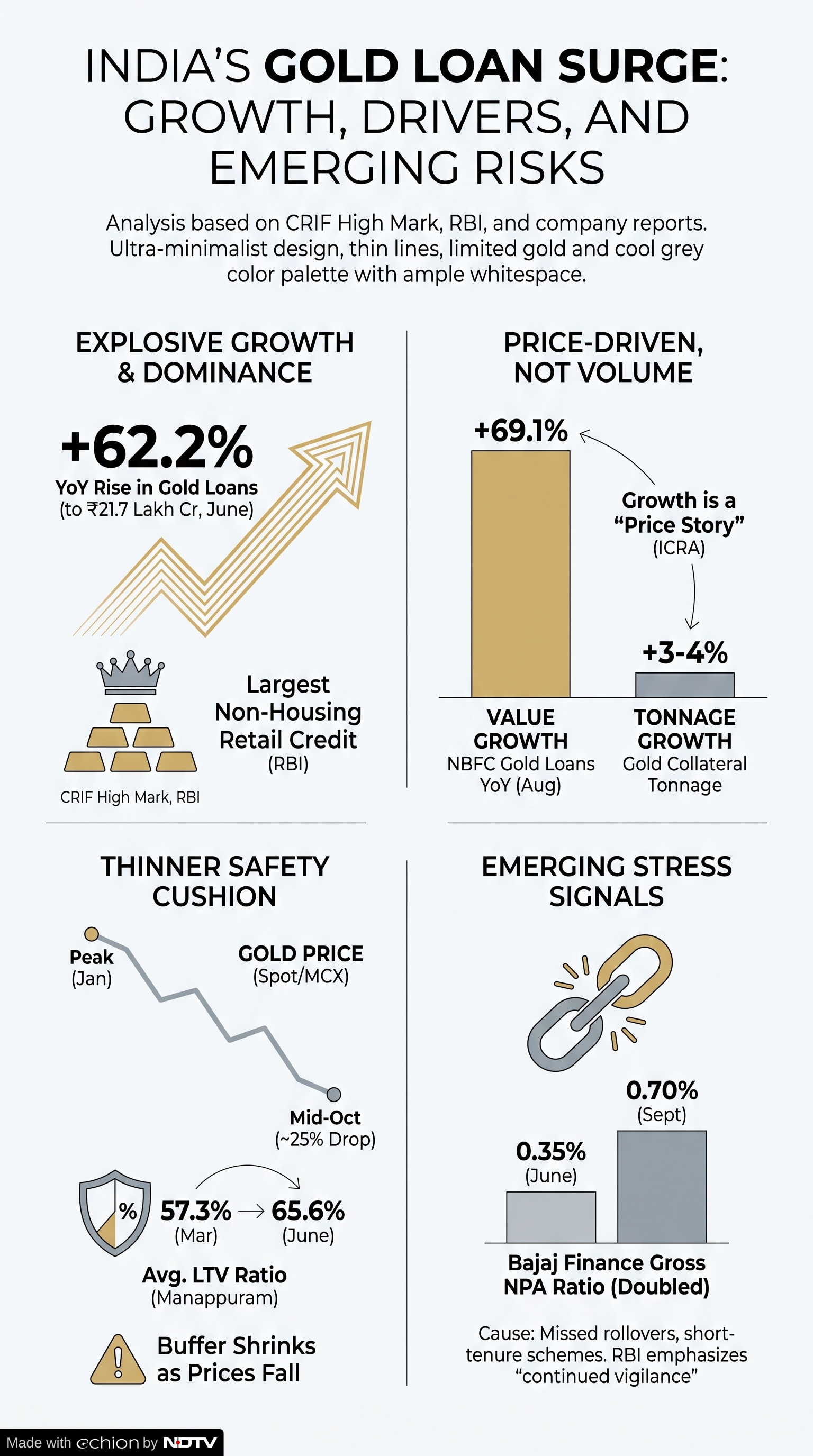
CRIF High Mark data show gold loans across all lenders, including agricultural gold loans, rose 62.2% year-on-year to Rs 21.7 lakh crore at the end of June, though CRIF noted that close to 10 percentage points of that growth came from one NBFC reclassifying loans. TransUnion CIBIL's April report said gold loans now hold the second-largest share of the retail loan portfolio after housing loans.
In a written reply to the Lok Sabha on Aug. 10, the finance ministry said that, as per information from the RBI, housing loans were the largest retail lending product at the end of March, followed by personal loans and vehicle loans.
Also, the RBI pointed out in its Financial Stability Report in June that gold loans had grown at a compounded annual rate of 42.4% since March 2024 and were now the largest category of non-housing retail credit. The growth, it said, came mainly from existing borrowers using higher gold prices to take larger loans and roll over debt, and the pace of lending against gold amid volatile prices "merits continued vigilance". It also noted that the gold loan boom has coincided with a decline in outstanding personal loans among sub-prime borrowers who hold both kinds of loans.
The momentum has continued. Loans against gold jewellery by NBFCs grew 69.1% year-on-year to about Rs 3.65 lakh crore in August, according to RBI data released on Oct. 6.
Much of this is a price story. Rating agency ICRA said in July that the gold loan books of large NBFCs expanded 24% between FY22 and FY26, while branch additions and the tonnage of gold held as collateral grew at a modest 3-4% pace.
A Thinner Cushion
Gold loans are considered safe because the pledged jewellery is worth more than the loan. That buffer has shrunk this year. Spot gold peaked near $5,590 an ounce on Jan. 28 and was trading around $4,150 in mid-October, roughly a quarter lower. The domestic market also witnessed a similar slide, as MCX gold rates peaked at about Rs 1.93 lakh per 10 gram in January-end, and are currently trading around Rs 1.46 lakh.
Lenders' cushions are already thinner. Manappuram Finance standalone average loan-to-value ratio on gold loans rose to 65.6% at the end of June from 57.3% in March, according to its investor presentation.
The rules have also changed. Since April 1, lenders can lend up to 85% of the gold's value on loans of up to Rs 2.5 lakh, compared with the earlier flat cap of 75%. The ceiling is 80% for loans of Rs 2.5–5 lakh and 75% above that. For bullet-repayment loans, the ratio is now calculated on the total amount due at maturity, and such loans are capped at 12 months.
The transition has caused some strain. Bajaj Finance said its stressed gold loans, mostly in the Stage 2 bucket that flags a significant rise in credit risk, rose by Rs 1,047 crore in the September quarter. Its investor presentation attributed the rise to short-tenure schemes it has since withdrawn, and said it does not expect an impact on credit costs. In its Oct. 19 earnings call, according to a transcript published by Investing.com, management said such three-month schemes were common across the industry after the new rules, and that customers missed the frequent rollovers. The gross NPA ratio on Bajaj's gold loans, while still low, doubled to 0.70% at the end of September from 0.35% in June, though it was 0.59% a year earlier.
Borrowing costs are also turning. On Oct. 7, the RBI raised its repo rate by 25 basis points to 5.50%, its first increase since February 2023.
The Case Against Alarm
On reported numbers, gold loans look healthier than at any point in recent years. Citing RBI data, Minister of State for Finance Pankaj Chaudhary told the Lok Sabha on Aug. 10 that the gross NPA ratio on gold loans fell to 0.12% for scheduled commercial banks and 0.81% for NBFCs at the end of March 2026, from 0.19% and 2.32% in March 2023.
The RBI has also said loan-to-value ratios across lenders declined during the gold price run-up, strengthening collateral buffers. CRIF puts the share of gold loans 31–90 days overdue at 0.9%, and 91–180 days overdue at 0.3%.
Specialist lenders hold large buffers. Muthoot Finance's management said on its August earnings call that the company's loan-to-value ratio, including accrued interest, was about 65–66% in the June quarter, and that auctions were negligible, according to call highlights published by GuruFocus.
ICRA said near-term delinquencies at gold loan-focused NBFCs could rise as they shift to regular repayment loans and higher LTVs, but that credit losses should stay limited because the collateral is easy to sell.
ALSO READ: Bajaj Finance's Gold Loan Book Doubles, Then It Pulls The Plug On A Scheme
What To Watch
The early signs are at the edges of the market. CRIF's June data showed delinquencies of 31–90 days rising from March at NBFCs, from 0.56% to 0.72%, and at private banks, from 1.08% to 1.46%, though both remain below year-earlier levels. Growth is also fastest outside the southern states that hold over 70% of the market. Uttar Pradesh's gold loan book grew 122.8% in the year to June, with 31–180 day delinquencies at 2% against 1.2% in Tamil Nadu.
Bullet loans can now run for at most 12 months, so any written near January's price peak must be repaid or renewed by early next year. For lenders, the jewellery remains a backstop. For a borrower who pledged it to clear another overdue loan, there may be none.
Essential Business Intelligence, Sharp Market Insights, Practical Personal Finance Advice, Daily Fuel, Gold and Silver Prices and Latest Stories — On NDTV Profit.