India is preparing for a major energy transition strategy centered around one of its most abundant natural resources: coal. The Centre has approved a Rs 37,000 crore coal gasification scheme aimed at converting coal into synthesis gas, or syngas, which can serve as an alternative to imported natural gas and petrochemical feedstock.
The initiative comes amid rising geopolitical uncertainty, volatile LNG prices, and concerns over long-term energy security.
Speaking about the initiative, Union Minister Ashwini Vaishnaw said the objective is to make India more self-reliant by converting domestic coal reserves into usable gas, fertilisers, power, and chemicals.
Also Read | Layoffs Are Rising In Tech, But These Skills Are Helping People Unlock Better Pay
What Is Coal Gasification?
Coal gasification is a process in which coal is converted into a gaseous fuel instead of being burned directly.
According to Vaishnaw, coal is first crushed and screened before being fed into a specialised gasification furnace. Inside the furnace, the coal is exposed to extremely high temperatures of nearly 1,000–1,500 degrees Celsius and pressure levels of around 30 bar.
“At such high temperature and pressure, coal does not burn in the conventional sense. Its chemical composition changes and it converts into synthesis gas, commonly known as syngas,” Vaishnaw explained.
ALSO READ: $1 Trillion Export Goal: Piyush Goyal Bets On FTAs To Power India's Trade Push
The resulting gas primarily contains carbon monoxide (CO) and hydrogen (H₂), and the ratio between the two can be adjusted depending on industrial requirements.
What Is SNG?
The synthesis gas produced through coal gasification can be processed into Synthetic Natural Gas (SNG), which functions similarly to conventional natural gas.
“Just as we refer to natural gas as PNG or LNG, similarly syngas can also be called SNG — Synthetic Natural Gas,” Vaishnaw said.
SNG can be used across multiple sectors, including:
Power generation
Fertilizer manufacturing
Production of LPG-equivalent fuels
Petrochemicals and industrial chemicals
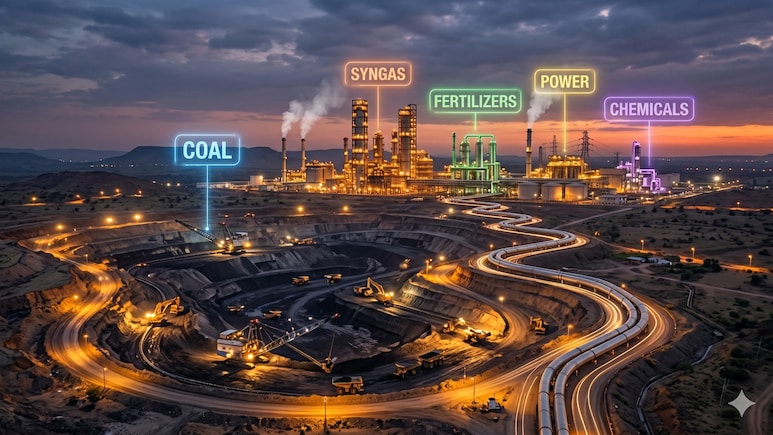
The minister summarised the broader industrial vision behind the programme as:
Coal to gas
Gas to fertilizers
Gas to power
Gas to chemicals
Why Is India Betting Big On Coal Gasification?
India currently imports substantial quantities of LNG, methanol, fertilizers, and petrochemical feedstock. The government believes coal gasification can reduce exposure to global supply disruptions while improving energy security.
“We should maximize the utilization of our coal reserves by converting coal into gas,” Vaishnaw said, adding that such gas can reduce LNG imports, especially for fertilizer production.
India is estimated to hold nearly 400 billion tonnes of coal reserves, while annual consumption stands at around 1 billion tonnes.
“Directly speaking, India already has enough coal for nearly 400 years,” the minister noted.
ALSO READ: PM Modi's Call To Avoid Foreign Travel May Boost Domestic Tourism, Says Ixigo Group CEO
Two Ways To Extract Gas From Coal
The government outlined two distinct methods through which gas can be obtained from coal resources:
1. Coal Bed Methane (CBM)
This involves extracting naturally trapped methane gas from deep underground coal seams through drilling operations.
2. Coal Gasification
In this method, coal itself is chemically converted into synthesis gas inside high-temperature, high-pressure reactors.
ALSO READ: Cabinet Likely To Approve Rs 37,000-Crore Coal Gasification Incentive Scheme
Essential Business Intelligence, Sharp Market Insights, Practical Personal Finance Advice, Daily Fuel, Gold and Silver Prices and Latest Stories — On NDTV Profit.