Beyond Tariffs: Trump-Xi Summit Puts Rare Earths, AI Guardrails, And Energy Flows To Test
The Trump-Xi summit on September 24 is less about achieving a grand ideological harmony and more about managing strategic competition. For the global economy, the stakes are binary.
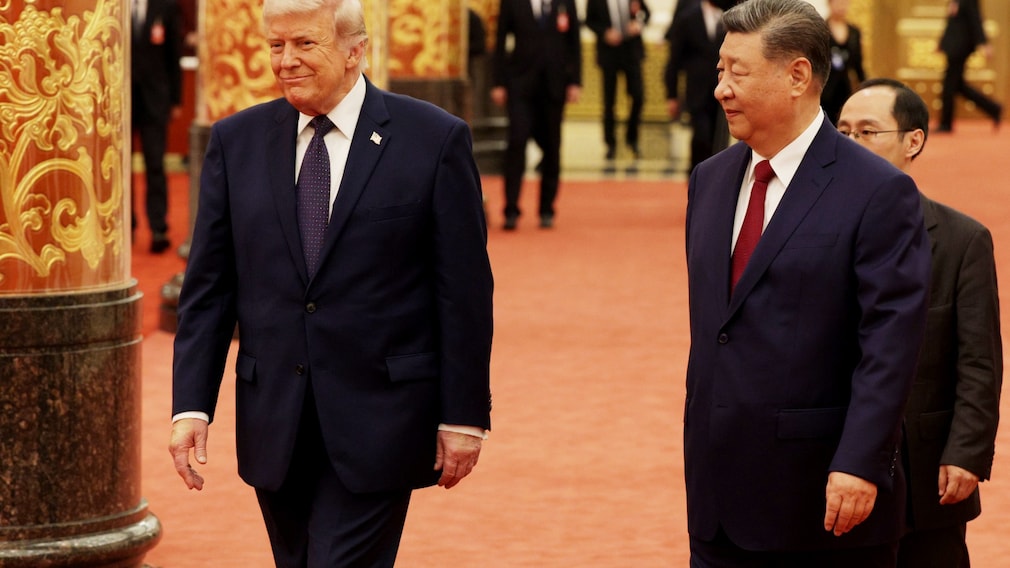
The upcoming meeting between US President Donald Trump and Chinese President Xi Jinping on Sept. 24 2026 carries great significance for the global economy. Set against a backdrop of complex trade restrictions, an accelerating artificial intelligence race, and fragile supply chains, this high-stakes summit at the White House marks President Xi's first visit to Washington in over a decade.
As the world's two largest economic superpowers navigate a delicate "constructive relationship of strategic stability" established during their previous meeting in Beijing, the outcomes of this summit will dictate the trajectory of global trade, technology standards, and energy markets for years to come.
ALSO READ: Trump-Xi Meeting: White House Releases Itinerary For Chinese President's Washington Visit
Preserving Global Supply Chains: The Trade Truce Extension
The most immediate consequence of the Sept. 24 summit for the global economy is the fate of the existing US-China bilateral trade truce. Set to expire on Nov. 10, the "Busan truce" had paused a devastating cycle of tit-for-tat tariffs that threatened to fracture global shipping and production.
Tariff Reductions: Ahead of the summit, negotiators are reportedly working on selective, mutual tariff rollbacks covering roughly $30 billion in goods on both sides. This includes lower duties on American energy and agricultural products, and reduced tariffs on Chinese products required as industrial inputs by US manufacturers.
Macroeconomic Stability: A successful extension of this pause on tariff escalation will signal to international markets that a return to a full-blown, protectionist trade war is temporarily averted. Conversely, a failure to renew the truce would inject massive volatility into global financial markets, escalating inflationary pressures worldwide.
Setting the Guardrails for the Global AI Race
Beyond traditional trade, the 2026 summit serves as a critical geoeconomic battleground for technology, specifically Artificial Intelligence (AI). President Trump has emphasized the geopolitical stakes, stating that leadership in AI determines global dominance. Because both nations are fundamentally intertwined across supply chains, financial markets, and consumer access, implementing unmitigated or absolute restrictions poses severe risks to both domestic stability and the global economy.
ALSO READ: Trump Dismisses Threat of Xi Cancelling Upcoming Summit Over Taiwan Strain
The global economy will watch for whether the leaders can formalize government-to-government dialogues on AI risk and model safety standards. Concrete definitions on tech controls-such as whether the US allows the export of advanced semiconductor hardware-will reshape global tech supply chains, altering investment flows across Silicon Valley, Taiwan, and Shenzhen.
Critical Minerals and Energy Dominance
The summit is poised to directly impact the global energy transition. China holds massive leverage over the global economy through its tightened export controls on rare-earth minerals, which are vital components for green technology, defense hardware, and consumer electronics. President Xi is accompanied by a substantial delegation of top Chinese business executives, perhaps indicating a readiness to negotiate commercial concessions.
Progress on critical minerals access in exchange for relaxed US investment restrictions would ease supply bottlenecks for global automobile and tech manufacturers. However, ongoing stalemates regarding Chinese industrial overcapacity-particularly in electric vehicles-mean that global businesses must remain prepared for localized trade friction.
Spillover Effects on the Global Security and Corporate Posture
The broader global economy is inextricably linked to the geopolitical undercurrents of the summit, including the Iran war and security frameworks around Taiwan. China's role as the primary buyer of Iranian oil places it at the centre of Washington's economic sanctions strategy.
How the two leaders handle China's financial ties to Tehran will dictate global oil prices and energy security.
Furthermore, international multinational corporations and institutions are closely monitoring the newly proposed U.S.-China Board of Trade and Board of Investment. These mechanisms represent an attempt to forge a highly transactional relationship capable of "managing the stalemate" even when political trust is absent.
Overall Assessment
The Trump-Xi summit on Sept. 24 is less about achieving a grand ideological harmony and more about managing strategic competition. For the global economy, the stakes are binary. A successful continuation of the trade détente will act as a stabilizing anchor, calming volatile commodity markets, securing tech supply chains, and curbing inflationary pressures.
A breakdown in communication, however, will signal a volatile shift toward protectionism, supply shocks, and deep geopolitical fragmentation that will drag down international market growth well into the future.
Whether through the temporary preservation of global trade flows, the standardisation of AI safety, or a calculated compromise on critical minerals, the decisions made at the White House will dictate whether the world economy moves toward a period of stabilised management or slides into further fragmentation.
Ultimately, this summit signals to New Delhi that it must continue prioritizing strategic autonomy, strengthening its domestic defense and technology capabilities, and diversifying its global alliances.
ALSO READ: US Treasury Secretary Bessent To Discuss AI, Rare Earths With China's He: Report
Implications for India
The upcoming summit between US President Donald Trump and Chinese President Xi Jinping on Sept. 24, 2026, carries deep strategic and economic implications for India. There are some fears that a transactional trade détente or "G2" style co-management of the global order between the United States and China could dilute India's strategic leverage as a preferred balancing power in the Indo-Pacific.
Economically, any relaxation of bilateral tariffs or tech restrictions might weaken the global "China-Plus-One" manufacturing shift, which threatens to deflect foreign direct investment (FDI) away from India's electronics and semiconductor sectors back toward Chinese factories.
Furthermore, if President Donald Trump's business-focused diplomacy results in geopolitical concessions for President Xi Jinping, an emboldened Beijing could adopt a more assertive posture towards India. Ultimately, this summit signals to New Delhi that it must continue prioritizing strategic autonomy, strengthening its domestic defense and technology capabilities, and diversifying its global alliances.
Disclaimer: The views expressed in this article are solely those of the author and do not necessarily reflect the opinion of NDTV Profit or its affiliates. Readers are advised to conduct their own research or consult a qualified professional before making any investment or business decisions. NDTV Profit does not guarantee the accuracy, completeness, or reliability of the information presented in this article.
-
Midterm Rally Lasted A Day. The Hard Reality Of A Divided US May Last Two Years | Opinion

Between a contested AI boom, a debt ceiling that arrives in 2027 and a president with every incentive to act alone, the next two years may prove more volatile than the first day's rally suggests.
-
Blue Wave Will Derail the AI Trade but Won't Dismantle the AI Era | Unhedged Position
The Democrats' sweep of the US Congress will see politics collide with economic forces both over the long and short term.
-
It's Time To Take The GST Council's Bet On Trust Global
Payment records can prove India's services exports, and clear, proportionate rules can bring foreign digital sellers into the tax net.
-
Opinion | India at 38: From Innovation Overperformer to Innovation Powerhouse
India now has 453 VC-backed deep science startups, 18 of them late-stage, after 117 percent growth since 2020. Laurus Labs, at USD 9.3 billion, is the most valuable deep science company in any middle-income economy outside China.
-
Navigating Energy Crossroads: S Jaishankar's Call For Diversified Supply Chains At G20 Ministerial Meeting
As geopolitical fault lines continue to test maritime trade routes and commodity flows, Jaishankar's message remains pertinent: true economic resilience requires open markets, protected transit lines, and a genuine commitment to multilateral cooperation rather than coercion.
-
Indians Are Travelling, But Not Every Journey Is A Holiday | The Week In Whys
Pilgrims, patients and working women are the real travellers, and the system hasn't quite caught up with them.
-
Getting To Work Costs Women More | The Reason Why
It is not just about women paying more than men. It is about women paying much more in cities than in villages.
-
AI Bias In Investing Cannot Be Eliminated, But It Can Be Governed
Framing is a particularly important example as identical financial information presented in terms of gains rather than losses can lead an LLM to reach a different assessment.
-
Joining The Dots | Dark Skies, Steady Diya: Why Hope Holds This Diwali
With war, a weak rupee and foreign outflows weighing on sentiment, policymakers at the NDTV World Summit and market veterans at NDTV Profit Ignite: Diwali Edition offered the same advice: stay invested and filter out the noise.









