(Bloomberg) -- The yen's rebound from the cusp of a 33-year low versus the dollar has only served to highlight the increased pressure it faces with other major currencies.
It touched the weakest in 15 years against the euro on Wednesday, depreciated to a record level to the Swiss franc and registered a drop versus ever other Group-of-10 currency. In fact, Bloomberg's measure of the yen's relative strength against its G-10 peers fell to the lowest since 2007.
Its rally against the greenback on Tuesday — the biggest in four months — was driven by US inflation data that suggests the Federal Reserve may not need to raise interest rates any higher. The limited recovery didn't reflect any change in Japan, where the central bank's short-term policy rate remains below zero and longer-term bond yields lag their US counterparts by about four percentage points.
“The yen keeps its special place as the most bearish major currency,” said Daisuke Uno, chief strategist at Sumitomo Mitsui Banking Corp. in Tokyo. “Even after successive rate hikes, European and US economic conditions look better than those in Japan, where there have been no rate hikes so far.”
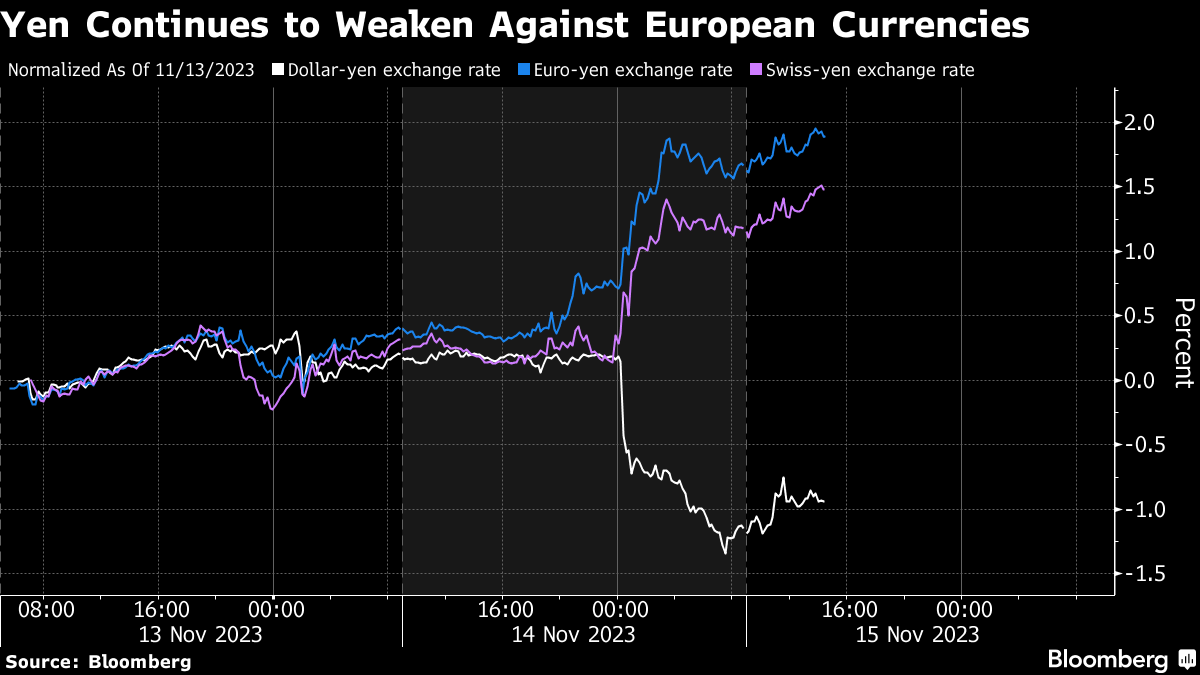
The yen traded around 163.80 to the euro at 12:42 p.m. in Tokyo and 150.60 versus the dollar, reflecting the cycle of rate hikes that have taken the European Central Bank's deposit rate to 4% and the Fed's Funds Rate 5.25-5.5%.
“The yield gap with European nations will probably stay wide as the ECB is unlikely to start cutting rates until late next year, while Japan's rate increase will be very marginal, if any,” said Masafumi Yamamoto, chief currency strategist at Mizuho Securities Co. “There may be some investors who buy the euro against the yen just to follow the pair's uptrend.”
Data in Japan on Wednesday showed gross domestic product shrank at an annualized pace of 2.1% in the third quarter, compared with estimates from economists for a 0.4% contraction, adding to the weight on the yen. Meanwhile, Germany's economy is projected to dislodge Japan's as the world's third largest this year, helped by the slide in the yen against the dollar and the euro.
“A soft GDP print in Japan indicates that the BOJ may need to maintain negative rates for longer than expected,” said Spencer Hakimian, the founder and chief executive officer of Tolou Capital Management. “This is bearish for the yen, which would have rallied on potential rate hikes in 2024.”
More stories like this are available on bloomberg.com
©2023 Bloomberg L.P.
Essential Business Intelligence, Sharp Market Insights, Practical Personal Finance Advice, Daily Fuel, Gold and Silver Prices and Latest Stories — On NDTV Profit.