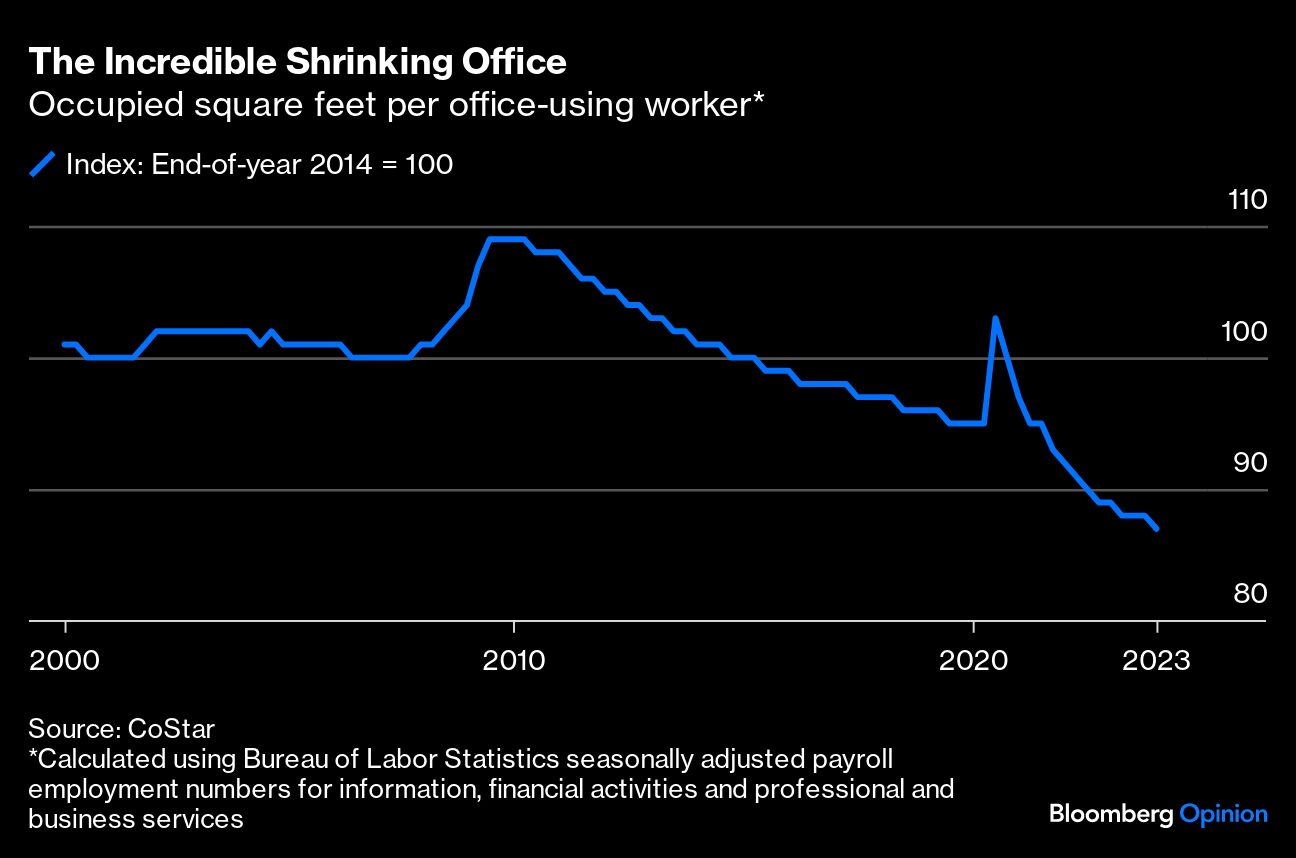
(Bloomberg Opinion) -- In the decade before the pandemic, the amount of office space per worker in the US shrank steadily — a trend given the charming name “densification.” Saving money was one driver, as was a belief among some employers that denser layouts encouraged interaction and innovation. But the best predictor of densification was “market-level job growth and the availability of space (or lack thereof),” commercial real estate brokerage Cushman & Wakefield concluded in a 2018 analysis of the phenomenon. That is, in large office markets such as Manhattan and San Francisco and up-and-coming ones such as Miami and Nashville, companies were simply hiring workers faster than they could find space for them.
Fast-forward to 2023. More than a billion square feet of office space stands empty in the US, according to Cushman & Wakefield's estimates, for a national vacancy rate of 19.4% (up from 13% just before the pandemic). Yet after an upward spike in square feet per worker in 2020, the densification appears to be accelerating.
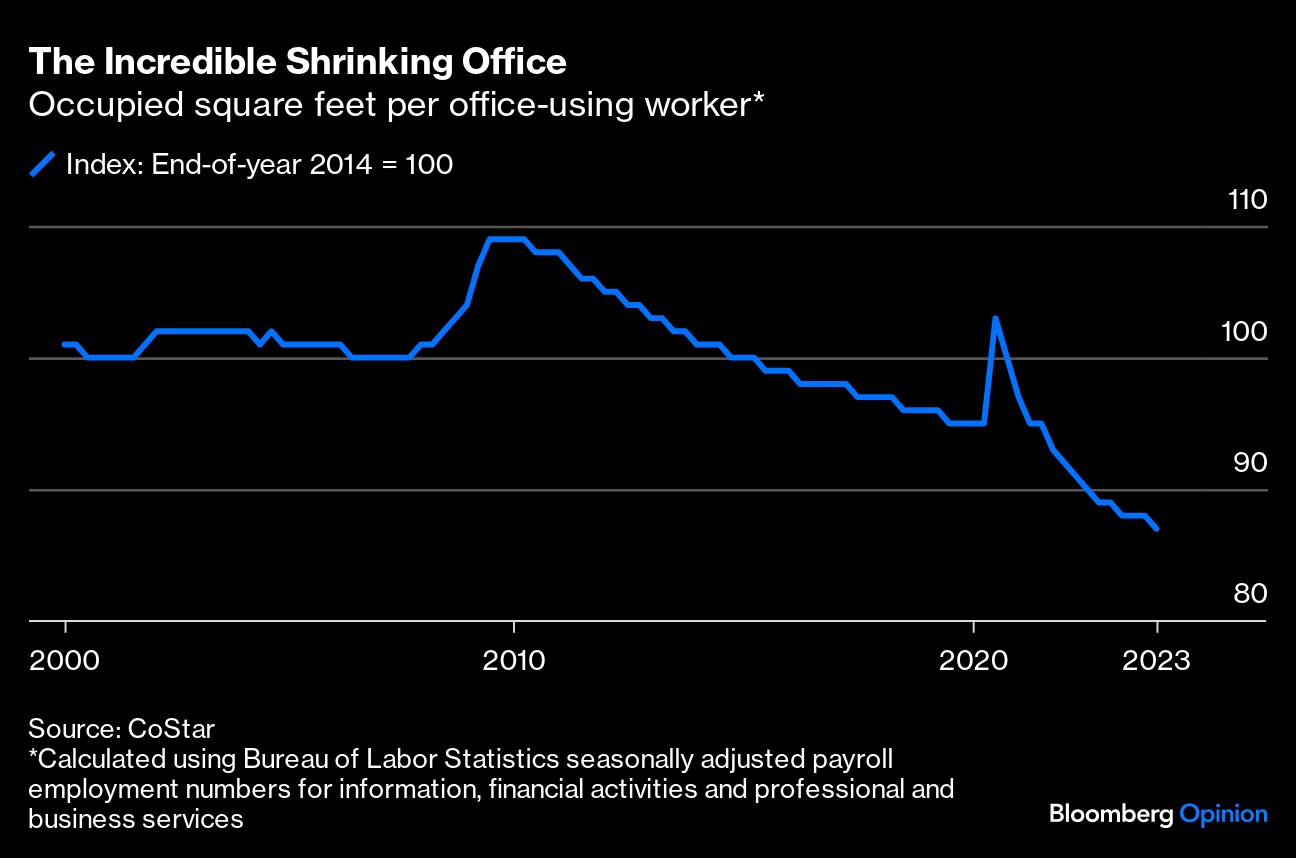
“Appears to be” is admittedly doing a lot of work here. The denominator of office-using workers used to calculate this index is simply the number of jobs in the three most office-oriented supersectors — information, financial activities and professional and business services — so it doesn't reflect the number of people actually coming to the office. The percentage of employees in these supersectors who “teleworked or worked at home” for all of their working hours in the October jobs report survey week was 27.4%, 26.1% and 25.4% respectively, according to the Bureau of Labor Statistics, and while there's no exact pre-pandemic benchmark to compare with, the percentages who worked from home in 2019 were 8.6%, 9.3% and 10.3%, according to data from the Census Bureau's 2019 American Community Survey that I accessed through IPUMS USA. The 8.4% decline in office square footage per worker since 2019, then, may have been more than canceled out by the increase in the percentage of workers who never come into the office.
But while remote-work percentages seem to have more or less stabilized, the office space squeeze continues. “We've seen for the past year a pretty consistent trend of average lease sizes being 20% lower than in the five years before the pandemic,” said Phil Mobley, national director for office analytics at commercial real estate data provider CoStar Group, who created the above chart. With about half of pre-pandemic office leases in the US still to come up for renewal, it certainly does not look as if offices are going to be growing.
On the one hand this is a little weird. A ton of vacant office space is available, many employers are trying to persuade (or force) workers to spend more time in the office, and we've just been through a pandemic that underscored the infection risks of working in close proximity with others. Yet there's little sign of office de-densification or, heaven forfend, a comeback for private offices.
On the other hand, it's not hard to come up with reasons densification isn't reversing. Here are four:
- A lot of the vacant space is in older, dingier buildings whose current owners are in no position to make significant improvements or even offer much-reduced rents. “We'll see more creative uses of that space,” Mobley said, “but in order to even try to execute some of those ideas, it really requires property to be owned at a different basis than it is now.”
- The new rhythms of hybrid work mean that many offices are still quite empty on Mondays and Fridays and thus underutilized from the perspective of those paying the rent and the utility bills.
- With home offices having proved well-suited to individual-focused work and virtual meetings with people in a variety of locations, offices are increasingly seen as spaces chiefly for in-person interaction.
- From an employer's perspective, there doesn't seem to be much downside to cramming workers into less space. “More space doesn't automatically mean a better experience,” said Peggie Rothe, chief insights and research officer at workplace-evaluation firm Leesman.
Leesman surveys employees on their workplace experience and productivity, churning out index scores that high-scoring employers can trumpet. In 2019, Rothe compared Leesman's productivity scores with space per worker in hopes that this might point toward some optimal number of square meters. Instead, she found not much correlation at all.
It's been the same with open-plan offices versus those with more enclosed space. One thing that does seem to have a positive effect on workplace experience in the Leesman data is having multiple work environments available, from private rooms to social spaces. “You're going to have employees coming in with different requirements, and you want to be able to cater to different needs, and one way of doing that is having variety,” Rothe said. “So you're giving the employee the choice of ‘Where am I best off doing this particular thing that I'm about to do right now?'”
A lot of the time, though, the answer to that is going to be “at home.” During the pandemic, Leesman began measuring the at-home work experience and finding that the resulting scores were consistently higher than those for in-office work. “It's quite sad that the average home that was designed for living is better at supporting work than the average office that was actually designed to support work,” Rothe said. (This will come as no surprise to readers of Nikil Saval's wonderful 2014 book, , one theme of which is that supporting work and workers has never been a top office-design priority.)
The home doesn't seem to be better at supporting every aspect of work. Economists Jose Maria Barrero, Nicholas Bloom and Steven J. Davis, who have been among the most assiduous documenters and in some cases cheerleaders of remote and hybrid work during the pandemic, concluded in a working paper this summer that “fully remote working appears to lower average productivity by around 10% to 20%.” But if employers conclude that work requiring quiet and privacy is best done at home, we may have a lot more office densification in our futures.
More From Bloomberg Opinion:
- New York Offices Are Empty. Tokyo Doubles Down: Gearoid Reidy
- Office Panic Eases, But a Critical Period Looms: Jonathan Levin
- Hottest Office Market in US Is … Midtown Manhattan?: Justin Fox
This column does not necessarily reflect the opinion of the editorial board or Bloomberg LP and its owners.
Justin Fox is a Bloomberg Opinion columnist covering business, economics and other topics involving charts. A former editorial director of the Harvard Business Review, he is author of “The Myth of the Rational Market.”
More stories like this are available on bloomberg.com/opinion
©2023 Bloomberg L.P.
Essential Business Intelligence, Continuous LIVE TV, Sharp Market Insights, Practical Personal Finance Advice and Latest Stories — On NDTV Profit.