.jpg?downsize=773:435 "Wal-Mart And Flipkart: A Grocery Giant In The
Making?")
According to people familiar with the matter, Wal-Mart and Flipkart are in advanced discussions for the former to invest in the latter. This has kicked off a new chapter in the great Indian parlor game of “What will happen to Flipkart?”. A column that I had written on the subject had pointed out that Flipkart needs significant capital to fight Amazon and a large retailer or a large e-commerce company (‘strategic') will be best placed to provide it. My reasons for this were simple – a strategic investment signals a long term orientation and assures that more capital will be available as and when needed.
Initial commentary about the potential transaction has centered around parallels with Wal-Mart's recent purchase of Jet.com in the U.S. and its desire to build a larger e-commerce business. Similarity to an investment that it made in JD.com in China has also been pointed out.
.jpg "Shopping carts sit inside a Wal-Mart store in New Jersey. (Photographer Daniel AckerBloomberg News)")
My own sense is that the rationale for a deal with Flipkart is deeper than just e-commerce in India. It may actually open up a very viable route for Wal-Mart to exponentially grow its business in the country and to become a dominant player in the food and grocery retail business.
Let's look at the history of Wal-Mart in India, the regulatory structure for multi-brand retail, and the importance of food and grocery in the overall retail pie, before coming back to the Wal-Mart-Flipkart deal rationale.
Wal-Mart In India
Wal-Mart entered the country by setting up a joint venture with the Bharti Group in 2007. In 2013, this was dissolved with Wal-Mart retaining the B2B business (referred to as cash and carry stores in India) and Bharti the B2C front-end business. Currently, Wal-Mart has only 21 B2B stores in India despite having been in the country for 9 years. The B2B business is severely limited in its growth potential given the restrictions on who can shop there (only businesses) and the edge of town locations necessitated by the size of the stores. India represents an insignificant part of the global Wal-Mart empire of over 12,000 stores and $482 billion in revenue.
Regulatory Recap
As per current regulations on multi-brand retail, 100 percent FDI (foreign direct investment) is allowed in the B2B business. 51 percent FDI (with FIPB approval and several restrictions) is theoretically allowed in the B2C multi-brand retail business but the current NDA government had opposed it in their manifesto and has not cleared any proposals. Despite Wal-Mart's (and others!) best efforts, the news is not so good on this front. Just recently, the Commerce Minister, Nirmala Sitharaman had reiterated, “Not yet”. She stated, "We haven't reached where there will be a level playing field if it (multi-brand retail) were to be opened up." Without a B2C presence, it will be very difficult for Wal-Mart to ramp up revenues in any meaningful way.
On the other hand, 100 percent FDI is allowed in an e-commerce marketplace with several restrictions on inventory (not allowed), dependence on a single supplier (less than 25 percent) and discounting (not allowed). As can be seen by how Flipkart, Amazon, Snapdeal and PayTM (to name a few) operate, the e-commerce marketplace route is pretty viable and almost anything can be done using appropriate structure or commercial arrangements.
Food And Grocery Retail In India
Food and grocery is the single largest segment of the overall Indian retail pie, representing 67 percent of the $616 billion market. In addition, it is also the segment which is least organized and has had the least penetration of online retail so far.
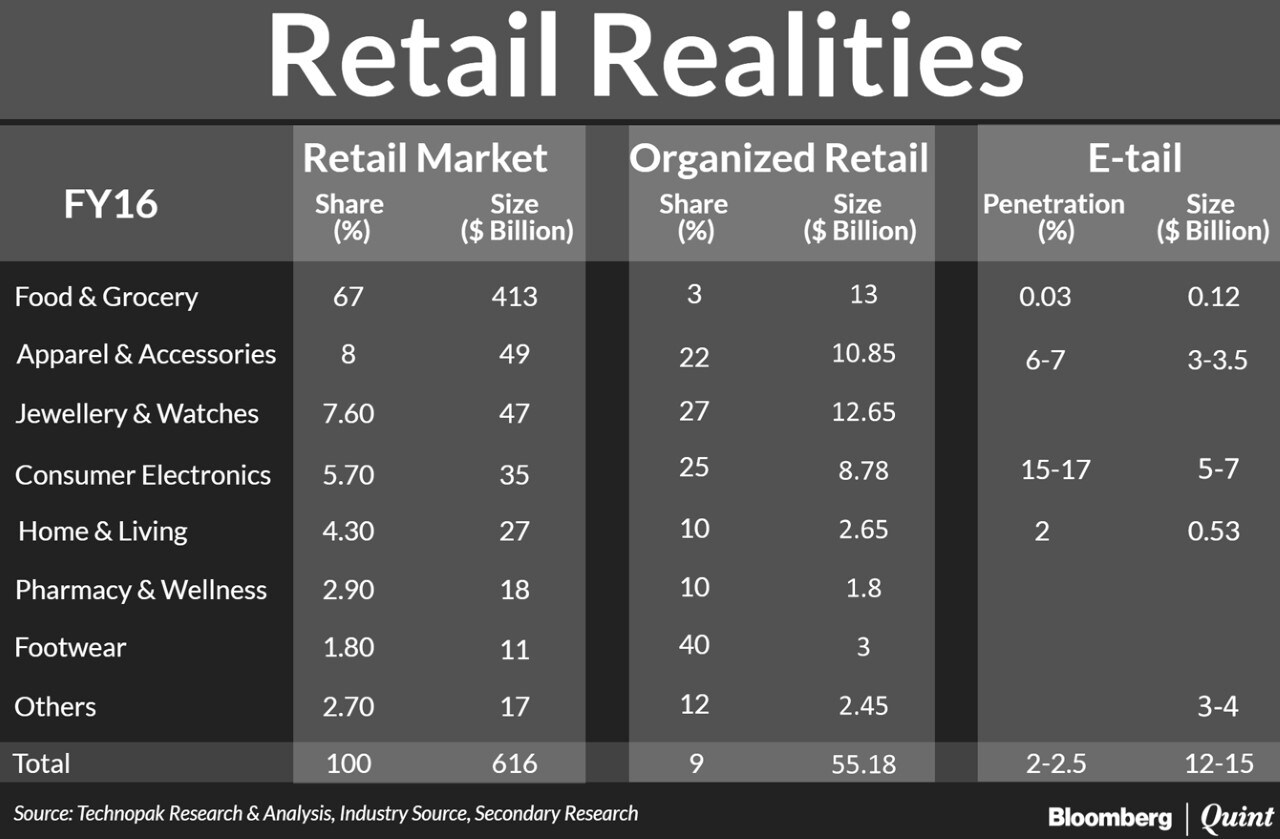
Given the scale and size of food and grocery business, there is no way that e-commerce players can ignore it, if they want to become really large in India. Flipkart had tried to enter the grocery business with an app called ‘Nearby' but decided to step back earlier this year to focus on the core business. Amazon has an effort underway under the Amazon Now banner and it has been trying to integrate with local kirana stores as well. Perhaps, BigBasket is the only online player in grocery with a clear focus and some scale in India with its inventory-led model. Hence, the opportunity is large and remains wide open for a well-resourced player to enter and dominate.
Can An ‘E-commerce' Company Be Successful In Food And Grocery?
One may object that food and grocery is a different business that needs a physical footprint and that very large Indian players already exist in this segment. However, it is actually a misnomer to call Flipkart and Amazon “digital” retailers as they are much more than that. Both of them have significant physical footprint in terms of distribution capability and in their ability to do last mile delivery at scale. They are also comparable in scale to the largest Indian physical retailers.
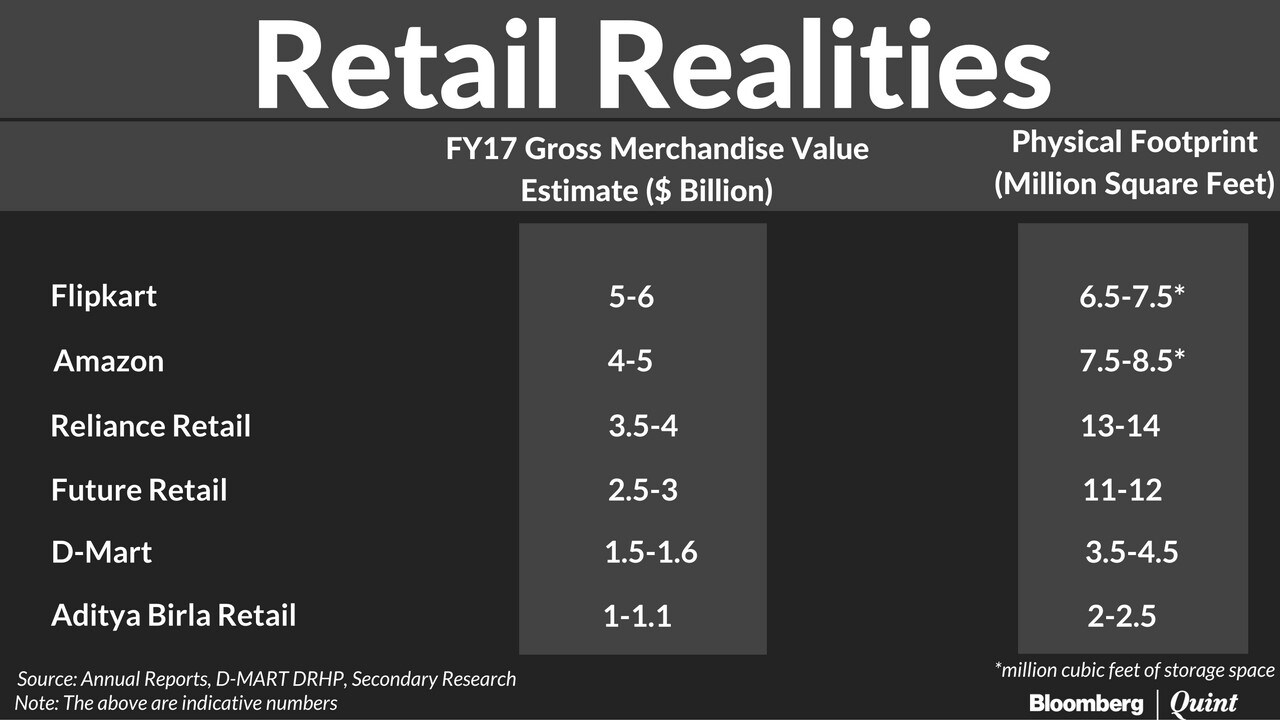
Let me point out that the above table is only directional in nature and is being used to make the point that the large e-commerce marketplaces are comparable in size to the largest Indian physical retailers. This should not be construed as a statement on the exact size and/or scale of the companies mentioned nor should direct comparability of numbers be assumed.
Why Flipkart and Wal-Mart?
Given the context above, a partnership with Flipkart would represent a great opportunity for Wal-Mart to grow its business multi-fold in India. Flipkart with its customer connect and last mile delivery capability can serve as a front end for Walmart's B2B stores. The stores in turn can now serve both as retail locations for businesses and warehouse locations for delivery. This will allow store locations to be ramped up much faster given the increased business potential. Layering on 2 hour/4 hour/one day/next day delivery to the Wal-Mart B2B stores backbone can allow several key grocery categories to be covered.
In fact, this is (was) the model that several grocery startups and hyperlocal companies were trying to build using Wal-Mart/Metro B2B stores. But without deep integration, it just doesn't work.
Not only could Flipkart become a key player in grocery, but it could also give Wal-Mart a presence on the front end to start building its brand in India and help it in becoming a leading player in the lucrative Indian food and grocery market. As and when FDI is allowed in multi-brand B2C retail, Wal-Mart will be well poised to step up and create physical presence.
.jpg "Flipkart's application is displayed in an arranged photograph. (Photographer: Brent Lewin/Bloomberg)")
Potential Deal Structure
From a deal structure perspective, Wal-Mart could buy 20-30 percent upfront for $2-3 billion and structure a path to control (right to buy a majority or the entire company) with Tiger/Naspers/others. The potential upside for existing shareholders and the long-term stability that Wal-Mart brings will help keep the initial valuation grounded for them.
There will be a few hurdles to cross for Wal-Mart – culture, the electronics focus of the current Flipkart business, and the leap of faith to invest a large sum in India. However, these don't seem insurmountable – the potential investment is small in the context of Wal-Mart's balance sheet and these are moments when long-term oriented strategic players like Wal-Mart strike.
From Flipkart's perspective, this will be a win-win deal for both the business and its shareholders. As mentioned earlier, the business will get the security of the balance sheet and long-term orientation of the world's largest retailer. It will also get an opportunity to build a large business in food and grocery, moving away from the head to head battle with Amazon into a relatively uncontested and a mammoth white space. The shareholders will get a logical buyer for the business with a potentially well-defined path to exit.
All in all, I would bet on this being be a transformational deal which will be good for both the companies and also consumers and vendors in India. As a side benefit, it will also re-energize the Indian start-up scene and dispel the needless doom and gloom that we are facing today!
Sarbvir Singh is an experienced venture capital investor in India and was the founding Managing Director of Capital18. The portfolio of companies that he has worked with include BookMyShow, Yatra and Webchutney among others.
The views expressed here are those of the author's and do not necessarily represent the views of BloombergQuint or its editorial team.
Essential Business Intelligence, Sharp Market Insights, Practical Personal Finance Advice, Daily Fuel, Gold and Silver Prices and Latest Stories — On NDTV Profit.