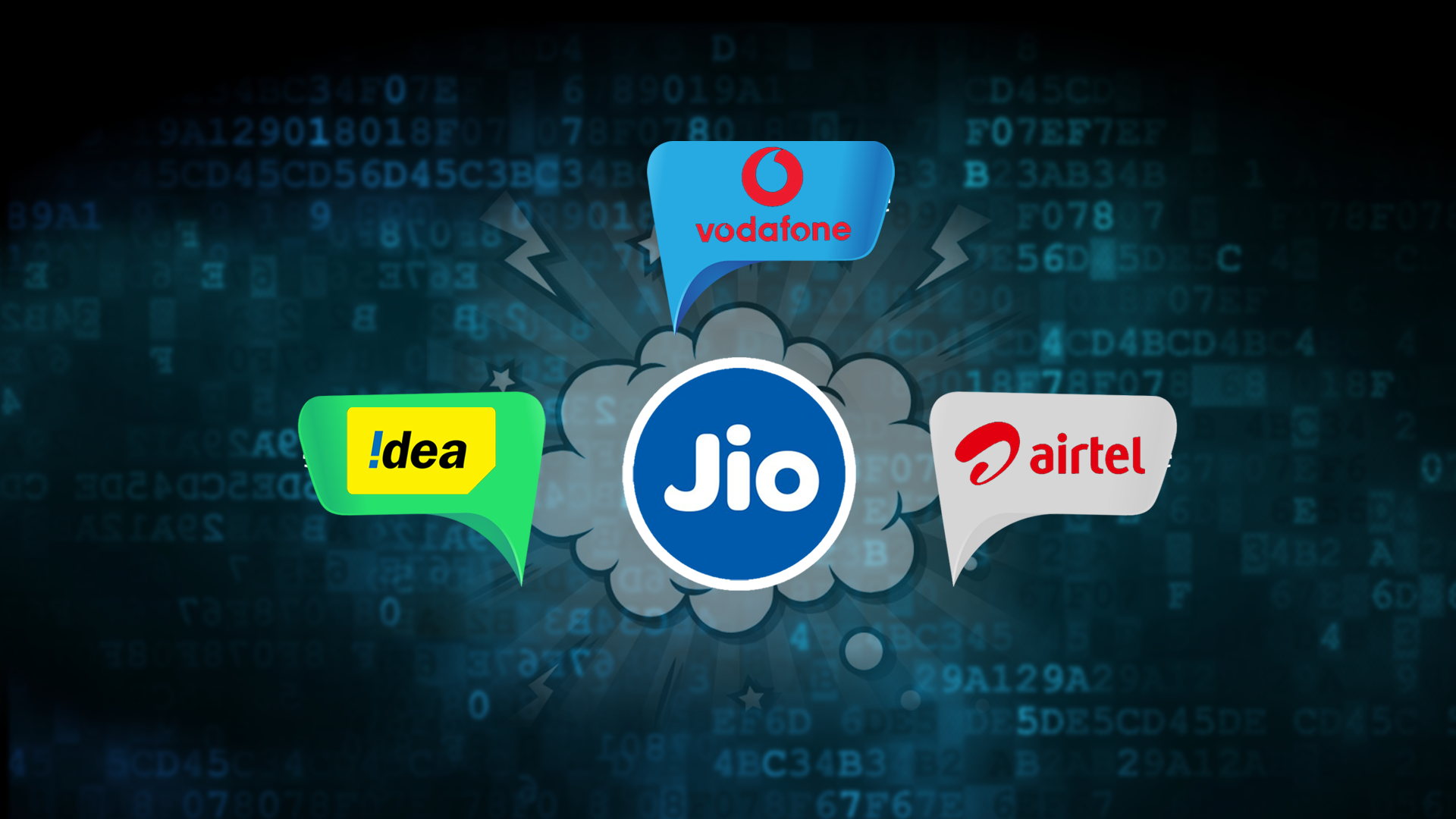
Airtel to pay Rs 1,050 crore; Idea Cellular to pay Rs 950 crore; Vodafone India to pay Rs 1,050 crore.
These are the penalties the Telecom Regulatory Authority of India (TRAI) recommended should be imposed on the three telecom service providers for not providing adequate points of interconnection to Reliance Jio Infocomm Ltd.
The non-compliance of the terms and conditions of the licence and denial of interconnection to Reliance Jio appears to be with ulterior motive to stifle competition and is anti-consumer.TRAI's Letter To DoT (October 21)
The TRAI concluded that Airtel, Idea, and Vodafone's failure to provide adequate points of interconnection was in violation of:
- Standards of Quality of Service of Basic Telephone Service (Wireline) and Cellular Mobile Telephone Service (Fourth Amendment) Regulations, 2009
- Cellular Mobile Telephone Service Regulations, 2009; and
- Unified Licence and Unified Access Service Licence
And so, it recommended that the Department of Telecommunications (DoT) should impose these penalties on the three service providers under the TRAI Act, 1997.
DoT: Unclear Of Its Penalty Powers?
In 2004, the DoT issued a circular allowing it to impose a penalty not exceeding Rs 50 crore in case of violation of terms and conditions of the licence agreement with telecom service providers.
This penalty is exclusive of Liquidated Damages as prescribed in this Licence Agreement: DoT's 2004 Circular
In January this year, the Tripura High Court held that this clause is opposed to public policy, ultra vires and is against the statutory provisions. The high court ruled so in the case of Dishnet Wireless where the company was penalised by DoT for having failed to meet the customer verification requirement. Dishnet challenged the penalty amount in the High Court and won.
As a result of this court order, the DoT, according to a PTI report, has now sought the Attorney General's opinion on whether or not it can impose the penalty recommended by the TRAI.
Did The Tripura High Court Clip DoT's Powers?
In its order, the Tripura High Court noted that the license agreement is a contract between the government and telecom service providers and so, is governed by the Indian Contract Act, 1872.
The question is whether you can apply the strict principles of contract law to regulatory contracts; there is a vast difference between a regulatory contract and a commercial contract, Vikram Nankani, senior advocate, Bombay High Court said in an interview to Bloomberg Quint.
Neitherside has argued this point. If the principles of commercial contract areapplied to regulatory contracts, it will result in a completely newjurisprudence.VikramNankani, Senior Advocate, Bombay High Court
Since this point was not argued before it, the High Court treated the license agreement as a contract and read down the clause that gives the DoT power to impose Rs 50 crore penalty. It held that the clause is in the nature of liquidated damages and not penalty. Damages are said to be liquidated when they have been agreed and fixed by the parties to a contract and are payable by the party that defaults on its obligation. Section 74 of the Indian Contract Act, 1872 provides for liquidated damages and the amount is subject to reasonable compensation i.e. the amount cannot exceed the sum agreed to by the parties in a contract.
Thisliquidated damage clauses are often wrongly described as penalty clauses. A clausewhich provides for liquidated damages for purpose of breach of contract areusually upheld by the courts. The courts do not uphold clauses which areintended as penalty to deter a breach of contract.Tripura High Court order (Dishnet Wireless vs Union of India)
In saying so, the court reasoned that a license agreement between DoT and a telecom service provider is a commercial contract and subject to liquidated damages not penalties.
Tushad Cooper, advocate, Bombay High Court pointed out that liquidated damages in a contract is an estimate of loss that one party may suffer if the other party commits a breach. The power to enforce liquidated damages is a different aspect and here the government must show the damage caused to it, he added.
Inthis case, it is Jio which is suffering a loss but it's the TRAI which issuggesting a penalty for failure to adhere to license conditions. And so, theHigh Court order will have some operation here to say that if the amount soughtto be imposed as penalty is above Rs 50 crore then the recommendation is badin law.Tushad Cooper, Advocate, Bombay High Court
Nankani added that the line of judgments that the high court has relied upon to distinguish between penalty and liquidated damages were in the context of commercial contracts. And so, before the apex court, if at all, answers the question regarding DoT's penalty powers, it will have to consider whether license, power purchasing or concession agreements can be treated as commercial contracts.
Essential Business Intelligence, Sharp Market Insights, Practical Personal Finance Advice, Daily Fuel, Gold and Silver Prices and Latest Stories — On NDTV Profit.