- Near term disruption to economic activity due to demonetisation remains acute
- Monetary Policy Committee has left its options open
- Expect repo rate to reach 5.75 percent by mid-2017
- Subtle changes in the monetary policy stance in the post Raghuram Rajan era
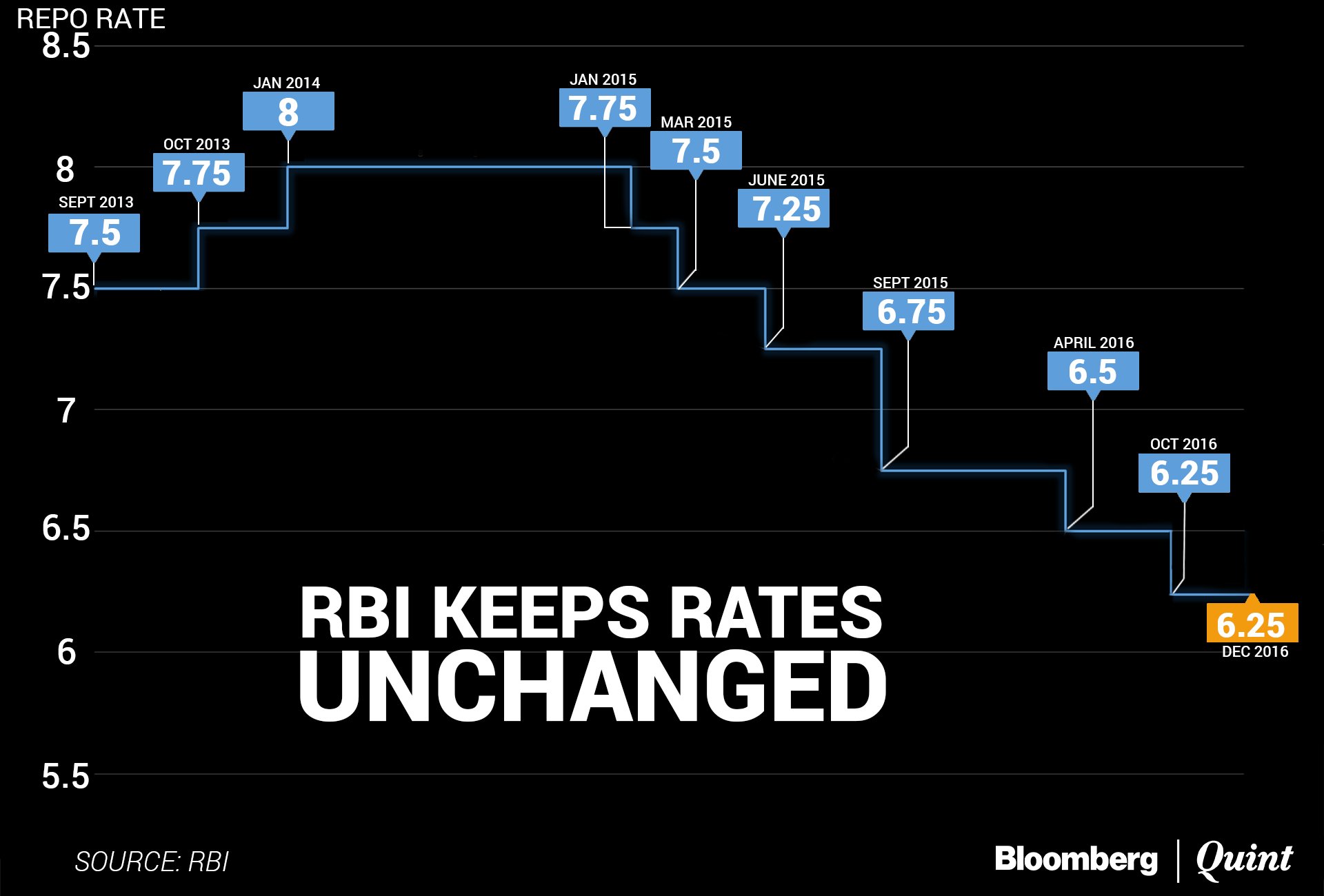
The RBI's decision to keep the repo rate on hold in December clearly springs a surprise. Indeed, 36 of the 44 economists surveyed by Bloomberg expected a repo rate cut in December – 31, including myself, expected a 25 basis points (bps) cut, while five had expected a more decisive 50 bps cut.
The December meeting was the second meeting for the newly-constituted monetary policy committee (MPC). Interestingly, all the six MPC members led by Governor Urjit Patel voted for a status quo on rates in the current policy. This was in sharp contrast to the October policy, when all the six MPC members voted for a 25 bps repo rate cut.
While the RBI remains broadly on an accommodative path, the December policy decision errs on the side of caution. The RBI flagged a few upside risks to the inflation trajectory, which, according to the central bank, are currently masked by a generally low headline inflation number driven largely by a favourable base effect. Overall, the RBI still feels that it is broadly on track to meet the target CPI level of 5 percent during Q1 2017. Such a CPI average is broadly in line with the Barclays' average CPI forecast of 5.2 percent during the quarter, though the month-to-month variability in the CPI prints can be sizeable.
The MPC clearly prefers to remain on a wait-and-watch mode at the moment as the effect of the recent ban on high denomination currency notes on major macroeconomic aggregates unfolds over the next few months.
Read: RBI Survey Shows Sharp Fall In Household Inflation Expectations
Expect 50 Bps In Rate Cuts During H1 2017
Indeed, currently the near-term disruption in economic activities due to the currency ban remains acute, likely affecting two to three quarters starting Q4 2016.
The near term damage appears most notable in the manufacturing, construction, trading and transportation sectors. The November Nikkei manufacturing PMI (survey period: 11-24 November), released last week, fell to 52.3 from a 22-month high of 54.4 in October.
The drop in services PMI was markedly more severe. The seasonally adjusted headline Nikkei India services PMI dipped from 54.5 in the previous reading to 46.7 in November. This was the sharpest fall in the services PMI in nearly three years as it entered the contraction territory for the first time since June 2015.
Overall, while still very uncertain, the government's currency ban move could pose a sharp downside risk of 50-100 bps to our FY 16-17 real GDP growth forecast of 7.5 percent. In this context, it is worth mentioning that it is possible that the economy rebounds into a decent growth zone after H1 2017. Currently we do not factor in any major downside risk to our FY 17-18 GDP growth forecast of 7.9 percent.
Read: Surprising But Prudent: How Economists Reacted To RBI's Rate Decision
The RBI feels that the risk to real economic activities (as per GVA) during FY 16-17 due to the currency note ban is about 50 bps. This remains at the lower end of our assessment of the downside risk of 50-100 bps on economic activities.
Importantly, the RBI flags that the current extreme disruption in economic activities due the currency ban is largely transitory and the central bank does not feel any need for monetary policy to respond to such a transitory factor. However, it is clear that the MPC has kept all options open for the subsequent policy meetings in the coming months.
Thus, while the RBI's current decision to stay on hold sprang a major surprise, it seems that the RBI, under Governor Patel and the MPC, will likely maintain bias towards a broadly accommodative policy stance given the generally well anchored inflation trajectory in 2017.
Subtle Changes In Monetary Policy Stance During The Post-Rajan Era
As regards the longer term path of monetary policy, we believe that the broad contours of Governor Raghuram Rajan's inflation targeting framework will likely not be altered, at least in the near term.
However, the RBI seems to have adopted a few subtle and between-the-lines changes.
First, as regards real interest rates, the RBI seems to be following a more flexible stance under Governor Patel and is not rigid about the 1.5-2 percent “target” for real interest rates that was frequently advocated by his predecessor. A generally well anchored path for inflation would likely provide room for the RBI to cut rates further in the coming months while still keeping real interest rates in the positive territory.
Second, as regards the inflation target, it seems that the RBI's most likely stance would be to remain committed to anchor inflation within a broad range of 4 percent (+/-2 percent) in the coming years, without following an aggressive policy to bring CPI down to 4 percent.
However, a critical factor in this context will be the sources of price rise. For example, the RBI will likely tolerate, for a few months at least, somewhat higher inflation, if driven largely by non-core factors, particularly if such factors are expected to be transitory. On the other hand, inflation driven by higher core prices would likely be a cause for a greater discomfort for the RBI relatively sooner.
Read: Transitory And Transient: How The RBI Sees The First Round Impact Of Demonetisation
Siddhartha Sanyal is chief India economist at Barclays Bank Plc.
The views expressed here are those of the author's and do not necessarily represent the views of BloombergQuint or its editorial team.
Essential Business Intelligence, Sharp Market Insights, Practical Personal Finance Advice, Daily Fuel, Gold and Silver Prices and Latest Stories — On NDTV Profit.