
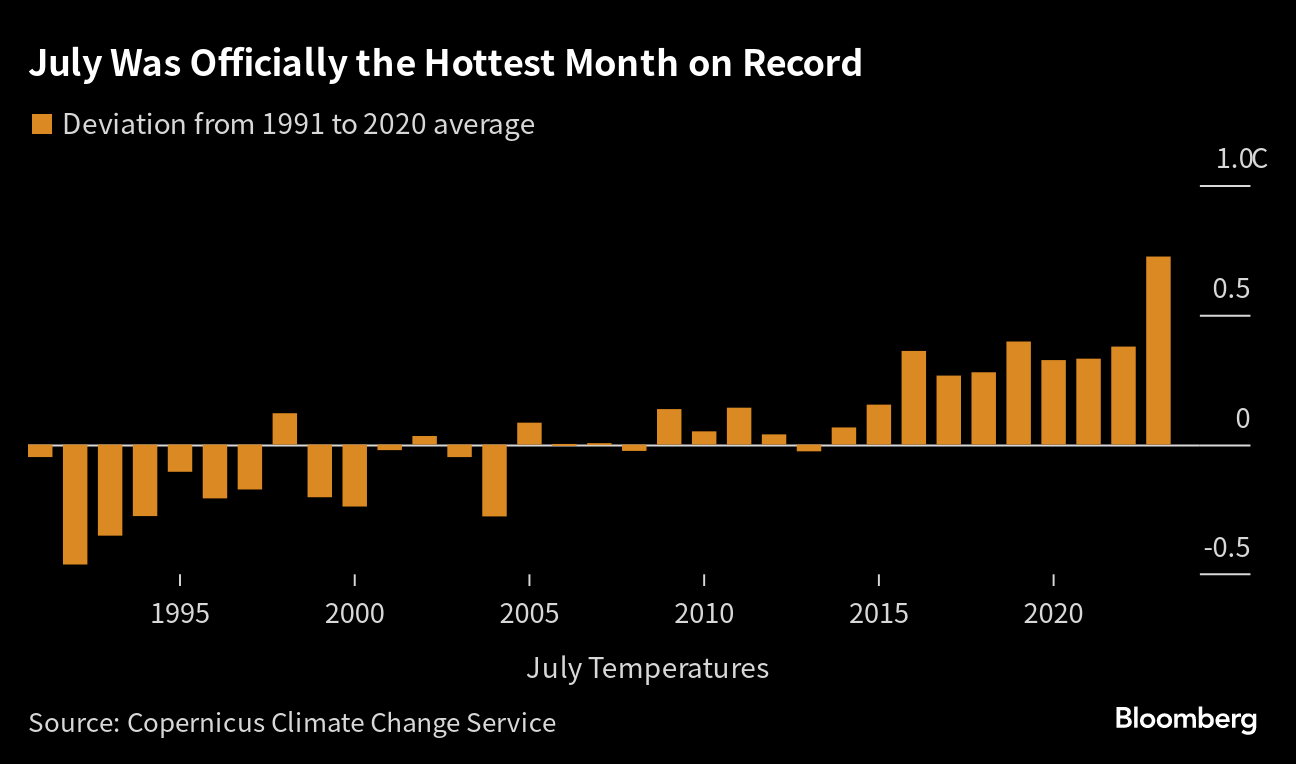
(Bloomberg) -- July was officially Earth's hottest month on record, causing the Antarctic to shrink at a record pace and the European Union's earth observation agency to warn of “dire consequences” as extreme weather events grow more frequent and more intense.
Global average temperatures rose above the previous record set in July 2019 by “the unusually large margin” of 0.33C, according to the EU's Copernicus Climate Change Service. Going back further, this July was 0.72C warmer than the 1991 to 2020 July average and about 1.5C warmer than the average for 1850 to 1900.
It's the first time global July temperatures have showed warming of 1.5C from preindustrial levels. While the threshold has become symbolic because it's the level set as the lower limit in the 2015 Paris Agreement, the goal in that document is for changes in 20 or 30 year averages — which aren't expected to be breached until the early 2030s.
July's heat spurred Antarctic sea ice to drop 15% below average, “by far the lowest July extent since satellite observations began,” Copernicus said. Sea surface temperatures globally were on average 0.51C above 1991 to 2020, making July the fifth month this year that the Antarctic reached record-low ice levels.
Read more: Antarctica May See ‘Cascades of Extreme Events,' New Study Warns
Last month's extreme weather events included heat waves across much of the Northern Hemisphere — in Europe, North America and Asia. Wildfires in Canada burned about 25 million acres of land, roughly the size of Iceland, and almost 200 wildfires in Greece forced evacuations. Italy and southwestern Europe experienced the driest conditions across the Mediterranean basin, Copernicus said.
The Copernicus Climate Change Service publishes monthly climate bulletins using billions of measurements from satellites, ships, aircraft and weather stations around the world.
(Updates details of Paris Agreement in third paragraph.)
More stories like this are available on bloomberg.com
©2023 Bloomberg L.P.
Essential Business Intelligence, Sharp Market Insights, Practical Personal Finance Advice, Daily Fuel, Gold and Silver Prices and Latest Stories — On NDTV Profit.