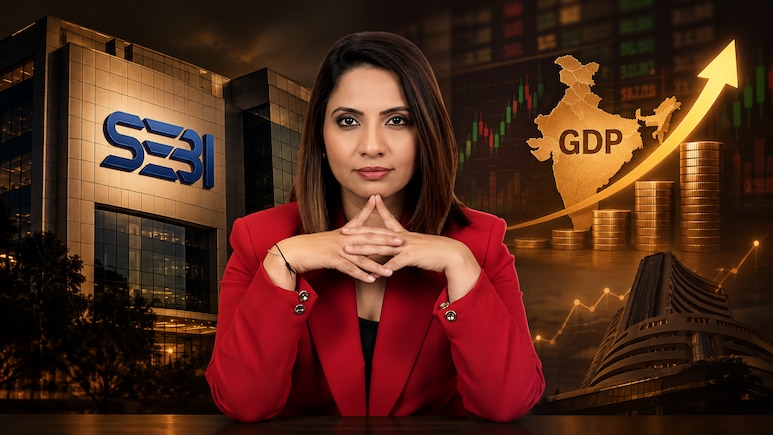
- India's Q1 FY27 GDP grew 7.8%, data released with a lag on August 31
- Former finance secretary disputed GDP growth using nominal terms, sparking debate
- World Bank's Neelkanth Mishra defended official GDP figures citing methodology differences
Tracking the Gross Domestic Product (GDP) numbers that the Ministry of Statistics and Programme Implementation (MoSPI) puts out every quarter is bread and butter for business journalists. The data point matters because it gives a broad sense of how the economy is doing across segments, and what's happening with private investment and consumption. It rarely moves markets, though, because the data arrives with a lag.
For instance, we learned that India grew 7.8% in the April-June quarter of 2026 (Q1 FY27). That information reached us on August 31. For markets, which are forward-looking, the GDP print is largely a feel-good factor confirming India's resilience through a tough period, not really breaking news. The green shoots had already shown up in high-frequency data like vehicle registrations and record power consumption, and were visible in Q1 corporate earnings and management commentary too.
ALSO READ: India's GDP Data: Debate Is 'A Waste Of Time', Adds Uncertainty, Says World Bank's Neelkanth Mishra
Which is why it was a bit of a surprise when questions over the credibility of the first-quarter numbers turned into a viral debate. Former finance secretary Subhash Chandra Garg argued that GDP should also be judged in nominal terms, that is, before adjusting for inflation, and that using the previous year's base for the same quarter, nominal growth works out to under 2.5%, against the 10.3% nominal growth implied by the revised numbers.
Neelkanth Mishra, India's Executive Director at the World Bank, called the comparison "ill-educated and egregiously wrong" in an interview with NDTV Profit, pointing out that Garg's figure mixes a nominal, current-price comparison on the old base with the 7.8% headline, which is a real, inflation-adjusted number on the new base.
Mishra's rebuttal has a paper trail behind it: a note from Axis Bank's economics team, which he headed until he moved to the World Bank in June, had already flagged the downward revision back on March 1, attributing it to an overestimation of the informal economy's post-Covid recovery in FY23 rather than any weakness in current growth. Axis Bank had held an above-consensus FY27 growth forecast of 7.5% at the time, a call Mishra has now reiterated.
ALSO READ: The First Month Of CAS Has Identified The Next Market Structure Question
That still leaves the softer question hanging: why doesn't growth of 7.8% feel like 7.8% to a lot of people? That's a debate about lived experience versus aggregate data that no methodology note can fully settle. It is, however, a good sign that demands for a better quality of life, infrastructure and opportunity have entered mainstream discourse. That's a far healthier debate for public life to be having.
The CAS effect
The Securities and Exchange Board of India's (SEBI) decision to revisit the Closing Auction Session (CAS) mechanism deserves credit. Rolled out on August 3 to determine closing prices for stocks eligible for futures and options (F&O) trading, the new 20-minute window drew swift pushback: sharp price spikes, a widening gap between the Sensex and Nifty closes, and F&O turnover falling 22% in August to a 14-month low.
After weeks of feedback from brokers, foreign portfolio investors and mutual funds, SEBI said this week it will issue a consultation paper within a week to revisit how settlement prices for derivative contracts are determined on expiry days. Exchanges have already tweaked the reference-price formula, switching to the volume-weighted average price (VWAP) of trades between 3:00 pm and 3:15 pm. It's rare for a regulator to move this quickly to fine-tune a freshly launched mechanism. That SEBI did so, after actively canvassing feedback from stakeholders, is the kind of responsiveness Indian markets could use more of.
ALSO READ: SEBI To Review F&O Settlement Price Methodology After CAS Rollout; Consultation Paper In A Week
The $500 toothbrush
James Dyson is 79, and still shipping products most people half his age wouldn't dream up. He personally unveiled the CameraJet, Dyson's first-ever toothbrush, in Paris on September 1, telling reporters the six-year project traces back to his own dislike of flossing. Priced at $499 in the US (£419.99 in the UK), it's almost absurdly over-engineered for a toothbrush: a 100,000-pixel macro camera that captures 28 images a second, machine learning that spots gaps between teeth, and a conical water jet that flosses and rinses those exact spots while you brush.
Dyson says the camera doesn't record or store any images. It's a lot of money and a lot of technology to point at oral hygiene, but that's rather the point. More than three decades after the bagless vacuum cleaner made his name, Dyson is still finding new categories to disrupt, and setting an oddly high bar for what a gadget under $500 should be able to do.
ALSO READ: Investing In Arbitrage Funds After CAS? Here's A Smarter Way To Deploy Your Money
Essential Business Intelligence, Sharp Market Insights, Practical Personal Finance Advice, Daily Fuel, Gold and Silver Prices and Latest Stories — On NDTV Profit.