(Bloomberg Opinion) --
If you're looking for signs of economic malaise and cracking consumers, you're not going to find many in the private-jet market.
Textron Inc., the maker of Cessna jets and Beechcraft turboprops, and General Dynamics Corp., the manufacturer of Gulfstream planes, both reported fourth-quarter earnings on Wednesday and said their aerospace order backlogs continue to be robust. “The only headwind that I see we run into is just on availability, right? People would like to get aircraft sooner,” Textron Chief Executive Officer Scott Donnelly said on a call to discuss the results. “There's no doubt there's demand.”
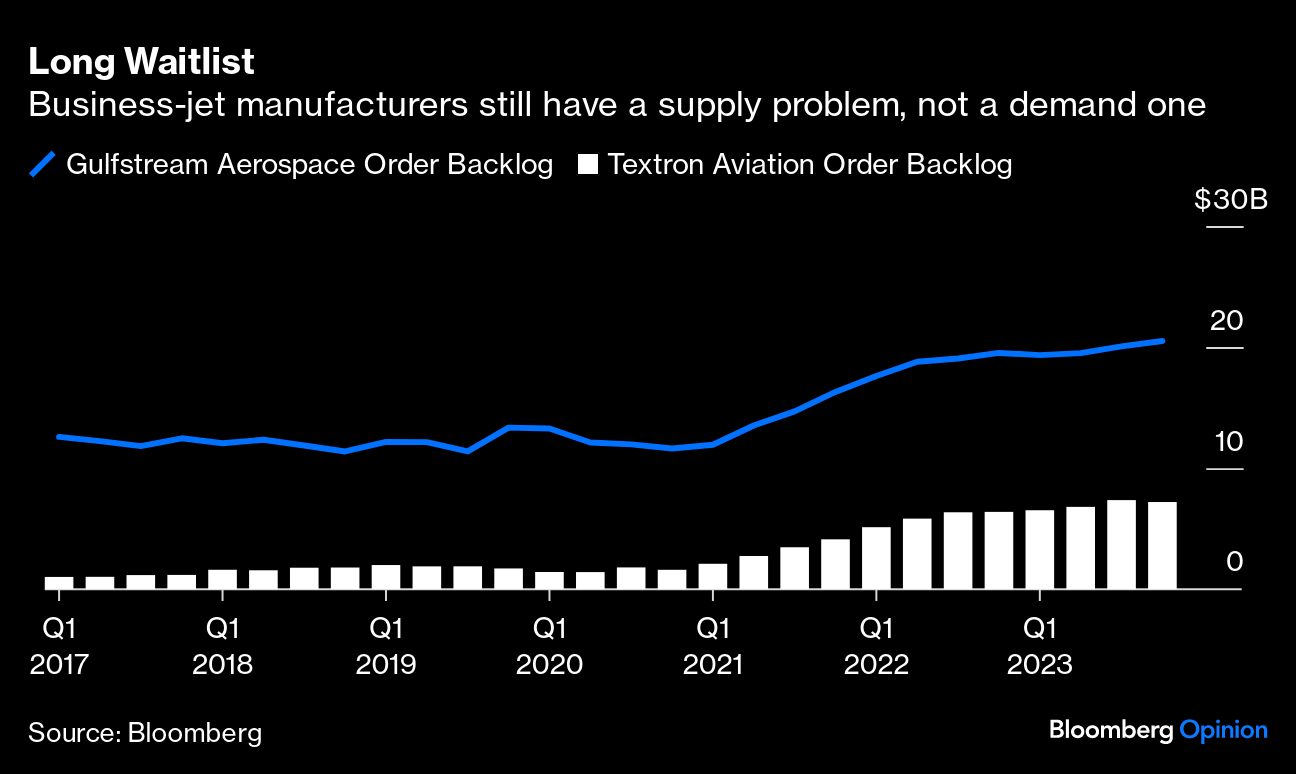
General Dynamics ended the year with an aerospace backlog of $20.5 billion, up about $1 billion from 2022. The company is still awaiting Federal Aviation Administration certification of its Gulfstream G700 jet, which meant the company couldn't deliver 15 aircraft that were ready to go in the fourth quarter. That cost it $1 billion in revenue and $250 million in earnings in the fourth quarter and likely elevated its tally of unfilled orders. Still, the company's aerospace backlog has increased more than 70% since the first quarter of 2021, and the only meaningful pauses in order activity have been short term and linked to the collapse of Silicon Valley Bank last March and the Hamas attack on Israel in October, CEO Phebe Novakovic said.
Like many industrial companies, business-jet manufacturers struggled with higher-than-expected workforce retirement and attrition levels during the pandemic and had to hire huge numbers of less experienced staff. As those new workers get settled in, productivity is improving, allowing Textron and General Dynamics to churn out more planes. General Dynamics has asked customers to schedule pre-delivery inspections with an eye toward handing over the first G700 jets sometime this quarter. All in, the company expects to deliver 160 Gulfstream jets this year, up from 111 in 2023. There will be another step up in deliveries in 2025 and yet another in 2026 as the company works through supply chain constraints, Novakovic said. While Textron didn't give a specific target for deliveries this year, it expects there to be more of them than in 2023.
Manufacturers collect the bulk of the cash flow and revenue associated with a particular aircraft when they actually deliver the plane, so increased handovers are good for the companies' reported results. But accelerated deliveries can also create the perception of slowing demand if orders aren't coming through at a commensurate pace to replace what's being shipped out. That turning point has been one that analysts have been eyeing cautiously for months as higher interest rates and inflation force consumers to pull back on other big-ticket items. So far, though, there's little sign that this notoriously boom-and-bust market is heading for another serious slump.
In fact, it's possible that all the doom-and-gloom prognostications about the economy may have actually suppressed business-jet purchases somewhat in 2023 and that easing fears about a recession, combined with moderating interest rate pressure, could unleash yet another wave of demand. Companies are flying their corporate jets more — including for personal travel for the CEO — in a sign that they can't be that worried about cost control.
“I don't see us particularly burning through backlog given the robust backlog we have and given the robust pipeline that we have,” Novakovic said. “Our order rate has been quite healthy and quite wholesome.”
Read more: Private-Jet Market Heads for Smooth Landing
While business-jet flight activity has been waning since the go-go days of the pandemic, private-plane trips remain elevated relative to the pre-Covid period. About 2.7 million business-jet flights were flown in North America last year, roughly 4% fewer than in 2022 but 18% more than 2019, according to WingX, an aviation data and consultancy company. It's hard to get a clear read on 2024 just yet as January is typically a seasonally weak month for business-jet activity, and several winter storms have kept planes on the ground. In the US, the rise in business-jet traffic since 2019 works out to only about a 4% compound annual growth rate, according to WingX. That pace of expansion is meaningfully better than what the market experienced pre-pandemic but not so brisk that it would suggest a high level of froth.
The biggest risk to the business-jet market may be operators of private-plane taxi services whose financial challenges threaten to unleash extra inventory. Wheels Up Experience Inc., the private-jet service operator that merged with a blank-check company in 2021, came uncomfortably close to bankruptcy last year before securing a rescue financing package from a consortium of investors including Knighthead Capital Management, Certares Management and Delta Air Lines Inc. Bonds of rival VistaJet have come under pressure recently amid high losses and debts, as documented by the Wall Street Journal. The number of used jets for sale has started to tick up from historically low levels, but for now, most of the available planes are quite old and there's little risk of that inventory cannibalizing demand for new models, Donnelly of Textron said. Manufacturers are still playing catch-up from the extended lull in private jet sales after the global financial crisis, so that also helps keep supply under control, Melius Research analyst Robert Spingarn wrote in a report this month.
Textron expects the pace of orders to roughly match its deliveries in 2024, although Donnelly noted he had the same goal for 2023, and the annual book-to-bill ratio ended up being a bit higher than that. Textron had $7.2 billion worth of outstanding orders in its aviation unit exiting 2023, up $782 million from the already robust pace of bookings in 2022, although some of those gains can be chalked up to price increases. Higher prices added $100 million to Textron's aviation sales in the fourth quarter. “We always have a little bit of lumpiness in terms of when deposits are coming in on some of our larger customers,” so there may be quarters that look more lopsided one way or the other, but that is more of a timing issue than a fundamental one, Donnelly said.
Things can change quickly in the business-jet market, but for now, it's operating at a comfortable cruising altitude.
Chart of the Week
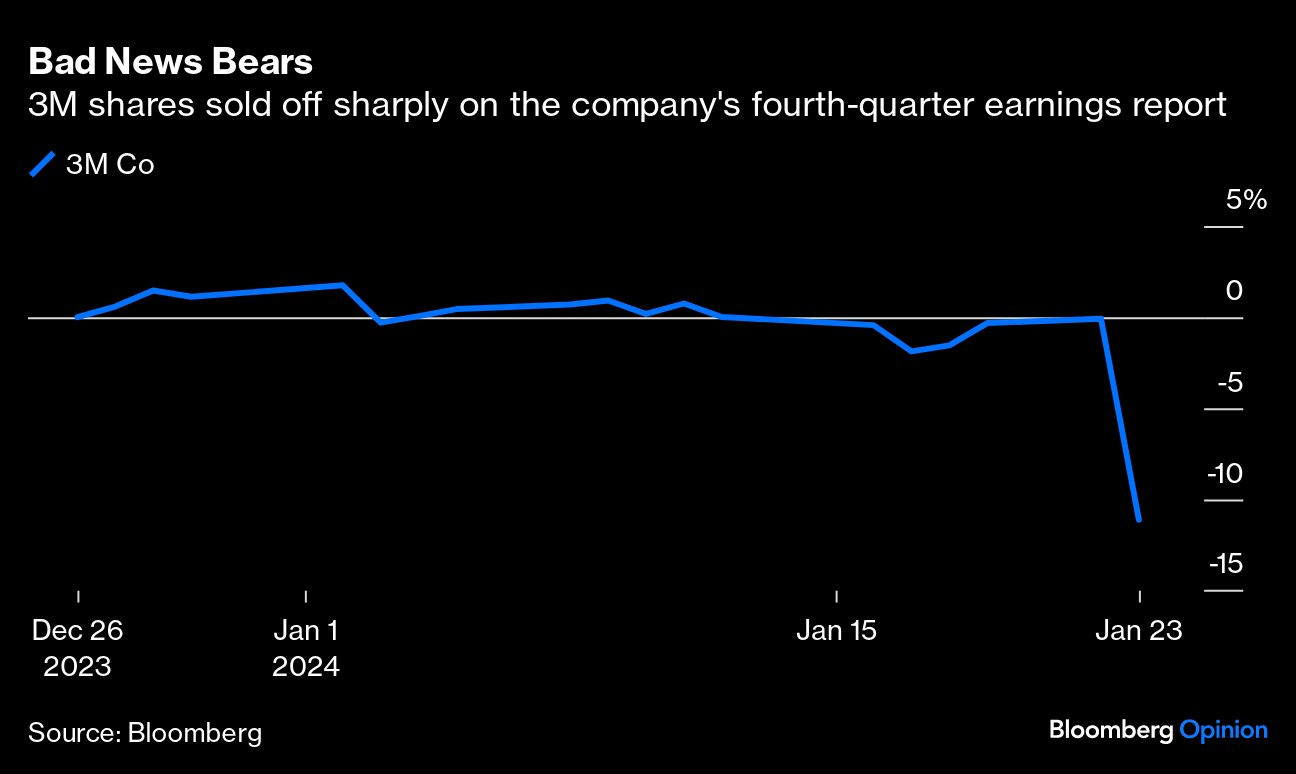
3M Co. had its worst earnings day selloff in five years this week after the company's 2024 guidance fell short of analysts' estimates. The stock closed down 11% on Tuesday for the biggest drop since April 2019. The reaction seems a tad extreme; there was nothing terribly new or noteworthy to worry about in 3M's latest investor update, and the company has had no shortage of disappointing earnings reports and legal woes in recent years. 3M's deep market rout over the past three years should make this a stock that's “more likely to perk up on bad news than go down,” Melius Research analyst Scott Davis wrote in a note. “I know people hate this stock, I get it — the company has been accident prone for some time, but this is a head scratcher to us.” And yet, 3M shares were trading down again on Wednesday, suggesting this was more than just a knee-jerk selloff.
There were a number of moving parts in 3M's fourth-quarter results, which is never particularly helpful and makes it harder to assess the company's profitability profile. 3M expects sales to at best increase 2% this year after adjusting for the impact of acquisitions, divestitures and currency swings. Such pedestrian growth after a 3.2% decline in adjusted organic sales in 2023 isn't particularly exciting and may have disappointed investors looking for industrial green shoots. The Institute for Supply Management's benchmark measure of US factory activity is now in its longest stretch of contraction since the dot-com bubble burst in the early 2000s. It has now been 34 months since the manufacturing gauge peaked in March 2021. That's twice as long as the normal amount of time it takes the benchmark to bottom out. Eventually, activity has to pick back up. But 3M's weak outlook underscores how the recovery may end up being pretty shallow.
Read more: Industrial Outlook Is a Mixed Bag for 2024
Deals, Activists and Corporate Governance
Forward Air Corp. negotiated new terms for its controversial takeover of Omni Logistics, ending a monthslong campaign to try to get out of the deal. Shareholders of freight forwarder Omni will now receive $20 million in cash and 35% of Forward's pro forma common equity, down from $150 million and 37.7% previously. The new terms imply an equity valuation of about $743 million based on last week's closing prices, less than half the initial price tag. The agreement ends the litigation between Forward Air and Omni, which now expect the transaction to close by the end of the week. The deal has few fans. Omni had been a customer of Forward Air's, and the company's encroachment on the freight-forwarding territory raises the risk that it loses business with other existing clients. A group of investors had sued over an unusual structure for the deal that would have diluted existing holders and not allowed them to vote on the transaction, while activist Ancora Alternatives had called for a management revamp, going so far as to call CEO Tom Schmitt the company's “chief value destroyer.” Forward's shares have slid more than 50% since the deal's announcement. Vertical Aerospace Ltd., a once highflying electric plane taxi firm backed by American Airlines Group Inc., has secured $50 million in fresh funding from its founder Stephen Fitzpatrick to help stave off a potential cash crunch. Fitzpatrick told Bloomberg News he preferred to invest more of his own money into Vertical Aerospace because taking outside investment at the current beaten-down stock price would have been too dilutive and would not have reflected the company's potential. Like many companies that participated in the merger boom with blank-check companies, Vertical Aerospace's shares have since collapsed. The company received notice from the New York Stock Exchange in late November that it's at risk of being delisted because the share price has hovered below the $1 mark for too long. The notice started a six-month clock to get the stock price back in compliance with the exchange's requirements.
Bonus Reading
- Something in Boeing's culture is broken. Take it from customers.
- Boeing's quality-control processes are a mess
- Inside Shawn Fain's fight for worker rights
- Every Boeing plane is fair game as the FAA investigates
- Leonardo wants to help consolidate the European defense sector
- Red Sea drama shows why shippers should be taxed like everyone else
- We don't really know how much US farmland China is buying
- Electric planes may actually have some promise
- Why are blueberries so expensive?
- Why did Mahomes' helmet crack?
- Why is a bank running a chain of cafes?
This column does not necessarily reflect the opinion of the editorial board or Bloomberg LP and its owners.
Brooke Sutherland is a Bloomberg Opinion columnist covering deals and industrial companies. A former M&A reporter for Bloomberg News, she writes the Industrial Strength newsletter.
More stories like this are available on bloomberg.com/opinion
©2024 Bloomberg L.P.
Essential Business Intelligence, Continuous LIVE TV, Sharp Market Insights, Practical Personal Finance Advice and Latest Stories — On NDTV Profit.