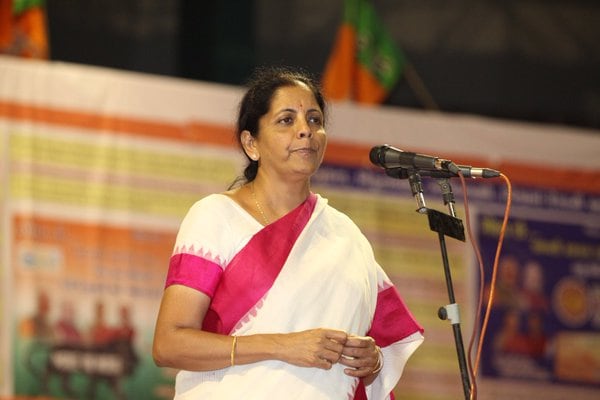
The Cabinet led by Prime Minister Narendra Modi approved duty concessions under the Asia-Pacific Trade Agreement (APTA) on Monday. The pact will help enhance trade ties between India, China, and other countries, Commerce Minister Nirmala Sitharaman said during a media briefing on Monday.
APTA is the only operational trade agreement between India and China. Negotiations with the 16-member Regional Comprehensive Economic Partnership (RCEP) are still underway.
Th Cabinet approval increases the number of products that benefit from duty concessions extended by India - from an earlier determined 570 to 3,124. The negotiations indicate that each of the six APTA member nations will provide 28 percent of their goods and services at concessional rates to other member nations.
This approval also allows APTA countries to export more products to India at a concessional rate, especially via government procurement like for railway locomotives.
Sitharaman added that India is looking at exporting raw materials including mineral ores to other Asian countries. “India stands to benefit from China and Korea's duty concessions on textiles and iron and steel,” said Sitharaman.
“RCEP is a lot more ambitious than APTA. RCEP is a comprehensive treaty and still in the process of negotiations. APTA will be a preferential trade agreement and it matters more as member countries are important and India is the founding member of APTA. We are hopeful of a quicker ratification of agreement among APTA members,” said Sitharaman.
Till date, three rounds of trade negotiations have taken place. Up to the third round, India has offered tariff preferences on 570 tariff lines at an average Margin of Preference (MoP) of 23.9 percent and an additional 48 tariff lines to LDC members at an average MoP of 39.7 percent at the 6-digit HS level. The third round, with respect to all participating states, cumulatively covered concessions on 4,270 products with MoP of 27.2 percent.Government Statement on Cabinet Decisions Taken On September 12
APTA covers six countries including founding member India, Bangladesh, China, Lao People's Democratic Republic, Republic of Korea, and Sri Lanka. The commerce ministry had sought Cabinet approval to expand the scope of the APTA agreement to promote domestic manufacturing, in line with the government's Make In India campaign.
Having received Cabinet approval, APTA now becomes the first pact to consider the inclusion of manufacturing and employment opportunities as part of India's trade negotiations.
The Cabinet approved India's offer of 28.01 percent of dutiable national tariff lines (i.e. 3142 lines in HS2012 at 8-digit) with an average MoP of 33.45 percent. This will deepen the concessions being offered under this Agreement. Approval was also given to amend the preamble of APTA to effect accession of Mongolia as the 7th APTA Participating State. Other amendments to incorporate the Sectoral Rule of Origin to the Agreement were also approved.Government Release on Cabinet's September 12 Decisions
“28 percent of each country's tariff lines will be offered for preferential trade. China has offered textiles, gems and jewellery and others for trade. None of the goods will have zero duty other than list of 20 goods that has been part of the list before,” explained Sitharaman.
Answering a question on when other countries will ratify the treaty, Sitharaman said India is looking at a January 2017 deadline for the treaty to be approved.
The Minister added that India has witnessed “constructive development in accessing markets with important countries,” and this Cabinet approval will help strengthen India's position in the sphere of trade.
“India is focusing on opening up government procurement, aircraft & spacecrafts in APTA agreement. We haven't given access to steel and iron ore to APTA countries yet. India is taking calibrated approach towards imports,” said Sitharaman.
When asked if the trade pact under APTA will be subsumed by RCEP once those negotiations conclude, the minister responded by saying, “RCEP is a lot more ambitious than APTA. That will take time.”
The negotiations on regional economic pacts with RCEP member countries started in 2013, and they cover trade in goods and services, competition, intellectual property rights, economic and technical cooperation among other issues. Member countries include 10 ASEAN countries, such as Indonesia, Malaysia, Philippines, Singapore, Thailand, Vietnam, Myanmar and others and six of their trade partners including India.
On August 24, Sitharaman had said during a media briefing that RCEP will miss the December 2016 deadline of concluding trade negotiations and added that she is hopeful talks will conclude by the end of 2017.
Essential Business Intelligence, Continuous LIVE TV, Sharp Market Insights, Practical Personal Finance Advice and Latest Stories — On NDTV Profit.