(Bloomberg Opinion) -- Here's some good news for electric cars: They're cheaper than ever. Here's some bad news for electric cars: They're cheaper than ever.
If this sounds like a paradox, it shouldn't. On Friday, Tesla Inc. cut prices in China for its best-selling Model 3 sedan by 5.9%, lowering the starting price to 245,900 yuan ($34,300). That pushes the cost of a new vehicle below $35,000 — a fabled level that Elon Musk has been promising since 2016, but (mostly) has failed to deliver.
Just hours earlier, one of the biggest buyers of Model 3s announced a sudden change to its electric-vehicle strategy. Hertz Global Holdings Inc. will sell a third of its US EV fleet and buy gasoline-powered vehicles instead, in what looks like the start of a dramatic reversal to the aggressive electrification policy it pursued in recent years.
The two events have identical causes. The falling cost of EVs is a boon for prospective buyers who want to get hold of an affordable ride. They're a disaster, however, for financially-attuned fleet owners such as Hertz, who will see depreciation accelerate and the value of their assets decline.
That makes Hertz's decision to buy 100,000 Model 3s in October 2021 — its first major policy since exiting bankruptcy earlier that year — look inexplicably foolhardy in retrospect. Musk (who locked in car sales) and everyday consumers (who are now getting cheaper cars) did well out of this episode. Car rental companies, not so much.
Granted, it was a strange time, when Covid-19 appeared to have torn up many financial rules.
Hertz had sold about a third of its fleet to pay its creditors, but then had to bulk back up. Shortages of semiconductors were causing delays in new car deliveries, and prices for used automobiles were rising as much as 45% year-on-year in the US. Musk, meanwhile, had been making the always-dubious claim that the rules of economics didn't apply to his vehicles: In a 2019 podcast interview, he said that a Tesla was “an appreciating asset — not a depreciating asset.”
Laws of nature, however, have a nasty habit of reasserting themselves. Depreciation is a key risk for rental companies, which can see a huge slice of their asset base wiped out at the stroke of an accountant's pen — roughly what happened in 2016, when Hertz shares fell 23% after it announced resale values were coming in well below its estimates. As a result, they have traditionally demanded steep discounts from manufacturers to provide a cushion against such losses — but Hertz appears to have neglected this in its Tesla deal, as Musk boasted at the time.
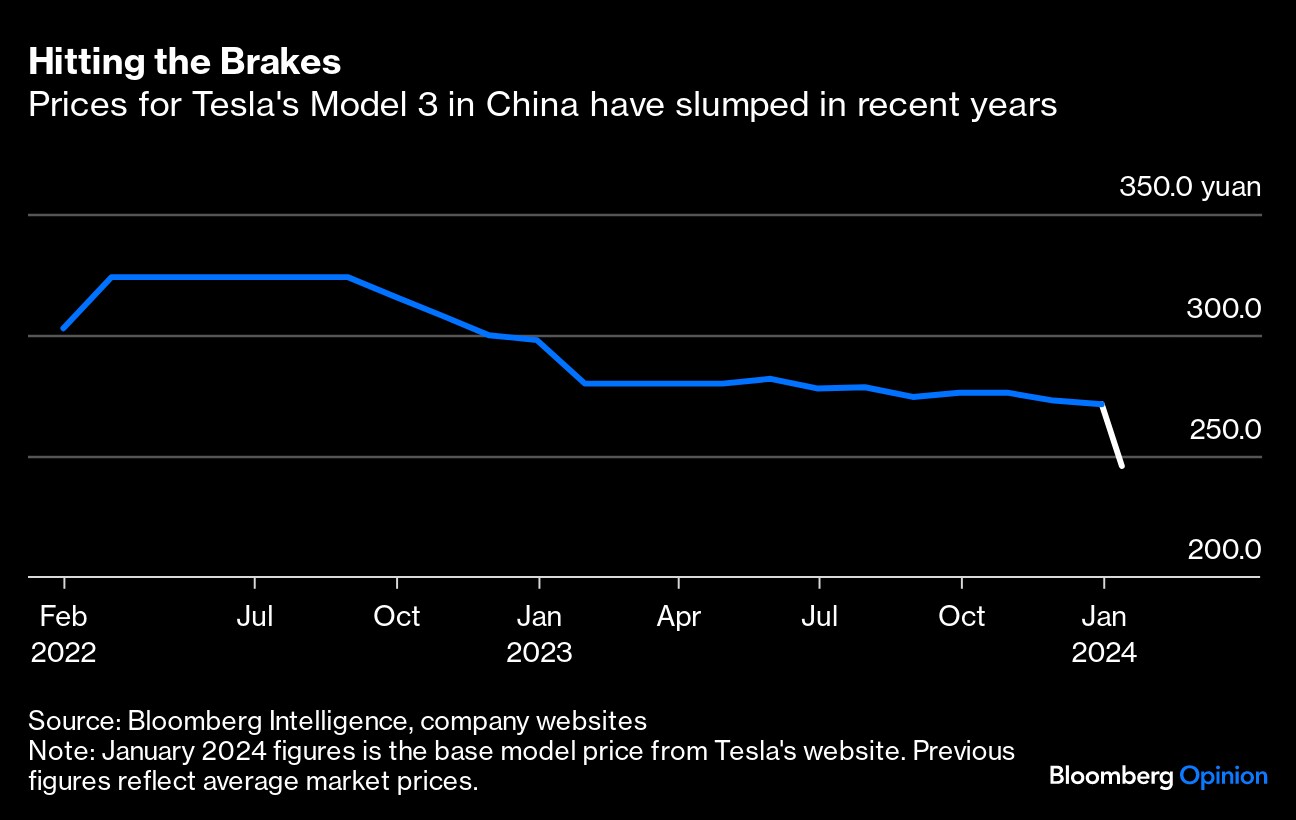
In retrospect, that looks like a fatal mistake. Musk's master-plan — start off building premium cars and invest the proceeds in making ever-cheaper mass-market vehicles — has always been predicated on rapidly falling costs for EVs. History has proved that bet right: Official prices for Model 3s are now about a third lower than when Hertz struck the original deal, Chief Executive Officer Stephen Scherr told an earnings call in October. Buying at full price from a man whose wealth was based on speeding the pace of EV depreciation looks like a remarkably bad business decision.
Hertz's loss, however, is ordinary consumers' gain. Individual owners don't appear to care that much about depreciation. The average car loses about half its value in the first three years, and yet people go on buying new cars regardless. Indeed, our inability to properly calculate how much we pay for our cars has long been a bugbear for EV promoters. Since we also fail to factor in the additional money we spend on fuel and maintenance, most people don't realize how much money they could be saving by going electric, and instead focus almost exclusively on the driveaway price they'll get from a car dealer. It's precisely carmakers' determination to get retail prices to parity with gasoline-powered equivalents that's caused such a depreciation headache for Scherr.
Price parity now appears to be arriving. That's great news for the electric car industry, and for drivers who've not been able to afford a battery vehicle — but it offers a silver lining for the beleaguered rental companies, too. Consumer appetites for EVs appear to be getting sated just as production of the vehicles ramps up, and manufacturers' recent scaling back of electrification plans may not happen fast enough to prevent another wave of oversupply and discounting.
Hertz's original Tesla deal was made at the top of a sellers' market for EVs — but over the next 12 months, the advantage will move back to the buyers. For rental companies, and individual car owners, that's going to be the ideal time to make a purchase.
More From Bloomberg Opinion:
- It's Not Tesla in BYD's Sights. It's the Whole Car Industry: David Fickling
- Let's Resolve to Ditch the $100,000 EV in 2024: Liam Denning
- Industrial Outlook Is a Mixed Bag for 2024: Brooke Sutherland
This column does not necessarily reflect the opinion of the editorial board or Bloomberg LP and its owners.
David Fickling is a Bloomberg Opinion columnist covering energy and commodities. Previously, he worked for Bloomberg News, the Wall Street Journal and the Financial Times.
More stories like this are available on bloomberg.com/opinion
©2024 Bloomberg L.P.
Essential Business Intelligence, Continuous LIVE TV, Sharp Market Insights, Practical Personal Finance Advice and Latest Stories — On NDTV Profit.