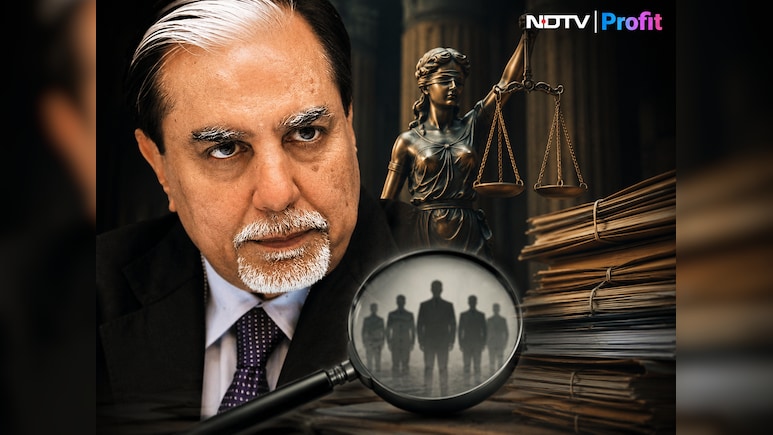
- NCLT approved Dr Subhash Chandra's insolvency plan with a 99.97% haircut for creditors
- Five related entities with 61.78% voting power were allowed to vote by the tribunal
- Experts say ruling exposes legal gaps allowing related parties to influence repayment plans
The National Company Law Tribunal (NCLT) has approved a personal insolvency repayment plan for media tycoon Dr Subhash Chandra that leaves creditors with just Rs 6.5 crore against Rs 22,000 crore in admitted claims, a 99.97% haircut. The order turned on whether five entities with financial ties to Chandra were eligible to vote in the committee of creditors (CoC). NCLT judge Nilesh Sharma ruled they were, holding that none of them met the narrow legal definition of "associate" under India's personal insolvency framework.
"There is no doubt about the fact that the said entities are controlled directly or indirectly by the individuals related to the PG," Judge Sharma wrote in his order, using the shorthand for personal guarantor and naming the five entities: Veena Investments Private Limited, Direct Media Distribution Ventures Private Limited, World Crest Advisors LLP, Lemonade Capital Advisors LLP and Corpcall Capital Advisors LLP.
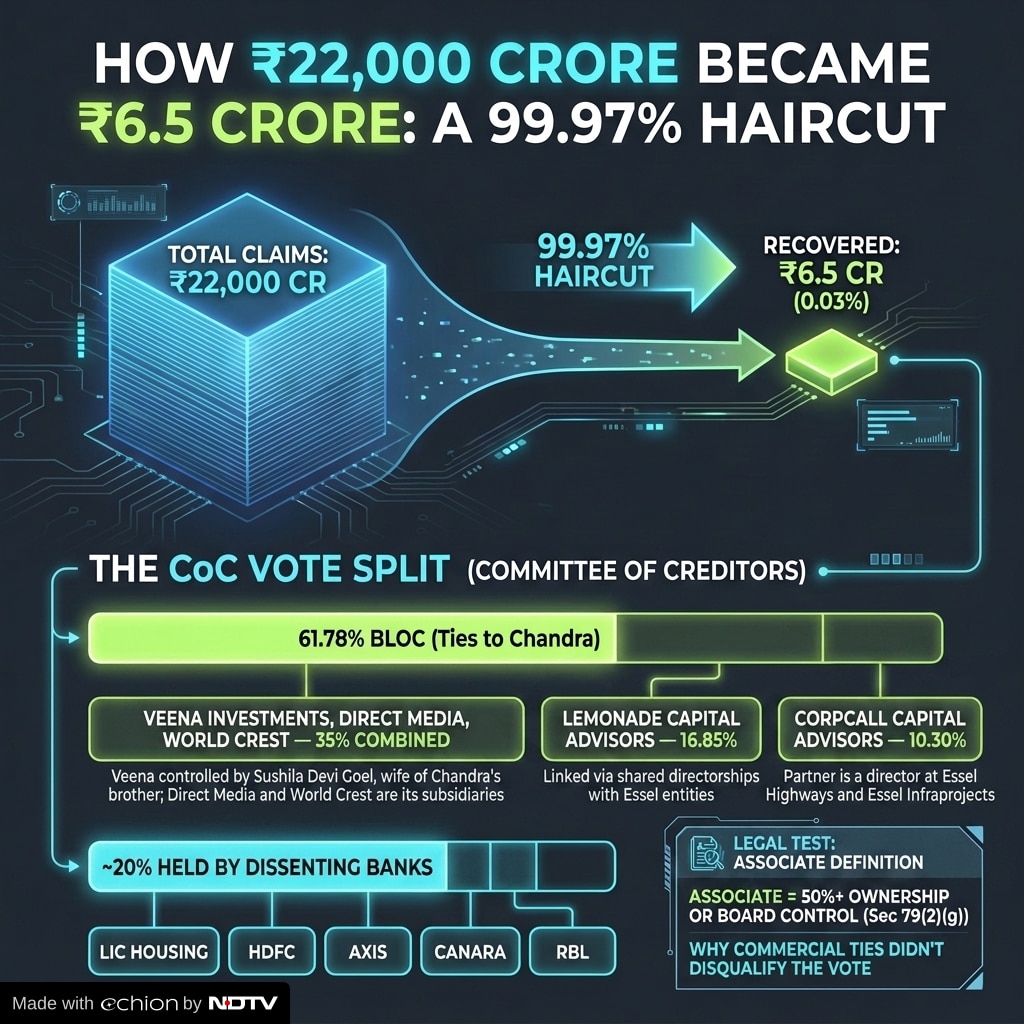
Dissenting banks, including LIC Housing Finance, HDFC Bank, Axis Bank, Canara Bank and RBL Bank, together holding close to 20% of the CoC's voting rights, contested the five companies' participation. LIC Housing Finance, which will recover just Rs 38 lakh against an admitted claim of Rs 1,322 crore, argued that letting related parties vote destroyed the CoC's independence.
Also Read | Layoffs Are Rising In Tech, But These Skills Are Helping People Unlock Better Pay
The creditors under Chandra's 'commercial influence'
The five-company bloc controlled about 61.78% of the voting power among creditors to Essel Group companies for which Chandra had issued personal guarantees.
A deeper look at the 99% haircut for Subhash Chandra
Photo Credit: NDTV Profit
Veena Investments is controlled by Sushila Devi Goel, wife of Jawahar Goel, Chandra's younger brother. Direct Media and World Crest are direct subsidiaries of Veena Investments; together the three companies held 35% of the voting rights.
Lemonade Capital Advisors, holding a 16.85% voting right, is linked to Essel Group entities through overlapping directorships: partners Ravindra Pashte and Naresh Manohar Ingale both sit on the board of Living Entertainment Enterprises Pvt Ltd, and Ingale is also a director of Ekmart Trading Pvt Ltd.
Corpcall Capital Advisors LLP, holding 10.30%, is linked through partner Vijay Bhujbal, a director of Essel Highways Ltd and Essel Infraprojects Ltd. Living Entertainment Enterprises and Essel Infraprojects were disclosed as "other related parties" in Veena Investments' FY21 consolidated financial statements, and Essel Highways is a subsidiary of Essel Infraprojects.
Eligibility to vote as a creditor, however, does not turn on commercial influence or familiarity but on Section 109(4)(b) and Section 79(2)(g) of the Insolvency and Bankruptcy Code (IBC), which bar an "associate" of the debtor from voting in a meeting of creditors.
Judge Sharma held that the question had to be decided on the language of the statute. Section 79(2)(g) "exhaustively" defines an associate as an entity in which the debtor, alone or with his associates, owns more than 50% of the share capital or controls the board or governing body. "The statutory test is therefore based on ownership and legal control, not merely on commercial influence or business proximity," the order reads.
The judge noted that if Parliament had intended a wider net, it would have used terms such as "under the influence of" or "connected person," as it did for "related party" in corporate insolvency. Because Chandra held no direct ownership or legal control over the boards of Veena Investments, Lemonade or the others, they could not be barred from voting.
A legal loophole?
Legal experts say the ruling exposes a gap between the letter and the spirit of the law.
"The tribunal correctly applied the law as drafted," said Alay Razvi, managing partner at Accord Juris. "Excluding a creditor from voting is a serious disability that requires clear statutory grounds and cogent evidence. The NCLT emphasised that suspicion or conjecture cannot justify disqualification."
But Razvi said the case still points to a structural problem: "A personal guarantor may be able to structure affairs so that entities with close economic or familial ties do not satisfy the strict legal test, yet still support a repayment plan that heavily favours the debtor. This can produce outcomes where creditors receive a very small fraction of admitted claims while the plan is approved by a majority that includes such entities."
Nishant Nigam, managing partner at 3Sixty Law Group, was more critical, calling the order a setback for the IBC's objectives. "The decision clearly reflects the lacunas that still exist within the procedural system prescribed within the law, where debtors are utilising it to their advantage, as was done in the present case," Nigam said. "A debt reduced from upward of Rs 22,000 crore to a mere Rs 6 crore, courtesy a resolution by the committee of creditors, a majority of which now seemingly is known to the personal guarantor, creates a doubt about the entire legal procedure rather than just procedural loopholes."
Chandra: this is not a loan against me; Rs 22,000-crore figure is misleading
The proceedings concern Chandra's liability as a personal guarantor, not as a direct debtor, a distinction he says has been lost in coverage of the case. In a statement, Chandra called the scale of the haircut misleading: the objecting banks in the personal insolvency proceedings are owed Rs 3,992 crore, of which Rs 620 crore has been settled and a further Rs 1,063 crore offered by the borrower entities.
In a video statement, Chandra asked the finance ministry to appoint an independent auditor to determine how much was borrowed and how much has already been repaid, adding that most of the Essel Group's total debt has already gone back to creditors. Government sources told NDTV Profit that only Rs 2,574 crore relates to loans where Chandra's personal guarantee was given at the time of original borrowing, and that the 99.97% figure reflects a haircut only on recovery action against Chandra personally, not on banks' overall exposure to the Essel Group.
Personal insolvency and corporate insolvency proceedings can run in parallel under the IBC, irrespective of any settlement at the corporate debtor level, as the Supreme Court has held. "Insolvency proceedings against both the Corporate Debtor and Personal Guarantor can run in parallel," said Amir Bavani, founder of AB Legal, Hyderabad.
Bavani said the apparently inflated claim reflects how the two tracks are triggered differently: a corporate debtor's default alone cannot trigger insolvency against its guarantor; a creditor must first invoke the guarantee and then start proceedings under Section 95. Interest continues to accrue on a guarantor's liability until the guarantor is admitted into personal insolvency, he said, which is why "the claim made against a personal guarantor will therefore seem inflated, as interest on the underlying debt of the corporate debtor is also calculated until the personal guarantor has been admitted under the Code."
Chandra's net worth: from Rs 45,888 crore to Rs 31 crore
The second flashpoint was Chandra's disclosed net worth of just Rs 31.79 crore. Creditors pointed to a 2017 certificate given to RBL Bank valuing his wealth at USD 7.17 billion (about Rs 45,888 crore) and a 2018 certificate given to Canara Bank that put it at Rs 40,562 crore. They sought an independent forensic auditor and an asset-tracing agency to investigate possible asset stripping, diversion of funds or fraudulent transfers.
Chandra called the high net-worth figures "a myth," pointing to a 2016 parliamentary disclosure that put his net worth at Rs 339 crore and questioning how it could have grown to Rs 45,888 crore within a year. That figure, he said, reflected the market capitalisation of his group companies, not his personal wealth. He said that since the Essel Group debt crisis in 2019, he has used most of his available capital to repay group company loans and now lives off rental income from part of his residence.
ALSO READ: Subhash Chandra Plans Switzerland Job After Rs 22,006 Crore Debt Resolution
Judge Sharma broadly accepted this account, reasoning that the 2018 certificates were based on provisional financials and included promoter group company assets, most of which were already pledged to the objecting creditors. He acknowledged that the fall in wealth raised questions but said a discrepancy alone is not legal proof of fraud or concealment. Rejecting the demand for a forensic audit, he held that it was not legally required to approve a plan and that no evidence of hidden or transferred assets had been produced. If creditors genuinely believed Chandra was concealing wealth, the judge said, their remedy was to vote against the plan and push him into bankruptcy, where a bankruptcy trustee holds statutory powers to trace and recover hidden assets.
Supreme Court advocate Tushar Kumar said a swing in net worth of this scale would ordinarily invite scrutiny, though the divergence alone cannot support an inference of concealment or diversion. "Where the disparity is of an exceptional magnitude, the integrity of the insolvency process would be strengthened by a reasonable reconciliation of the material historic assets with the present statement of affairs, so that creditors are able to exercise their commercial judgment on the basis of sufficiently reliable information," Kumar said.
A case for legislative rethink
Legal experts say the case should prompt a re-examination of how creditor control is defined in personal insolvency. Razvi said allowing entities directly or indirectly controlled by a guarantor to sit on a CoC against him may amount to a "legal loophole," depending on whether Parliament intended a narrower or broader definition of associate, and the ruling may spur calls to align it more closely with the "related party" concept used in corporate insolvency.
Nigam said the case fits a pattern in which "skewed decisions from courts and tribunals have compelled the judicial authorities in other cases to take a more stringent approach," and argued it is "the right time to step in and make the requisite changes... to bolster confidence into the insolvency process as had been fathomed when the law was incorporated." He added: "The legislature also should examine this decision in great detail and consider bringing amendments to avoid such situations in the future."
ALSO READ: HDFC Bank Calls US Class Action 'Without Merit', Says It Will Vigorously Defend Itself
Essential Business Intelligence, Sharp Market Insights, Practical Personal Finance Advice, Daily Fuel, Gold and Silver Prices and Latest Stories — On NDTV Profit.