- India's two-wheeler industry is growing fast but entry-level bikes show strain signs
- Bajaj notes 100cc-125cc segments grow low-single digits; 150cc-250cc rise over 20%
- Bajaj shifts focus to 125cc+, plans new Pulsar models and brand launches this year
India's two-wheeler industry is growing at its fastest pace in years, but the entry-level motorcycle segment that has traditionally driven volumes is showing clear signs of strain, according to first-quarter FY27 earnings commentary from Bajaj Auto and Hero MotoCorp.
Bajaj Auto's joint managing director Rakesh Sharma was the most direct on the trend, telling analysts that the 100cc and 125cc segments were growing at "low-single digit numbers" even as the 150cc-250cc range expanded over 20%.
He linked the divergence to income inequality within the customer base, saying "the upper half of the society are economically much, much stronger and the people down the pyramid have weakened," a dynamic he said was now visible in how different engine-capacity segments were performing.
Also Read | Layoffs Are Rising In Tech, But These Skills Are Helping People Unlock Better Pay
Sharma said Bajaj was prepared to let its 100cc market share erode rather than compete purely on price. The segment's share of the overall motorcycle market has fallen from 55% to around 46% over the past five to seven years, he said, adding that Bajaj would "participate in it at our own terms" and was willing to accept share losses "when growth and profitability... start getting into a conflict situation."
The company's strategic focus, he said, has shifted to the 125cc-plus range, where Bajaj plans to launch two new Pulsar models and roughly ten variant refreshes within six weeks, alongside two entirely new brand nameplates in the 125cc segment later in the fiscal year.
ALSO READ: How An Auto Ancillary Player Became One Of India's Biggest Railway Safety Suppliers In 12 Months
Hero MotoCorp described a more mixed picture. CEO Harshavardhan Chitale said the 100cc category — where Hero holds close to 86% market share — was still growing, helped by post-GST affordability, but acknowledged that "125cc and above are growing faster," with the company's own market share gains concentrated in the higher segments.
Hero disclosed that it had taken a tactical price cut on certain HF Deluxe variants in select states to draw in first-time buyers, a move CFO Vivek Anand and business unit heads said had produced an "immediate boost" in demand at the entry level.
Analyst Sonal Gupta of HSBC Mutual Fund pointed out that Hero's overall Vahan (registration) market share had actually declined around 150 basis points year-on-year despite the company's broader 23% volume growth, prompting the entry-level price intervention.
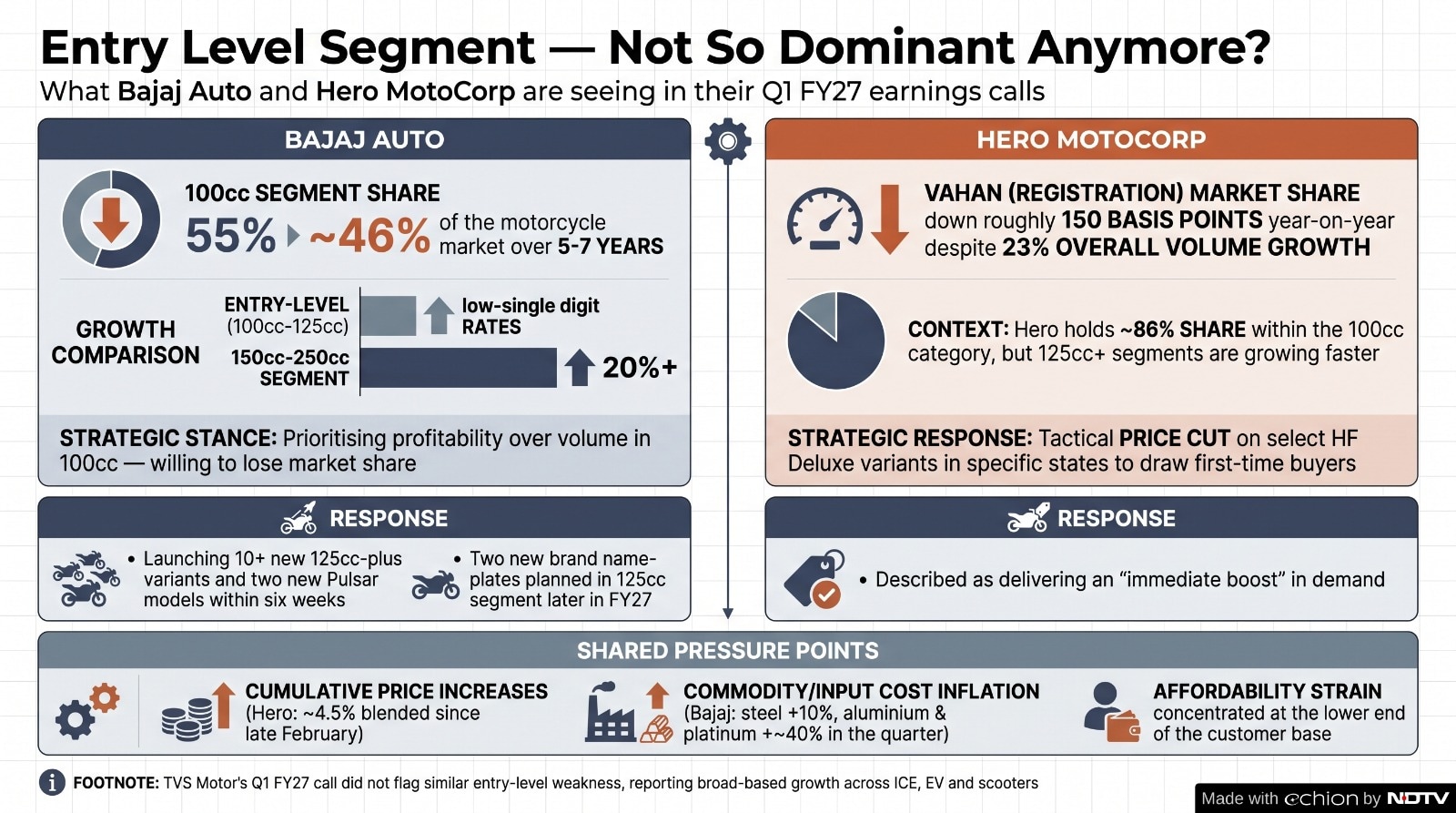
Both companies tied the entry-level softness to affordability pressure following a run of price increases. Hero said it had taken a cumulative 4.5% blended price increase across ICE models since late February, even as commodity costs forced further increases in July.
Bajaj's CFO Dinesh Thapar described a "hyperinflationary" commodity environment in the quarter, with steel up over 10% and aluminium and platinum up nearly 40%, which the company only partially offset through calibrated pricing — leaving less room to protect the price-sensitive entry segment.
TVS Motor's own call, by contrast, did not single out entry-level weakness as a theme; CEO K.N. Radhakrishnan's commentary centred on broad-based scooter, EV and export growth without breaking out a specific concern for lower-cc motorcycles, suggesting the pressure Bajaj and Hero described may not be uniform across the industry.
Essential Business Intelligence, Sharp Market Insights, Practical Personal Finance Advice, Daily Fuel, Gold and Silver Prices and Latest Stories — On NDTV Profit.