- South Korea's $4.6 trillion stock market surged 200% over the past year, driven by AI chipmakers
- Retail investors are borrowing record sums, with new accounts for under-18s up nearly tenfold
- The Kospi index is now the most volatile major gauge globally, with daily swings of 5% or more
In South Korea's $4.6 trillion stock market, signs of euphoria are popping up everywhere. Enthralled by a 200% surge over the past year that has far outpaced every other market on earth, locals are borrowing record sums to amplify their bets on stocks. Trading volumes have soared to all-time highs, while daily price swings of 5% or more have become more common — making the benchmark Kospi index the most volatile major stock gauge worldwide.
The sense of FOMO spreading through offices, lunchrooms and family gatherings across South Korea has gotten so intense that investors are increasingly buying stocks for their kids, too: Data compiled by Toss Securities show a near 10-fold surge in new account openings for under-18s in the first quarter versus a year earlier.
“The mood in the retail community is very hot, nearly maniacal,” said Jang Eunjung, 37, a Seoul-based video producer whose YouTube show on stock investing grew from a tiny audience to more than 1.3 million subscribers as the market soared. “Will we ever see such a vertical rally again?”
Also Read | Layoffs Are Rising In Tech, But These Skills Are Helping People Unlock Better Pay
Fueled largely by South Korean chipmakers' central role in the artificial intelligence boom, the trading frenzy has transformed a long-dormant market into one of the world's most closely watched indicators of how far the mania surrounding AI can go.
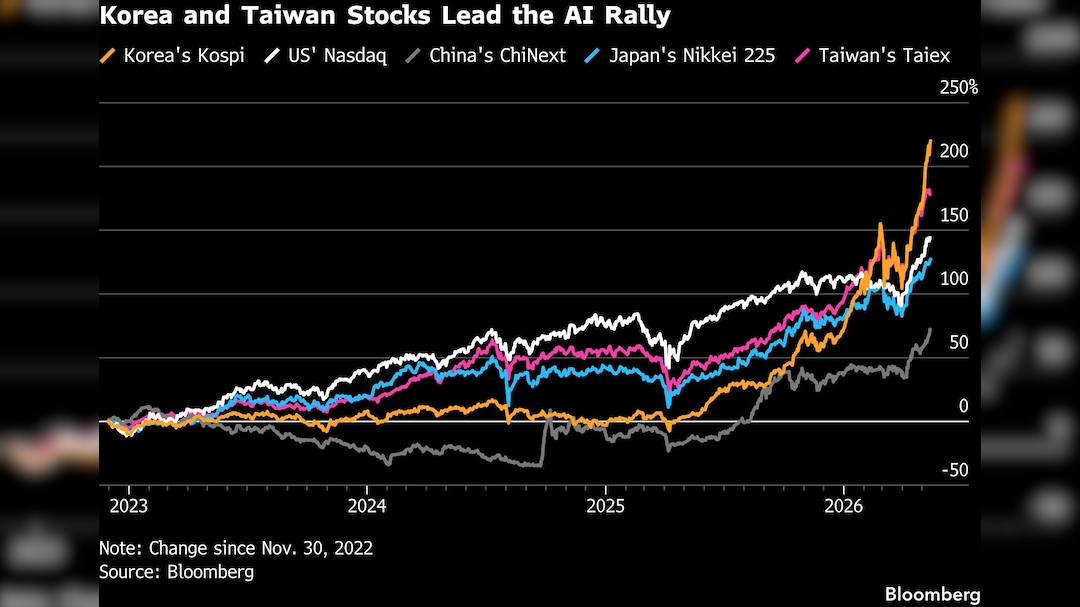
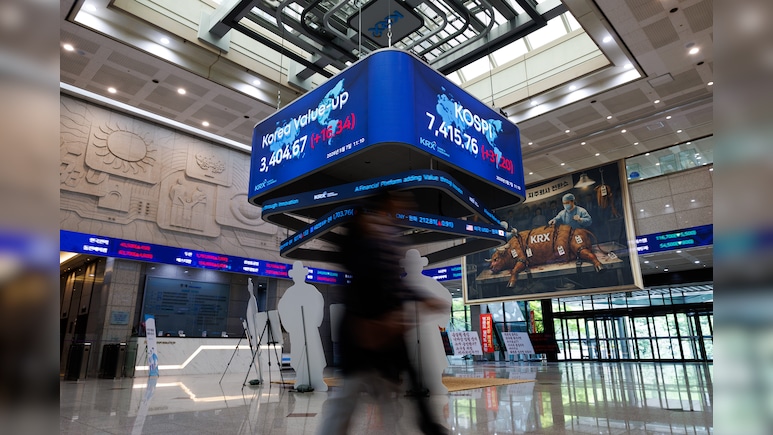
Korea and Taiwan Stocks Lead the AI Rally
Photo Credit: (Photo: Bloomberg)
While bulls point to record profits at companies like Samsung Electronics Co. and SK Hynix Inc. to justify the rally, the risk of a sudden reversal was on display this week. The Kospi shed about $300 billion of value in less than two hours on Tuesday as jitters that the rally is getting overheated coincided with a lengthy Facebook post from a senior official on a potential “citizen dividend” using excess tax on AI profits. Stocks recouped more than half their losses by the close and the government later clarified it was a personal post, not policy.
“People with FOMO see others making big profits and may jump in recklessly, often using excessive leverage. But no one knows when the bull run will end,” said Kim Taewhan, a doctor who runs an ENT clinic in the Gangseo district of Seoul and started posting his returns on social media a year ago.
“The danger is that people often ramp up their investment size at the end, only to suffer losses. I've done that myself — in 2018, during the Bitcoin craze. I increased my investment at the peak and ended up with losses,” he added.
Korea's rally has few historic parallels at home and around the world. The leverage-fueled frenzy helped it leapfrog peers to become the world's seventh largest market, while heavyweight Samsung has blazed past the $1 trillion valuation mark. It's now Asia's second-most valuable company.
The momentum has been stoked by the return of Korea's legion of 14 million day traders. They've jumped back in after largely staying on the sidelines for much of 2025, lured by what many see as a once-in-a-lifetime rally. So far this year, they've poured about 37.7 trillion won ($25.3 billion) into local shares, even as foreigners pare nearly double that amount on a net basis.
“There is a growing sentiment that social mobility is no longer possible through traditional means — it is only achievable through speculative assets,” said Jaewon Choi, professor of economics at Seoul National University. “Having witnessed people make overnight fortunes in crypto, investors are now flocking to stocks like SK Hynix, seeing them as a superior vehicle for rapid wealth accumulation.”
According to the Korea Financial Investment Association, margin balances hit a record 36.3 trillion won earlier in May, up 32% from the end of December. That only captures a part of the real picture as many loans used to buy stocks are often classified under other categories, while credit extended by smaller financiers can fall outside of the scope of official data. That's raised concerns about how long the rally can last, and more importantly, how quickly things can reverse.
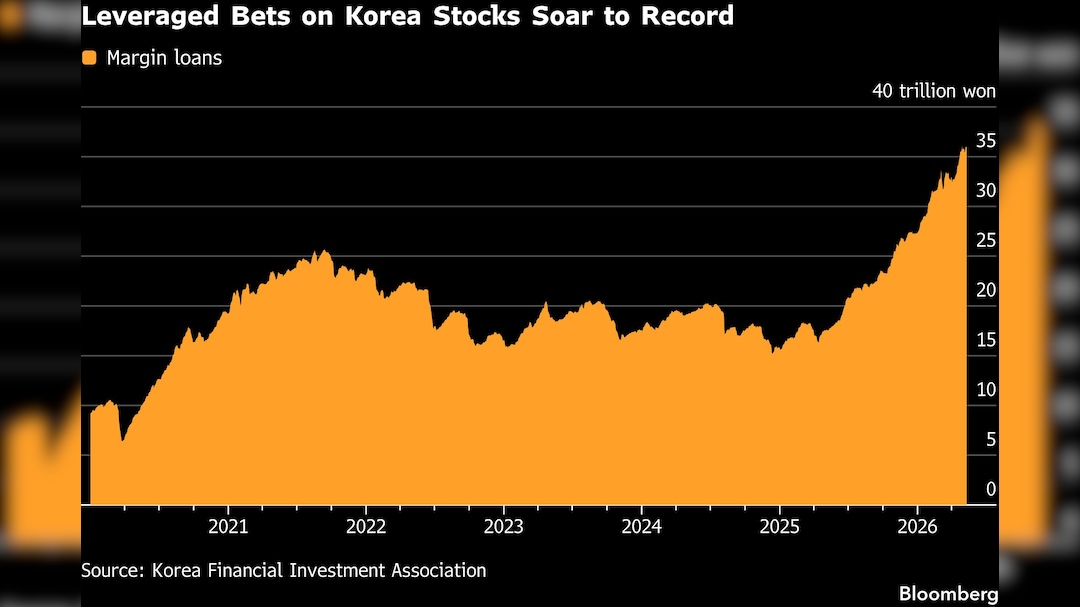
Leveraged Bets on Korea Stocks Soar to Record
Perhaps nowhere is Korea's stock obsession playing out more visibly than on social media, where a flood of trading tips and investment returns from influencers and retail investors feed a growing fear of missing out. The competition is no longer confined to just beating the market — it's also extending to friends, colleagues and even anonymous internet trolls.
The gains in Korea's market are part of a global frenzy for all things artificial intelligence. The country had largely missed earlier rallies as its chipmakers are tied more closely to older segments of the industry, but that changed when AI-driven demand went into hyperdrive and tightened supply chains. President Lee Jae Myung's campaign to spur the stock market through sweeping financial reforms also added fuel to the rally.
The situation is playing out similarly in Taiwan, also home to key companies in the AI supply chain. “The market's relentless rise has lulled families and retail investors into a false sense of security — as if stocks could climb forever,” said Dachrahn Wu, professor at the department of economics at the National Central University in Taiwan. “Now many families are diverting the money they once set aside for buying a home into the stock market, convinced that fast gains will let them trade up to something even bigger.”
For now, many analysts believe that Korea's market has more room to go. Besides strong earnings from the likes of SK Hynix, which reported a five-fold jump in quarterly profit thanks to surging memory-chip prices, the broader economy has also returned to growth mode. That's prompted Wall Street banks to lift Kospi targets to 8,500, 9,000 and even 10,000 in a bull case scenario. The Kospi closed 2.6% higher at 7,844.01 on Wednesday.
For Kyle Lee, a day trader who exited his Korean positions earlier this year and now focuses on Nasdaq futures, the steady drumbeat of successive records is prompting renewed caution. “Naturally I feel some FOMO but I don't plan to buy again now when Korean stocks keep hitting high. When a correction does come, I think it will be sharp.”
(This story has not been edited by NDTV staff and is auto-generated from a syndicated feed.)
Essential Business Intelligence, Sharp Market Insights, Practical Personal Finance Advice, Daily Fuel, Gold and Silver Prices and Latest Stories — On NDTV Profit.