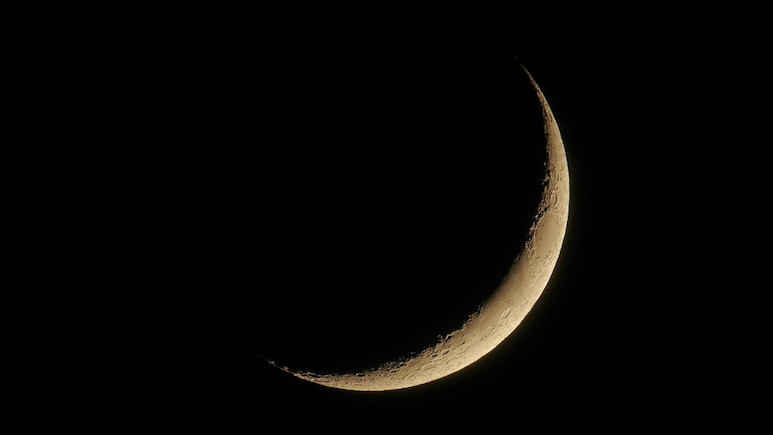
UAE-based astronomers have issued a public safety advisory ahead of February 17, warning that attempts to observe the Ramadan crescent using telescopes or binoculars could result in temporary or permanent eye damage due to the Moon's extremely close proximity to the Sun.
The caution comes as the crescent sighting date coincides with a solar eclipse earlier in the day, significantly increasing risks associated with optical observation.
The Abu Dhabi-based International Astronomy Centre (IAC) told Khaleej Times that directly viewing the Sun through telescopes, binoculars, or other optical instruments without certified solar filters may cause severe eye damage, including blindness.
“Attempting to direct optical instruments toward celestial objects located very close to the Sun poses significant risk if proper professional safety standards are not strictly applied,” the IAC said.
Why Angular Separation Matters
On Tuesday, February 17 — when moon-sighting committees across the region are expected to search for the crescent — the angular separation between the Moon and the Sun at sunset will be just one degree in Riyadh.
Khadijah Al Hariri, Operations Manager at Dubai Astronomy Group, confirmed the narrow gap, explaining: “Even though the eclipse will occur earlier in the day, by sunset, when people normally go out to look for the crescent, the moon will still be extremely close to the sun.”
Angular separation is measured between the centres of the Sun and Moon's discs. This means that if a crescent is present, it would lie approximately half a degree from the Sun's disk — effectively placing it within or extremely close to the Sun's glare when viewed through optical instruments.
According to the IAC, this creates a dual risk: potential damage to observation equipment and serious harm to eyesight. “Any telescope directed towards the crescent's position during sunset will also have the Sun either within its field of view, or extremely close to it, exposing both the equipment to damage and posing a real danger to the observer's eye that could lead to permanent vision loss,” the IAC said.
‘Astronomically Impractical'
Beyond safety concerns, experts say crescent sighting under these conditions is unlikely to succeed. Khadijah Al Hariri described public attempts to sight the Moon using optical instruments on February 17 as “astronomically impractical.”
The IAC echoed this assessment, noting that even if observers wait until the Sun fully sets, the crescent would no longer be visible.
“If the observer waits for the sun's disk to fully set before beginning observation, by then the moon's lower edge will have naturally set, and there will be no crescent to search for,” the centre said.
Regional Context
The advisory comes as several Gulf nations move ahead with Ramadan date announcements. Oman last week became the first GCC country to officially declare the start date for Ramadan in advance of traditional moon-sighting, citing scientific impracticality and its principle of “not accepting reports that contradict observable reality or scientific certainty.” Three other countries have also announced February 19 as the first day of Ramadan.
Clarification On Advisory
The IAC clarified that its safety warning, issued on Friday, is intended solely to caution the public against “unsafe observation practices” such as using telescopes or binoculars without certified solar filters.
Professional astronomical observatories, it said, operate under internationally recognised safety protocols and use specialised equipment and certified filters when observing near-solar objects.
ALSO READ: Ramadan 2026 Moon Sighting: Fasts From Wednesday? UAE Observatory Issues Key Update
Essential Business Intelligence, Sharp Market Insights, Practical Personal Finance Advice, Daily Fuel, Gold and Silver Prices and Latest Stories — On NDTV Profit.