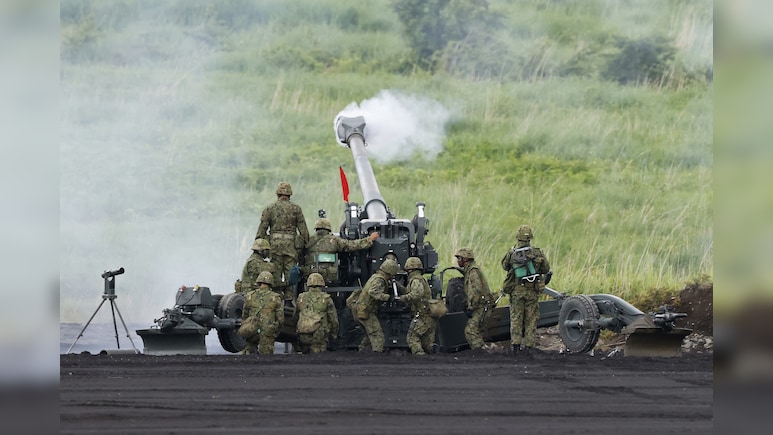
Japan removed most of its restrictions on weapons exports, allowing the nation to sell arms overseas for the first time since World War II in a move aimed at strengthening its defense industrial base.
The cabinet of Prime Minister Sanae Takaichi on Tuesday approved changes to defense export rules that will create a larger market for companies in the arms business. Previously, businesses could only export military equipment for use in operations related to rescue, transport, warning, surveillance and minesweeping.
“These decisions are intended to safeguard Japan's security and further contribute to the peace and stability of the region and the international community amidst rapidly evolving changes in the security environment,” Chief Cabinet Secretary Minoru Kihara said in a press briefing after announcing the move. “At the same time, the government will uphold the fundamental principles of a peaceful nation that have been built over more than 80 years since the end of the war.”
Also Read | Layoffs Are Rising In Tech, But These Skills Are Helping People Unlock Better Pay
ALSO READ: Indian Fund Outperforming 98% of Peers Bets on Defense Stocks
Controls will remain on exports of lethal equipment to countries already engaged in conflict, but exceptions will be allowed if such shipments are deemed to be in Japan's national interest, according to the new rules.
Only six months after becoming national leader, Takaichi, a security hawk, has moved quickly to boost Japan's military profile by raising defense spending and positioning the nation to become a major player in the global defense market.
The new rules come days after Tokyo signed a deal to sell advanced warships to Australia, its first postwar export of lethal war-fighting equipment. The lead contractor on the warship deal, Mitsubishi Heavy Industries Ltd., ranked 32nd globally in 2024 by revenue from the defense sector, according to the Stockholm International Peace Research Institute.
The government hopes the deal will be a harbinger of further export contracts in the defense sector as companies seek to capitalize on growing global defense spending by investing in R&D and manufacturing. Japanese government officials also hope that the move will encourage local companies to catch up in key areas of defense technology including military-use drones, which have proved effective in conflicts in Ukraine and the Middle East.
Unlike large defense-focused contractors in countries such as the UK and the US, Japan's defense sector consists of a handful of manufacturing and technology conglomerates primarily focused on other businesses. For most, defense has long accounted for less than 20% of companywide revenue and has mostly involved supplying the Japanese military, known as the Self-Defense Forces.
The limited market has deterred companies from adding production capacity, and smaller businesses have struggled to make a profit because of low margins. Some businesses have also been wary of the stigma associated with the “business of death” after Japan's militarism in the early 20th century, although that concern has waned as younger generations have supported a shift away from Japan's postwar pacifist orientation.
ALSO READ: BofA, Jupiter See Upside for Asia Defense Stocks On Arms Buildup
The rise of China as a military power, as well as North Korea's missile and nuclear programs, has fueled support in Japan for a stronger military to deter regional rivals. Share prices of Japanese companies with defense businesses have risen in response to Takaichi's move to accelerate a planned increase in defense spending to 2% of gross domestic product to the fiscal year that ended in March, along with growing global conflict.
“To protect our own country and regional peace, it's important to further promote the transfer of defense equipment and strengthen the deterrence capabilities of our allies and nations,” Kihara said. “By promoting the transfer of defense equipment, it is also important to strengthen the domestic defense production technology base that supports the Self-Defense Forces' mooring capabilities.”
Smaller Japanese companies such as technology startups are among the most bullish about defense exports. Some larger businesses have been hesitant to direct investment away from other business sectors, but the multibillion-dollar Australia frigate deal has highlighted the potential for defense deals. Despite Japan's relatively small defense sector, it's among the fastest growing, according to SIPRI data.
A bigger, more diverse domestic defense industry could help lower Japan's heavy reliance on American defense equipment. Tokyo is set to have the largest fleet of Lockheed Martin's F-35 fighter jets outside the US, but it is also developing its own advanced fighter jet in collaboration with the UK and Italy, known as the Global Combat Air Program.
Under the new export rules, countries that can buy lethal Japanese defense equipment will be limited to those that have signed agreements with Japan on protecting classified information related to such equipment and technology. At present Japan has agreements with 17 countries, including several European and Southeast Asian countries, as well as the United Arab Emirates, India and the US.
(This story has not been edited by NDTV staff and is auto-generated from a syndicated feed.)
Essential Business Intelligence, Sharp Market Insights, Practical Personal Finance Advice, Daily Fuel, Gold and Silver Prices and Latest Stories — On NDTV Profit.