
China's factory-gate inflation eased for the first time since the Iran war broke out in late February while consumer prices also decelerated, in another sign that cost pressures from the oil shock are starting to fade.
The producer price index rose 3.5% in July from a year earlier, slower than expected and compared with a gain of 4.1% in the previous month, according to data published by the National Bureau of Statistics on Sunday. That's the first slowdown since China's PPI turned positive in March on the back of higher oil prices after more than three years of declines.
Consumer inflation decelerated to 0.5% from 1% in June. The core consumer price index, which strips out volatile food and energy items, eased to 0.9% from 1%.
Also Read | Layoffs Are Rising In Tech, But These Skills Are Helping People Unlock Better Pay
ALSO READ: China's July Factory-Gate Inflation Eases To Three-Month Low As Iran War-Led Oil Shock Eases
"Deflation risks in China could be rising again," Citigroup economists including Xinyu Ji said in a report distributed Monday. "Both CPI and PPI missed expectations, driven not only by energy price corrections but also by more pronounced weakness in domestic demand."
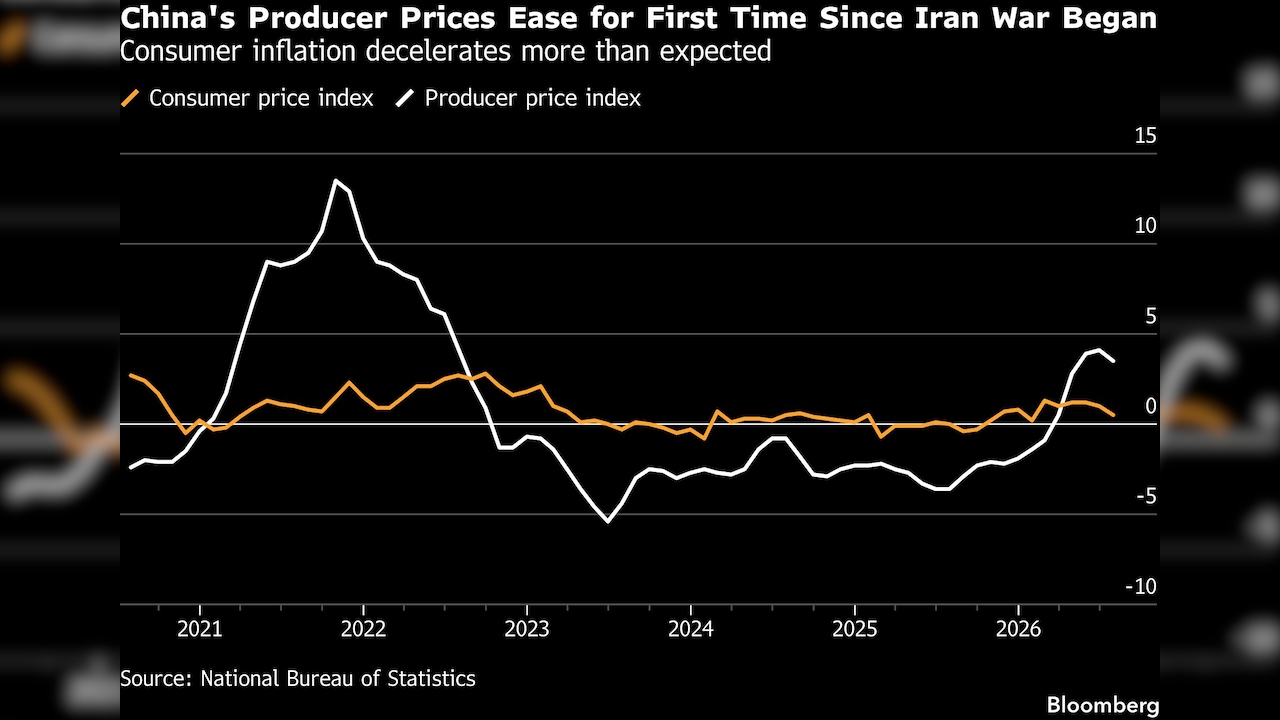
| China has emerged from a record bout of deflation with weak upward momentum for prices. Sluggish domestic consumer spending has so far limited the extent to which factories can pass on their growing production expenses from higher global prices for oil, chips and metals. As a result, a divergence in profits has opened up between upstream and downstream sectors. Industries like clothes-making are suffering a plunge in their earnings, while others such as energy producers are seeing profits soar. The economic fallout of higher global prices for commodities is already starting to fade in China. While crude fluctuated wildly in June and July, average costs still eased from their peak earlier this year. US President Donald Trump said this week that negotiations between Iran and Oman over the Strait of Hormuz are "moving along." Tehran said it's "very close" to a deal with Oman on a new maritime transit route in the strait, even as the Islamic Republic renewed a list of demands for the US to agree to before the waterway would open. Many economists have warned in recent years that persistent deflationary pressures in China could harm the economy's long-term growth, encouraging households to cut back on spending, eating into corporate profits and stifling investment and hiring. A slowdown in the headline price gauges could reignite such concerns by offering further evidence that a return of healthy inflation in the aftermath of the oil shock could still be a long way off. ALSO READ: US Record Oil Production, Economists Debate On China Growth & The New Fed Plan | The Week In Whys The cost of pork, China's staple meat, narrowed its year-on-year decline in a sign that an oversupply is easing in the hog industry after a year of contraction. The cost of tourism services rose 2.2% from a year ago, slowing from the 4.5% increase in June. Domestic spending in the sector was worse than expected during the summer holidays, local media reported, citing a decrease in hotel rates and flight ticket costs from a year earlier. |
(This story has not been edited by NDTV staff and is auto-generated from a syndicated feed.)
Essential Business Intelligence, Sharp Market Insights, Practical Personal Finance Advice, Daily Fuel, Gold and Silver Prices and Latest Stories — On NDTV Profit.