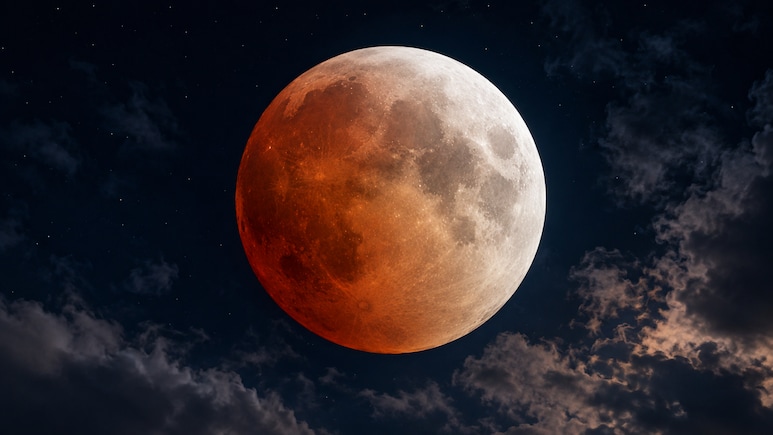
Skywatchers in several regions are looking ahead to a partial lunar eclipse on Aug. 28, as the Sturgeon Moon, August's traditional full moon, moves into Earth's shadow. For observers in India, though, the celestial display will remain out of sight, with the entire eclipse occurring during daytime hours when the Moon is not visible above the horizon.
What Is Sturgeon Moon?
The unusual name has its origins in Native American fishing customs, reflecting the time of year when sturgeon fish were once especially abundant across North America's Great Lakes and in Lake Champlain.
The Sturgeon Moon returns every year, and this year's full moon will coincide with an unusually deep partial lunar eclipse. Almost 96% of the Moon's visible disc will move into Earth's darkest shadow, known as the umbra. With most of the lunar surface immersed in shadow, the Moon is expected to glow a striking copper-red, giving rise to descriptions such as an “almost blood moon”.
Also Read | Layoffs Are Rising In Tech, But These Skills Are Helping People Unlock Better Pay
Sturgeon Moon 2026: Why Will The Moon Turn Red?
The reddish glow is caused by the way Earth's atmosphere affects different wavelengths of light, according to NASA. As sunlight passes through the atmosphere before reaching the Moon, much of the blue and other shorter-wavelength light is scattered, leaving predominantly red and orange tones to illuminate the lunar surface.
ALSO READ: NASA's Pandora Satellite Begins Search For Clouds, Water On Alien Worlds
Partial Lunar Eclipse: Timings
In parts of the world where the Moon is above the horizon, the eclipse will span roughly five hours. For skywatchers in India, the timing means the entire event will pass unnoticed.
Penumbral Phase Begins: 6:53 a.m. IST (Aug. 28)
Partial Eclipse Begins: 8:03 a.m.IST
Maximum Eclipse Peak: 9:42 a.m. IST
Partial Eclipse Ends: 11:21 a.m. IST
Penumbral Phase Ends: 12:31 p.m. IST
Because all key stages occur during the morning and early afternoon in Indian Standard Time (IST), the Moon will remain below the horizon throughout the eclipse. The eclipse will be visible from much of North America, South America and parts of Western Europe, subject to local weather and Moon-above-horizon conditions.
Can You See The Sturgeon Moon Eclipse From India?
While skywatchers in India cannot step outside to view the deep partial eclipse with the naked eye, there are several ways to experience the spectacle online.
ALSO READ: Chandra Grahan 2026: August 27 Or 28? Check Lunar Eclipse Date, Time And India Visibility
How To Watch The Partial Lunar Eclipse Online
While skywatchers in India cannot step outside to view the deep partial eclipse with the naked eye, there are several ways to experience the spectacle online.
Astronomy organisations and observatories across Europe and the Americas are likely to bring the lunar eclipse to audiences through high-definition livestreams. NASA's official channels and the Virtual Telescope Project are among the platforms offering live coverage, with Griffith Observatory in Los Angeles also expected to provide a feed.
Check the livestream below which is scheduled to begin at 7:30 a.m. on Aug. 28, timings as per IST
Essential Business Intelligence, Sharp Market Insights, Practical Personal Finance Advice, Daily Fuel, Gold and Silver Prices and Latest Stories — On NDTV Profit.