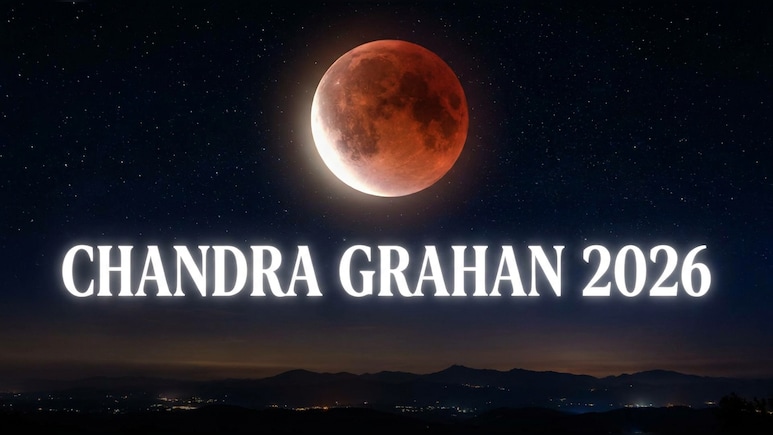
Chandra Grahan 2026, or the partial lunar eclipse, will occur on Aug. 27–28, depending on the time zone. In India, the eclipse will take place during the daytime on Aug. 28 and will not be visible.
A partial lunar eclipse happens when the Earth moves directly between the Sun and the Moon, but the three celestial bodies are not perfectly aligned. This causes only a portion of the Moon to pass through Earth's darkest central shadow, or umbra. The shadow grows and then recedes without ever entirely covering the Moon.
Chandra Grahan 2026: Date And Time
The eclipse will begin on Aug. 27 in some time zones and Aug. 28 in others. The entire process will take approximately 5 hours and 35 minutes. The entire process will take approximately 5 hours and 35 minutes. The partial phase, which is more visually noticeable, will continue for about 3 hours and 16 minutes.
Also Read | Layoffs Are Rising In Tech, But These Skills Are Helping People Unlock Better Pay
Where Will The Partial Lunar Eclipse Be Visible?
The lunar eclipse will be visible across North and South America. Some parts of Europe, Africa and certain western regions of Asia may also witness portions of the event.
Visibility will depend on the Moon's position above the horizon at different stages of the eclipse. The event will be particularly well positioned for observers in several parts of the Americas.
How To Watch Lunar Eclipse Online?
NASA and the European Space Agency (ESA) are expected to provide live coverage of the eclipse through their official websites and YouTube channels closer to the event.
ALSO READ: Sturgeon Moon 2026: What Does It Mean And When To Watch The Almost Blood Moon' Eclipse
Chandra Grahan 2026: Will It Be Visible In India?
People in India will not be able to watch the eclipse as it will be daytime when the event occurs. The eclipse coincides with Raksha Bandhan on Aug. 28, making its timing and visibility a key question for people in India.
The lunar eclipse, moreover, will not be visible from Australia, Antarctica and the area called the ‘Pacific Rim' due to daylight hours.
Chandra Grahan 2026: Timing In India (IST)
Although the eclipse timings in India fall between 6:55 a.m. and 12:30 p.m. IST, the event will not be visible from India because the Moon will be below the horizon during the relevant phases.
Here are the key eclipse timings in Indian Standard Time (IST), as per Drik Panchang:
- Penumbral Eclipse begins: 6:55 am
- Partial Eclipse begins: 8:04 am
- Maximum (Peak) Eclipse: 9:43 am
- Partial Eclipse ends: 11:21 am
- Penumbral Eclipse ends: 12:30 pm
Lunar Eclipse 2026 Viewing Safety Information
Unlike a solar eclipse, a lunar eclipse can be viewed safely with the naked eye and does not require special eye protection.
The eclipse can be viewed safely with the naked eye. Binoculars or a small telescope can provide a closer view.
Essential Business Intelligence, Sharp Market Insights, Practical Personal Finance Advice, Daily Fuel, Gold and Silver Prices and Latest Stories — On NDTV Profit.