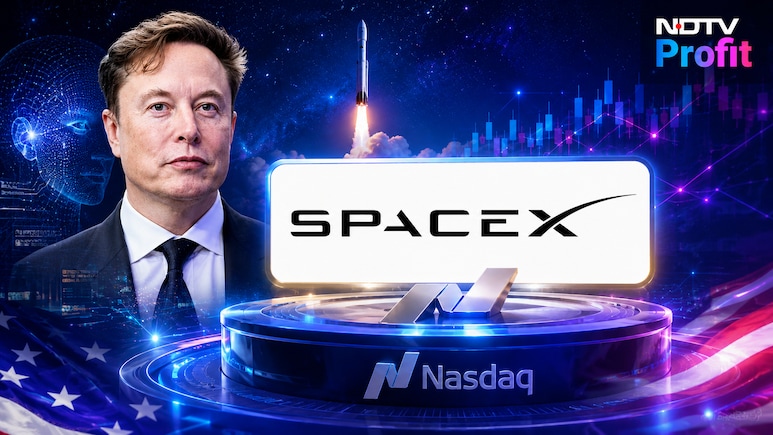
The listing of SpaceX is historic for many reasons. Key among those is that there is a high chance that SpaceX, thanks to its invention of reusable rocket technology, will be among the few companies that will be remembered even a hundred years from now. It is only fitting that its listing could mark another milestone: the making of the world's first trillionaire, Elon Musk.
After all, the maverick inventor has shown that the way to achieve incredible goals is to make them audaciously, and keep pushing relentlessly even in the face of repeated failures - treating failure as the feature rather than the bug in his working model.
ALSO READ: SpaceX IPO Opens Today: Inside The Sci-Fi Vision Of Musk's Multiplanetary Future
SpaceX has also made a large AI play, which in part has lifted its valuations alongside other AI peers.
Its post-listing valuation goal of $1.7 trillion is staggering when compared to its revenue of about $19 billion.
This has led many to believe that the listing - combined with the expected upcoming listings of OpenAI and Anthropic - could mark the peak of the AI bubble.
The hypothesis is compelling, and could well prove to be true.
After all, valuations of AI companies indeed appear to represent the qualities associated with a bubble: typically built on a solid premise of disruption but stretched beyond what the medium-term reality can support by way of earnings growth.
Let's look at SpaceX in this context.
The standard way of valuing companies is the discounted cash flow model, where analysts make assumptions about long-term future profits and discount it to the present for valuation estimates.
But in cases of uncertainty, a better model is reverse DCF, where we assume a reasonable future PE ratio in the future, and then estimate how quickly the company must grow to justify its current valuations.
And according to one analysis, over the next 10 years, SpaceX will have to grow revenues from the current $19 billion to about $500 billion - a compounded annualised growth rate of over 40% while maintaining margins at around 45%.
No company generating more than $20 billion in annual revenue has ever sustained a 40% CAGR over a decade. This does not automatically mean it's not possible but just that practically everything will have to go right for SpaceX.
As an investor, it is generally foolhardy to bet on everything going right.
ALSO READ: SpaceX IPO Raises $75 Billion in Biggest Debut of All Time, Share Price Set At $135
Does that automatically mean that the listing of SpaceX and its ilk could pop the AI bubble?
The first point to make is that making precise predictions, both about an event and its timing, is an exercise fraught with hazard. A better model is to think probabilistically.
Which brings me to the bull case scenario -- my personal base case.
It has been commonly seen that bubbles tend to last longer than most people imagine. It is why George Soros famously said that when he sees a bubble forming, he buys. And, as the saying goes, bull markets don't end "till the last bear has thrown in the towel" -- there's plenty of skepticism over AI currently. This supports the case that there's a high chance the bubble continues to expand.
So, what will have to give for the bubble to pop?
All bubbles are psychological phenomena.
Investors buy because: (a) prices have risen recently and investors expect them to continue rising (recency bias); or (b) there is a belief that expensive assets can become even more expensive (the greater fool theory).
Market prices are often driven by self-reinforcing beliefs. (Say enough people believe that a stock crossing its 200-day moving average is important, and hence it becomes important - the stock crosses the level and people buy, causing the belief to become self-fulfilling.)
This means that how the SpaceX stock fares on listing day could dictate where the AI boom goes from there – and that's impossible to predict.
But what can be predicted is the way things proceed depending on how SpaceX share price moves on the listing day. Here's how I look at it.
- Blockbuster listing: The party likely continues.
- A muted listing: There is a sense of sobering – even healthy consolidation – before this grows further for months, if not years.
- Prices crash spectacularly: The AI bubble pops.
Essential Business Intelligence, Sharp Market Insights, Practical Personal Finance Advice, Daily Fuel, Gold and Silver Prices and Latest Stories — On NDTV Profit.