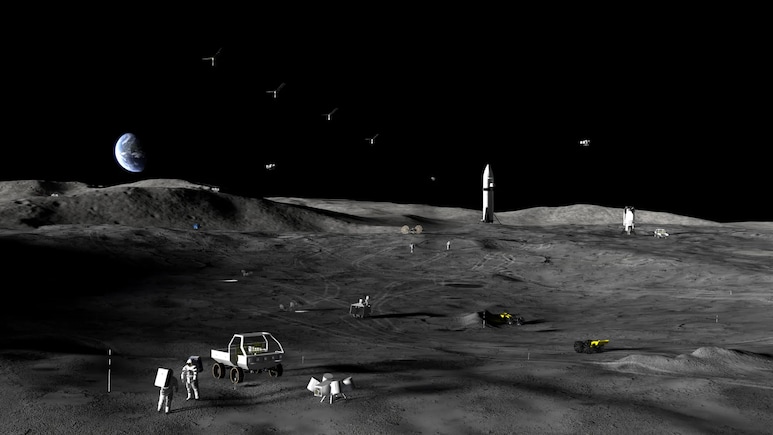
NASA on Tuesday revealed plans for a trio of robotic missions to the moon set for later this year, describing them as key groundwork for a future permanent lunar base.
According to the agency, the missions will concentrate on surveying the South Pole region, carrying out scientific research, evaluating emerging technologies and laying the foundation for astronauts to once again walk on the moon.
“NASA will establish the Moon Base in the lunar South Pole region through a phased, iterative approach that builds capability over time. By starting with near-term technology demonstrations, robotic missions, and early experiments, NASA and its partners can test systems, learn quickly, and steadily mature the capabilities required for continuous human presence on the Moon,” according to NASA's official website.
Also Read | Layoffs Are Rising In Tech, But These Skills Are Helping People Unlock Better Pay
ALSO READ: US Unveils Space Nuclear Power Plan, Targets Moon Reactor By 2030
NASA plans to send all three newly announced lunar missions, Moon Base 1, Moon Base 2 and Moon Base 3, into space by the end of the year. NASA Administrator Jared Isaacman said the first of the launches is slated for sometime this autumn at the earliest.
The second @NASAMoonBase mission will fly cargo to the lunar surface aboard the @Astrobotic Griffin lander and the third will deliver payloads chosen through open competition as well as international partners.
— NASA (@NASA) May 26, 2026
Both missions are targeted to launch before the end of 2026. pic.twitter.com/Hr3yZa3LMo
Commercial Partnership
According to NASA, aerospace firms such as Blue Origin, Intuitive Machines and Astrobotic have been selected to develop the mission hardware.
NASA said it expects Blue Origin's Endurance lander to carry out accurate lunar descents while operating with advanced autonomous navigation and control systems. The company, owned by Jeff Bezos, has been chosen to deliver two scientific and technology payloads to the moon as part of the Moon Base 1 mission.
Isaacman said the Moon Base 2 mission will rely on a lander built by Astrobotic to deliver over 1,000 pounds of cargo, along with a rover, to the moon.
The third mission in the programme is designed primarily for scientific investigation. Researchers plan to examine “lunar swirls”, mysterious bright formations scattered across the moon's surface that stand out against the surrounding terrain.
This mission will also carry instruments from the European Space Agency and South Korea's space agency, highlighting growing international cooperation in lunar missions, Isaacman added.
Three Phases
NASA said the newly announced lunar flights represent the first step in its long-term effort to create a moon base. The opening phase of the programme, scheduled to continue until 2029, will rely heavily on a rapid succession of uncrewed missions.
“Phase one, for example, will have 25 launches, 21 landings, and we're planning to deliver about 4 metric tons of cargo to the surface of the moon,” said Carlos Garcia-Galan, NASA's moon base program manager, as per NBC News.
In the second phase of the programme, spanning 2029 to 2032, NASA intends to establish semi-permanent infrastructure designed to support early human habitation on the moon.
From 2032 onwards, during the third stage, the agency hopes to maintain a lasting human presence on the lunar surface. Garcia-Galan said the planned moon base could eventually stretch across “hundreds of square miles”. NASA officials also said they foresee routine crew rotations between Earth and the moon, with uninterrupted operations taking place on the lunar surface.
Drone Deployment
As part of the announcement, NASA unveiled new progress on the MoonFall mission, which aims to deploy four drones capable of making brief hops across the moon to identify landing areas for future Artemis crews.
NASA's Jet Propulsion Laboratory has been leading the design work and hardware testing for the mission, while Firefly Aerospace will develop the spacecraft responsible for carrying the drones from Earth orbit to the lunar surface. The mission is currently targeted for launch in 2028.
Contracts To Firms
NASA also announced several new funding awards for private aerospace firms on Tuesday. Among the beneficiaries were Astrolab of California and Colorado-based Lunar Outpost, both of which received contracts valued at $220 million.
The companies have been tasked with building autonomous lunar terrain vehicles designed for future astronaut operations on the moon.
Firefly Aerospace, which is headquartered in Texas, has been awarded a $75 million deal by NASA's Jet Propulsion Laboratory to build four lunar exploration drones. The drones are expected to survey areas of scientific interest around the moon's south polar region.
The aerospace company previously achieved a successful moon landing with its Blue Ghost lander, which operated on the lunar surface for a fortnight while conducting research missions on behalf of NASA.
ALSO READ: SpaceX IPO Gets Another Greenlight Toward Faster Index Inclusion
Essential Business Intelligence, Sharp Market Insights, Practical Personal Finance Advice, Daily Fuel, Gold and Silver Prices and Latest Stories — On NDTV Profit.