
Indian businesses are no strangers to machine learning, robotic process automation, natural language processing, or even advanced artificial intelligence. Despite years of these technologies being in use, these solutions fail to charm typical business users the way ChatGPT or DALL-E manage to.
Popularity and hype around new-age generative AI means that chief information officers face relentless user demands for their introduction. This raises the question about maturity of generative AI like ChatGPT (or rather GPT-4 at the time of writing) for business use cases. It also raises the need for perception management among users, as we will see soon.
Faster, Higher, Stronger
CIOs cannot ignore generative AI, especially in this era characterised by increase in self-service capabilities for users. It holds potential, especially for automation of mundane, repetitive tasks. More importantly, in the empowerment of the workforce, rather, AI's capabilities to deliver more from less.
Also Read | Layoffs Are Rising In Tech, But These Skills Are Helping People Unlock Better Pay
A working paper by the U.S. National Bureau of Economic Research gives insights into how generative AI can significantly improve productivity of less experienced employees. It used a tool based on OpenAI's GPT large language model to assist customer support agents with suitable response suggestions. The study reveals an average productivity rise of 14% in customer issue resolutions per hour. More interestingly, employees with just two months of experience using the AI tool achieved productivity levels of more experienced employees (agents with six months of experience and no AI tool access).
A similar Microsoft and GitHub experiment reveals comparable results. Software developers with access to GitHub's AI tool were 55.8% faster than the similarly skilled unaided group, in successfully completing the task. The main beneficiaries here? Again, coders with less experience. This delivers immense benefits for faster skillset development and rapid project turnarounds. It also frees up more experienced programmers so that they can concentrate on higher business impact projects.
Unparalleled Transformation
Eventually, Indian CIOs will see AI increasingly integrated in their organisations and respective industry verticals. For instance, use of generative AI in customer service automation can ensure automated, 24x7 support in multiple Indian languages.
From a support standpoint, new-age AI tools enable precise, contextual, highly personalised, and error-free responses to customer queries and day-to-day workplace requirements. This can be in the form of higher quality email replies and office notes. “Customer service and regular office support will gain strategic advantages in the near term from AI developments like ChatGPT. Another area is data analysis to detect patterns, identify anomalies, and predictive capabilities,” Dr Sourav Dutta, executive director of information technology for IDBI Bank Ltd., said.

Sourav Dutta, Executive Director, IT, IDBI Bank
Process automation of repetitive tasks and workflows using AI frees up employees for high-value assignments. For instance, this is an area where AI can augment or replace existing RPA implementations based on the organisation's needs. Cybersecurity and knowledge management are other areas where generative AI holds significant transformative potential.
Sales and marketing teams can leverage AI tools to engage with customers in real time to answer questions or deliver personalised product recommendations. The interaction can be handed over to a human agent in case of advanced queries.
From a macro perspective, industry verticals that will spearhead AI adoption in India include:
Data centres.
Power generation and distribution.
Auto.
Healthcare.
Banking, financial services and insurance.
Telecommunication.
Government.
Manufacturing.
Aerospace.
“In the financial services space, AI can be used in advisory roles, coding, process automation, or personalised marketing. From an enterprise standpoint, generative AI is an advance like nuclear fusion. It provides immense benefits when used in the right manner,” Srijit Ramakrishnan, senior vice president and CIO of ECL Finance Ltd. said. ECL Finance is evaluating the latest version of ChatGPT (based on GPT-4) to identify the full potential and use cases in its business.
Perception matters
With the hype around ChatGPT at an all-time high, CIOs face a deluge of demands to fast-track AI across the enterprise. Impatient users may often fail to understand the need for detailed evaluation. This can be managed in a better manner if CIOs educate top leadership and employees about AI's strengths, weaknesses, opportunities and threats.
Users must be made aware of the nascent nature of generative AI. Generative AI tools are still “learning” and must “mature” from a business usability perspective. This calls for a measured adoption approach on the generative AI front. “Realistic expectations set at an early stage dispel myths and misconceptions. Most importantly, underscore that you cannot AI-enable every process. Human intelligence still reigns supreme, and has no substitute in many business use cases,” Dutta said.
Issues like data privacy, security and ethical considerations are yet to be ironed out when it comes to generative AI outputs. Recent incidents that resulted in confidential data leakage due to use of ChatGPT by employees further emphasise the need for corporate policies. In the future, regulatory intervention is also likely to govern AI usage in sensitive sectors like BFSI. Conducting employee awareness sessions about such security, privacy and ethical issues is essential in this context.
Pilot projects are an ideal mechanism to integrate AI into the business ecosystem. It highlights the technological potential and areas of improvement. The need for a measured approach during generative AI evaluation exercises and usage was echoed by Ramakrishnan. “Emphasise the fact that if your organisation's sensitive data or other assets are unintentionally exposed in the public domain, it can result in massive repercussions and liabilities. You must also account for the possibility of inaccurate and unvalidated data in LLM models which can affect business outcomes,” said Ramakrishnan.
Constellation Research's best practices for successful generative AI implementations can be one of the reference points to start off with.
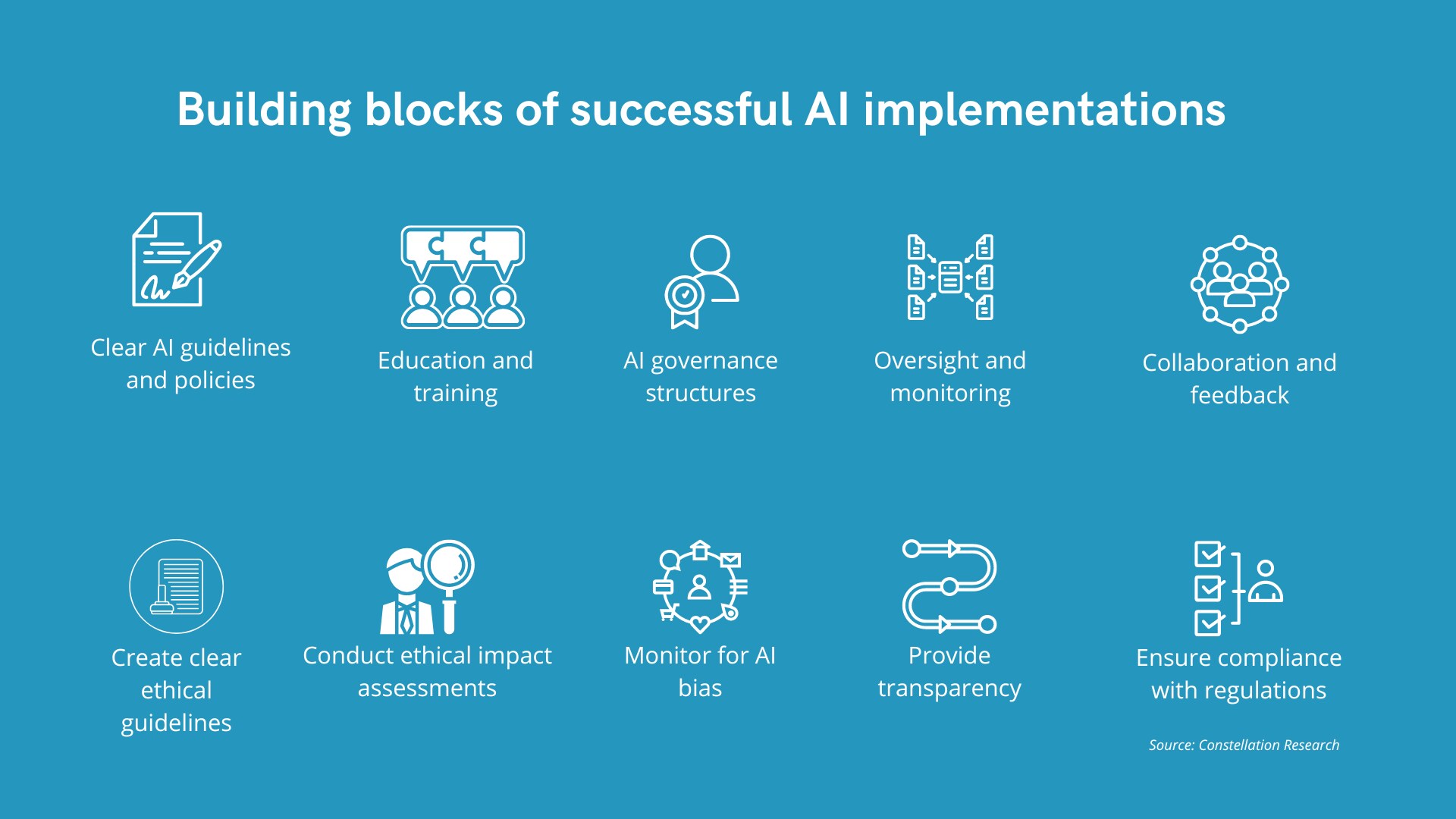
Figure: Building blocks of successful AI implementations
Clear metrics must be in place to gauge the success of AI implementations. It must measure the tool's organisational impact, optimisation capabilities and return on investment. The pathbreaking potential introduced by generative AI might require CIOs to re-evaluate their existing metrics and assessments.
CIOs must focus on talent building and acquisition to prepare for the generative AI transformation, since the requisite skillsets are in short supply. It also calls for a whole new organisational approach to technology implementation due to AI's far-reaching effects on management, recruitment, retention and skill building. To sum up, adoption of a slow and steady calculated approach to generative AI usage will reap rewards for the entire business.
Essential Business Intelligence, Sharp Market Insights, Practical Personal Finance Advice, Daily Fuel, Gold and Silver Prices and Latest Stories — On NDTV Profit.