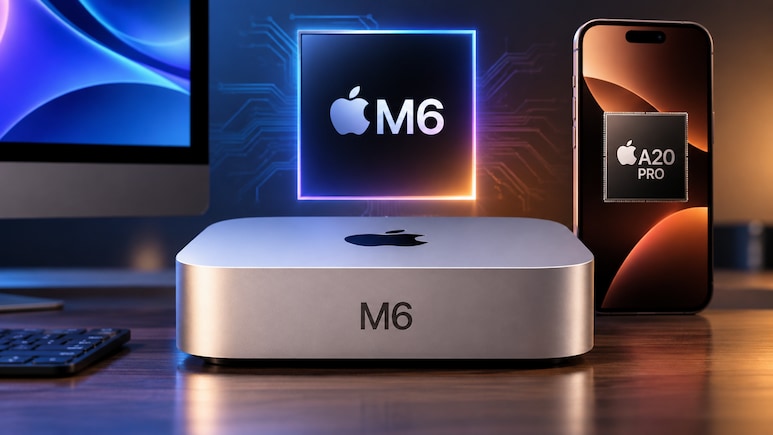
Apple's upcoming Mac mini M6 has surfaced in a Geekbench listing ahead of its retail launch. A Geekbench 6 result spotted on September 15 shows a 12-core M6 chip paired with 32GB of memory, logged under the internal model name Mac18,5, putting up scores of 4,610 in single-core and 20,676 in multi-core testing.
The Multi-Core Numbers Check Out
When Apple unveiled the M6, it claimed up to 20% faster multithreaded performance over the M5. This early listing supports that claim: stacked against a spread of public M5 benchmark results, the new chip's multi-core advantage works out to roughly 16% to 21%.
The two additional cores and higher clock speed help explain the improvement. The M6 runs at 4.79GHz in the Geekbench listing, compared with 4.61GHz for the M5. Single-core gains are more modest, sitting closer to 7-10% over the M5.
Also Read | Layoffs Are Rising In Tech, But These Skills Are Helping People Unlock Better Pay
ALSO READ | Why Is Chat-GPT Maker OpenAI Buying Tens Of Thousands Of Apple Mac Minis?
A Complication For Apple's "Fastest Chip" Claim
There's a wrinkle in the story, though. Apple has marketed the M6 as its fastest single-threaded chip yet, but the A20 Pro powering the iPhone 18 Pro Max actually posted a higher single-core score on the same Geekbench 6 scale — 4,725 versus the Mac mini's 4,610, a roughly 2.5% edge in the phone's favour.
Whether that gap means anything is genuinely unclear. Benchmark runs naturally fluctuate between individual units, and last year's M5 scores varied by about the same margin depending on which device ran the test. That means a single early result like this one shouldn't be treated as the final word. One possible explanation is clock speed: the A20 Pro's fastest cores run at 4.93GHz, slightly ahead of the M6's 4.79GHz.
| Listing detail | Mac18,5 result |
| Chip named in listing | Apple M6 |
| CPU cores | 12 (2 super, 4 performance, 6 efficiency) |
| Base clock speed | 4.79GHz |
| Memory | 32GB |
| Operating system | macOS 27.0 (26A428) |
| Benchmark version | Geekbench 6.3.0 |
| Single-core score | 4,610 |
| Multi-core score | 20,676 |
Multi-core performance is a different story entirely, and here the Mac mini's extra hardware headroom shows clearly. Running all twelve cores, the M6 more than doubled the A20 Pro's output - 20,676 versus 12,575 - putting the desktop chip roughly two-thirds ahead.
The result is unsurprising given that the M6 has 12 cores versus six on the A20 Pro, while the Mac mini also has more thermal headroom for sustained workloads.
How The Chip Is Built
The listing breaks the M6's 12 cores into three functional tiers: two high-speed "super" cores for fast, single-task performance, four performance cores for heavier parallel work, and six efficiency cores handling lighter background processes - a layout consistent with what Apple detailed when it formally announced the chip on August 25.
The benchmarked unit was running macOS 27.0 with 32GB of memory, the highest memory option currently available on the M6 Mac mini.
One caveat worth flagging: these comparisons only make sense because every figure cited here comes from Geekbench's older version 6 scale. Geekbench developer Primate Labs made version 7 its current benchmark in July, and scores don't translate cleanly between the two versions, so mixing them would distort any comparison.
| Chip and run | Single-core | Multi-core | M6 gain in multi-core |
| M6, Mac18,5, 15 September 2026 | 4,610 | 20,676 | Baseline |
| M5, median of five runs | 4,195 | 17,072 | 21.1% |
| M5, MacBook Pro, 22 October 2025 | 4,298 | 17,795 | 16.2% |
| M5, MacBook Pro, 17 October 2025 | 4,263 | 17,862 | 15.8% |
Pricing And What's Next
The new Mac mini arrives September 22. Indian pricing starts at Rs 99,900 for a 16GB/256GB configuration, while the higher-tier M5 Pro variant is priced from Rs 2,09,900. In the US, the entry-level model starts at $899. Apple's own figures put CPU performance gains at up to 40% over the outgoing M4 Mac mini for demanding workloads.
ALSO READ | Apple Unveils New Mac Mini Featuring M6, M5 Pro: Check Price, Specifications
Whether that's worth an upgrade depends largely on what someone actually does with the machine. Workloads such as video exports or code compilation that scale across multiple cores should benefit more from the M6's multi-core gains.
As more retail units begin appearing on Geekbench, a broader set of results should provide a clearer picture of the M6's typical performance and whether the A20 Pro's early single-core lead holds up.
Essential Business Intelligence, Sharp Market Insights, Practical Personal Finance Advice, Daily Fuel, Gold and Silver Prices and Latest Stories — On NDTV Profit.