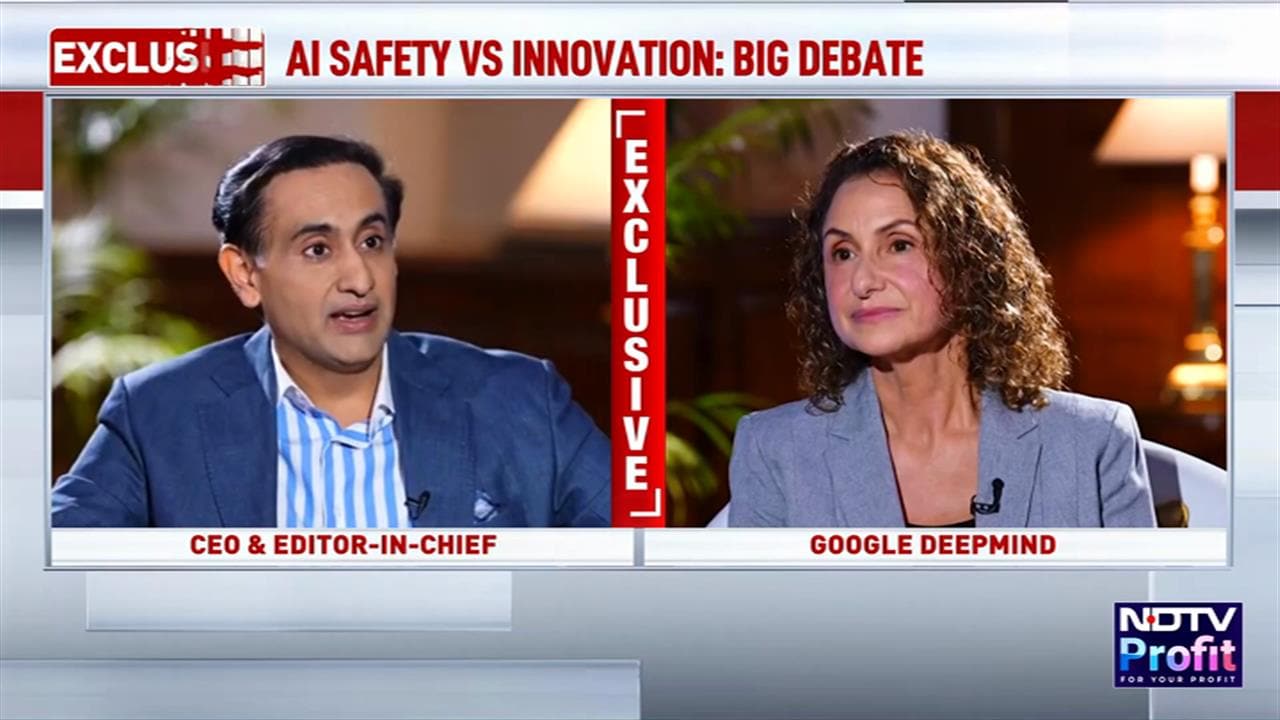
Can artificial intelligence (AI) pose an existential threat to humanity? Google DeepMind's Chief Operating Officer, Lila Ibrahim, said the technology carries risks that developers must openly acknowledge and address, stressing the need for safety frameworks, advanced research and external evaluations to ensure responsible development.
“As an engineer, I look at things very clearly, right? Are there risks in any technology? Yes, and it is our responsibility to actually openly talk about that,” Ibrahim told NDTV Profit in an exclusive interview.
She highlighted Google DeepMind's Frontier Safety Framework, which outlines potential risks associated with advanced AI systems. She said the company's approach includes conducting research in advance, developing policies and carrying out evaluations with external partners to assess potential risks.
Also Read | Layoffs Are Rising In Tech, But These Skills Are Helping People Unlock Better Pay
“I think this is the only way we are going to develop the technology safely,” she said, emphasising the importance of keeping conversations about AI risks open.
READ | AI Regulation Must Balance Safety With Innovation: Google DeepMind's Chief AI Readiness Officer
Ibrahim also acknowledged how popular culture, particularly Hollywood, has shaped perceptions of what could go wrong with AI. She said such portrayals have created a shared context for discussing these concerns across countries and cultures, making it important to have conversations that can help shape the technology's development.
AI Regulation: Balancing Safety With Innovation
On the question of regulation amid the rapid pace of technological advancement and competition among frontier AI laboratories, Ibrahim said AI's transformative potential demands exceptional care.
“AI could be the most transformational technology of our time, and that requires exceptional care,” she said, adding that the challenge is to determine how to regulate the technology appropriately.
She said the objective should be to minimise risks without limiting AI's potential to make an impact and address some of the biggest challenges of the time.
Ibrahim stressed that regulation cannot be the responsibility of any single company or country, given that AI models released by developers are accessible to people worldwide.
“This means it can't be about any one company or any one country. We have to find a way to collaborate,” she said.
From AI Safety Discussions To Concrete Action
Ibrahim cited India's AI Action Summit earlier this year as an example of bringing multiple stakeholders together to discuss AI governance. However, she stressed the need to move beyond conversations and focus on implementation.
She added that Google DeepMind founder Demis Hassabis had published a proposal earlier in the summer outlining how AI laboratories could work with the public sector and governments in Western democracies on regulation and AI applications.
Ibrahim said focusing on specific applications of AI, rather than treating the technology as a standalone entity, could be the right approach to regulation.
Essential Business Intelligence, Sharp Market Insights, Practical Personal Finance Advice, Daily Fuel, Gold and Silver Prices and Latest Stories — On NDTV Profit.